

Start here
Why Fluid Checks Matter More Than You Think
Core knowledge
The Six Essential Fluids Every Driver Should Know
Hands-on skills
How to Read Levels and Spot Trouble
Build a routine
How Often to Check Each Fluid
Know your limits
When to Call a Mechanic Instead of DIYing
Why Fluid Checks Matter More Than You Think
Most mechanical breakdowns don't happen without warning - they follow a slow decline that fluids often signal first. Engine oil lubricates hundreds of moving metal parts. Coolant prevents your engine from overheating or freezing. Brake fluid transmits the physical force of your foot into stopping power. Without the right fluid at the right level, these systems degrade silently until something expensive fails.
The good news: checking fluids is one of the simplest forms of car maintenance available to any driver. No special training is required, and catching a problem early typically costs far less than repairing the damage it causes. For a broader look at routine upkeep, see our seasonal car maintenance checklist - fluids are central to every season's priorities.
Dipstick
A long metal rod inserted into a fluid reservoir - typically for engine oil or transmission fluid - that you pull out to read the current fluid level and condition.
Coolant / Antifreeze
A liquid mixture (usually ethylene glycol and water) that circulates through the engine to regulate temperature, preventing both overheating in summer and freezing in winter.
Hydraulic fluid
A liquid (such as brake fluid) that transmits mechanical force through a sealed system. When you press the brake pedal, hydraulic pressure carries that force to the brakes at each wheel.
Fluid flush
The complete draining and replacement of a vehicle fluid - such as coolant or transmission fluid - as opposed to simply topping off what's already there.
Master cylinder
The component in your braking system that converts pedal pressure into hydraulic pressure. The brake fluid reservoir sits directly on top of it.
Viscosity
A measure of how thick or thin a fluid is. Engine oil viscosity (e.g., 5W-30) affects how well it flows and lubricates at different temperatures.
The Six Essential Fluids Every Driver Should Know
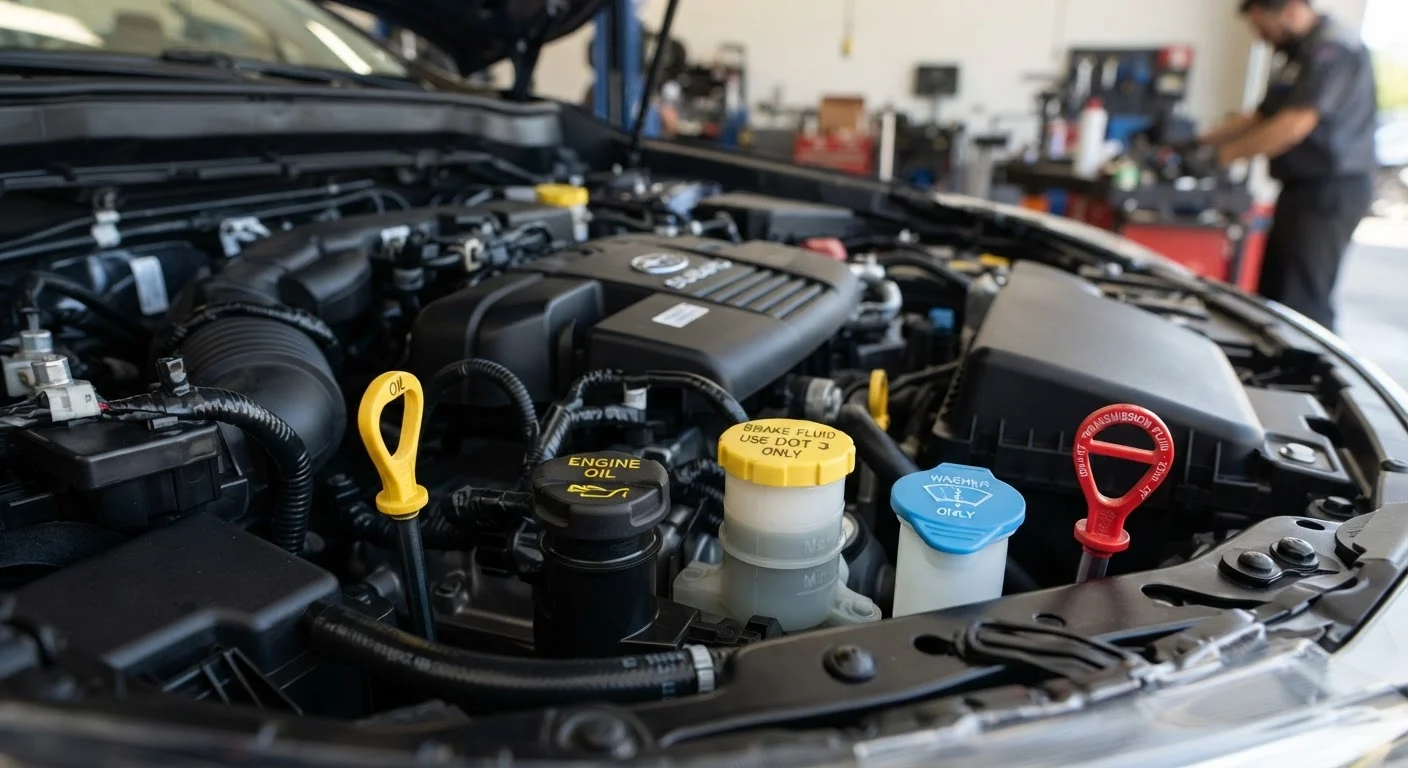
Every passenger vehicle depends on the same core set of fluids. Here's what each one does and where to find it:
- Engine oil - Lubricates and cools internal engine components. Located on the dipstick, usually marked with an oil-can icon. Oil that looks black and gritty is overdue for a change; new oil is amber-colored.
- Engine coolant (antifreeze) - Regulates engine temperature in both heat and cold. Found in a translucent plastic reservoir with MIN/MAX markings. Coolant should be bright green, orange, or pink depending on type - never brown or rusty.
- Brake fluid - Transfers hydraulic pressure from the brake pedal to the brake components. The reservoir sits atop the master cylinder, usually near the firewall. Fresh brake fluid is nearly clear to light yellow; dark or cloudy fluid should be inspected by a professional. Learn more about how the braking system uses this fluid in our guide to brake pads, rotors, and calipers.
- Transmission fluid - Lubricates gears and keeps automatic or manual transmissions shifting smoothly. Many vehicles have a dedicated dipstick; others require a mechanic to check. Healthy fluid is red and slightly sweet-smelling; burnt or dark fluid signals wear.
- Power steering fluid - Assists steering effort in vehicles with hydraulic power steering systems. Found in a small reservoir, often near the front of the engine bay. Note: many newer vehicles use electric power steering and have no fluid reservoir at all.
- Windshield washer fluid - Cleans the windshield for clear visibility. The reservoir is clearly marked with a wiper symbol. Plain water can be used temporarily, but dedicated fluid resists freezing and removes road grime more effectively.
How to Read Levels and Spot Trouble
Before checking most fluids, park on a level surface and let the engine cool for at least 15 minutes. Hot engines can give false readings and present burn risks.
Using a dipstick: Pull the dipstick out, wipe it clean with a lint-free rag, reinsert it fully, then pull it out again. The oil level should fall between the MIN and MAX (or LOW and FULL) marks. The color and texture matter just as much as the level.
Reading reservoir markings: Coolant, brake fluid, and washer fluid all use translucent reservoirs with printed lines. Simply look at where the fluid sits relative to the MIN and MAX lines. Never open the coolant reservoir cap when the engine is hot - pressurized coolant can cause serious burns.
Beyond level readings, pay attention to warning signs that indicate contamination or system failure:
- Milky or foamy engine oil - possible coolant intrusion, seek immediate professional diagnosis
- Dark brown coolant - corrosion inside the cooling system
- Brake fluid that's nearly black - moisture absorption and degraded performance
- A burning smell after driving - could indicate a fluid leak dripping onto hot components
Dashboard warning lights often lag behind actual fluid problems. Understanding what those lights mean before they appear is valuable - our article on dashboard warning lights covers every common symbol in detail.
Keep a Small Flashlight in Your Glove Box
Engine bays can be dim even during the day, making it hard to read dipstick markings or spot discoloration in a reservoir. A small LED flashlight makes fluid checks faster and more accurate. While you're at it, keep a pack of lint-free shop rags in the trunk - they're essential for a clean dipstick reading.
How Often to Check Each Fluid
There's an important distinction between checking a fluid (observing its level and condition) and changing it (full replacement). Both matter, but on different timelines.
| Fluid | Check Frequency | Typical Change Interval |
|---|---|---|
| Engine oil | Monthly or before long trips | Per manufacturer spec (often 5,000-10,000 miles for modern vehicles) |
| Coolant | Monthly visual check | Every 2-5 years (confirm in owner's manual) |
| Brake fluid | Every 6 months | Every 2-3 years or per manufacturer guidance |
| Transmission fluid | Annually or per manual | Every 30,000-60,000 miles (varies widely) |
| Power steering fluid | Annually | Varies; often only topped off unless contaminated |
| Washer fluid | As needed | No set interval - refill when low |
Always treat the intervals in your owner's manual as the primary authority. Driving conditions - extreme heat, heavy towing, stop-and-go traffic - can accelerate fluid degradation and may call for more frequent attention.
When to Call a Mechanic Instead of DIYing
Checking fluid levels and topping off washer fluid are well within reach for most drivers. However, some fluid-related tasks carry enough risk that a qualified mechanic should handle them.
Seek professional help when:
- You notice a persistent fluid leak under the vehicle - identifying the source and fixing it correctly requires proper diagnosis
- Engine oil appears milky or coolant looks rusty - these point to internal problems, not just low levels
- The brake fluid reservoir is significantly low - this rarely happens through normal use and usually signals a leak or brake system issue
- Transmission fluid needs a full flush - requires proper equipment and disposal procedures
- Any fluid warning light stays illuminated after a top-off
Our guide to DIY car maintenance walks through the broader boundary between tasks you can confidently tackle at home and those best left to professionals. Unusual smells, sounds, or dashboard signals alongside fluid issues can also point to deeper problems - see warning signs your car is trying to tell you something for a fuller picture.
Fluid maintenance is one of the lowest-cost, highest-impact habits a driver can build. A few minutes each month under the hood can prevent repairs that run into thousands of dollars - and keep you safer on the road.
Frequently Asked Questions
A quick visual check of all major fluids once a month is a reasonable habit for most drivers. Engine oil and coolant are worth checking most frequently - especially before long road trips. Your owner's manual will specify change intervals, which differ from check intervals.
For windshield washer fluid, mixing brands is generally fine. For engine oil, coolant, transmission fluid, and brake fluid, mixing different specifications or types can cause problems. Always consult your owner's manual to confirm the correct fluid specification before topping off.
A milky or foamy appearance in engine oil usually indicates coolant has mixed with the oil - often a sign of a blown head gasket or a cracked engine block. Stop driving and have the vehicle inspected by a qualified mechanic as soon as possible.
No. Low brake fluid can indicate a leak in the braking system or severely worn brake pads, both of which compromise your ability to stop safely. Do not drive the vehicle until a qualified mechanic has diagnosed and resolved the issue.
Coolant degrades over time and loses its ability to prevent corrosion and regulate temperature effectively. Most manufacturers recommend a full coolant flush and replacement on a set schedule - typically every two to five years, depending on the vehicle. Topping off is fine short-term but does not substitute for periodic replacement.
Your vehicle's owner's manual is the most reliable source for exact fluid types and grades. The cap on each reservoir may also list the specification. When in doubt, ask a qualified mechanic rather than guessing, since using the wrong fluid can cause serious damage.
The content provided on our blog site traverses numerous categories, offering readers valuable and practical information. Readers can use the editorial team’s research and data to gain more insights into their topics of interest. However, they are requested not to treat the articles as conclusive. The website team cannot be held responsible for differences in data or inaccuracies found across other platforms. Please also note that the site might also miss out on various schemes and offers available that the readers may find more beneficial than the ones we cover.