

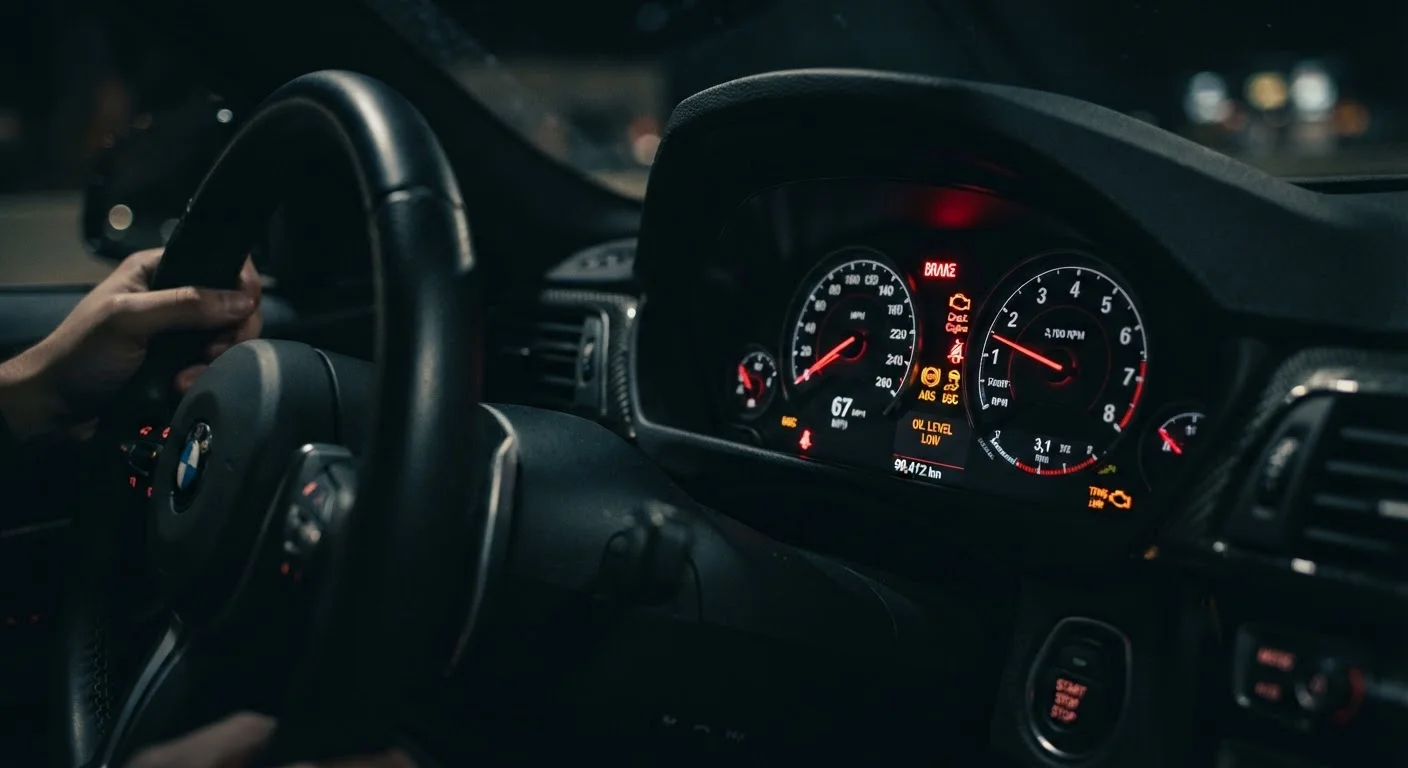
How Cars Communicate Trouble
Your car rarely breaks down without warning. Long before a roadside emergency, it sends signals through sounds, smells, vibrations, and dashboard lights. The challenge is knowing which signals to act on immediately and which can wait for a scheduled appointment. Learning to read these cues is one of the most practical skills any driver can develop.
This reference guide covers the most common warning signs organized by symptom type - so you can quickly look up what you're experiencing and understand what it likely means. For a deeper dive into dashboard symbols specifically, see our complete dashboard warning lights guide.
| Color of urgent warning lights | Red (Standard automotive dashboard color-coding convention) |
| Color of advisory warning lights | Amber or yellow (Standard automotive dashboard color-coding convention) |
| Vehicles with OBD-II diagnostic ports | All US cars and light trucks from 1996 onward (US EPA and CARB emissions mandate) |
| Most common cause of check engine light | Loose or faulty gas cap (evaporative emissions leak) (General industry diagnostic data) |
| Brake squeal indicator | Wear indicator tab contacting rotor - pads near end of life (Standard brake system design) |
| Ideal response to a red warning light | Stop driving as soon as safely possible (General automotive safety guidance) |
Warning Signs by Symptom Type
Unusual Smells
- Burning rubber or plastic: May indicate a slipping drive belt, overheating brakes, or an electrical issue. Pull over safely and inspect before continuing.
- Rotten eggs (sulfur): Often points to a failing catalytic converter or a battery issue. Have it inspected promptly.
- Sweet or syrupy odor: Typically signals a coolant leak. Do not ignore - coolant loss can cause engine overheating rapidly.
- Burning oil: Oil dripping onto hot engine components. Check your oil level and look for leaks underneath the vehicle.
Sounds That Shouldn't Be There
- Squealing or grinding brakes: Squealing often means worn brake pads; grinding suggests metal-on-metal contact. Either warrants immediate inspection by a qualified mechanic.
- Knocking or pinging from the engine: Can indicate low-octane fuel, carbon buildup, or a more serious internal engine problem.
- Clicking when turning: A classic sign of a worn CV (constant velocity) joint, especially audible during low-speed turns.
- Hissing under the hood: May point to a vacuum leak, coolant leak, or a punctured hose.
Vibrations and Handling Changes
- Steering wheel shaking: Often caused by unbalanced tires, worn suspension components, or warped brake rotors.
- Vehicle pulling to one side: Suggests uneven tire pressure, wheel misalignment, or uneven brake wear.
- Shuddering during acceleration: Could indicate a failing transmission, worn motor mounts, or driveshaft issues.
Dashboard Lights - Color Matters
Dashboard warning lights use a traffic-light color system. Red means stop or act immediately (e.g., oil pressure, engine temperature, brake system). Yellow/amber signals a condition that needs attention soon but isn't always an emergency (e.g., check engine, tire pressure). Green or blue lights are informational, confirming a system is active. For fluid-related warnings, our fluids guide explains what each fluid does and how to spot leaks early.
Check Engine Light (CEL)
An amber dashboard indicator triggered when the vehicle's onboard diagnostic system detects a fault in the engine, emissions, or related systems. It can range from minor sensor issues to serious mechanical problems.
CV Joint
Constant Velocity joint - a component of the drivetrain that transfers engine torque to the wheels at a consistent speed. Worn CV joints often produce a clicking sound when turning.
Catalytic Converter
An emissions control device in the exhaust system that converts harmful combustion gases into less harmful substances. A failing unit may produce a sulfur-like smell.
TPMS
Tire Pressure Monitoring System - a sensor-based system that alerts the driver when one or more tires are significantly under-inflated, displayed as an amber dashboard light.
OBD-II Scanner
An onboard diagnostics tool that plugs into a standardized port in most vehicles made after 1996. It reads stored fault codes to help identify the source of warning lights.
Brake Rotor
The disc component of a disc brake system that rotates with the wheel. Warped or worn rotors can cause vibration or shuddering when braking.
Act Now vs. Schedule Soon
Not every warning demands you pull over immediately - but some absolutely do. Use this framework to assess urgency:
| Symptom | Urgency Level |
|---|---|
| Red dashboard warning light (oil, temp, brakes) | Stop driving - address immediately |
| Grinding or loss of braking response | Stop driving - address immediately |
| Smoke from under the hood | Stop driving - address immediately |
| Coolant or burning smell | Pull over, let cool, inspect |
| Amber warning light (check engine, TPMS) | Schedule within days |
| Squealing brakes, mild vibration | Schedule within the week |
| Minor fluid spots in your parking spot | Monitor and inspect soon |
When in doubt, a qualified mechanic can run a diagnostic scan to retrieve error codes stored in your vehicle's onboard system. This takes the guesswork out of ambiguous warning lights. For a focused look at one of the most common dashboard alerts, see what the check engine light is actually telling you.
Staying alert to your car's signals pairs naturally with broader safe driving habits. Some risky driving patterns creep in gradually - much like mechanical problems that go unnoticed until they become serious.
This article is for general informational purposes only. Always consult a qualified, licensed mechanic for diagnosis and repair of your specific vehicle.
The content provided on our blog site traverses numerous categories, offering readers valuable and practical information. Readers can use the editorial team’s research and data to gain more insights into their topics of interest. However, they are requested not to treat the articles as conclusive. The website team cannot be held responsible for differences in data or inaccuracies found across other platforms. Please also note that the site might also miss out on various schemes and offers available that the readers may find more beneficial than the ones we cover.