

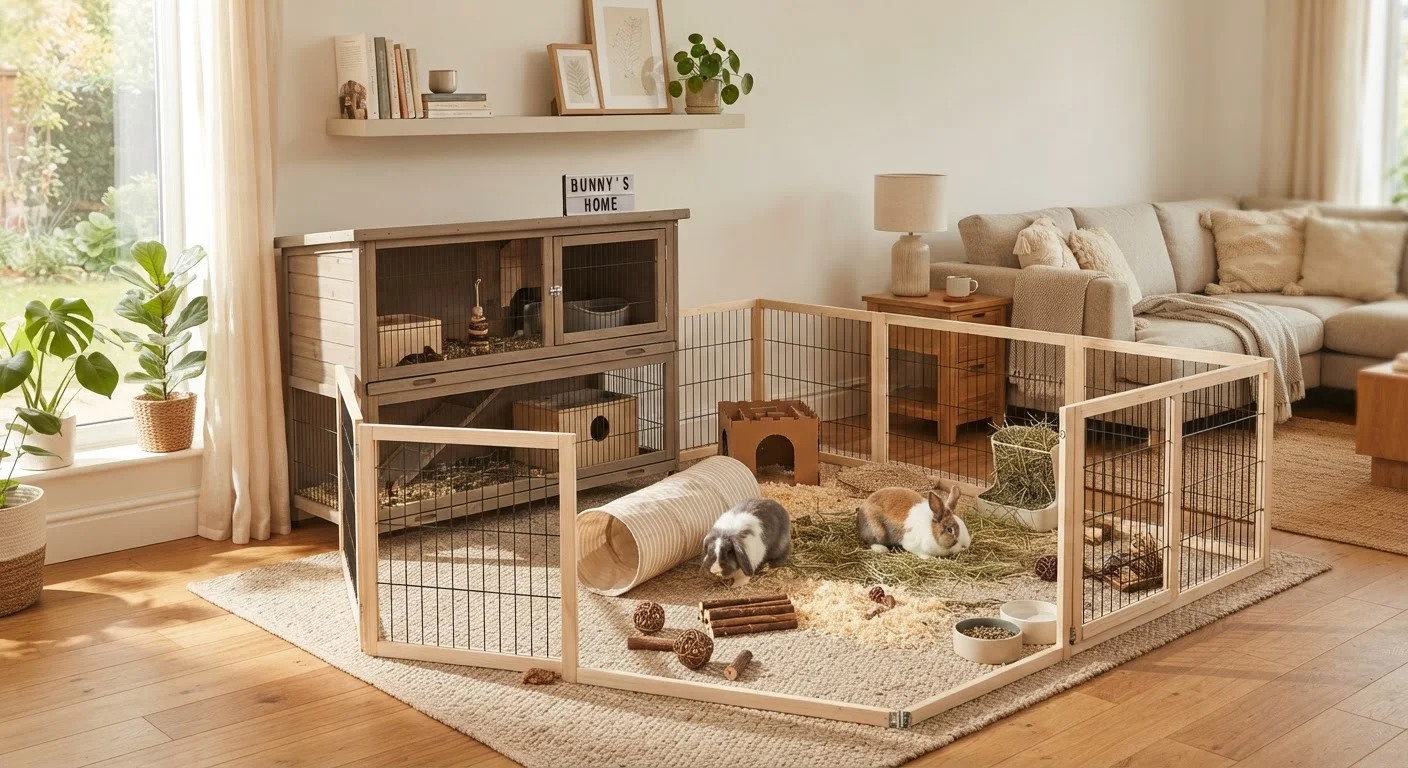
Option A
Rabbit Hutch Setup
The structured, contained approach to indoor rabbit housing.
Best for: Owners who need defined boundaries, live in shared spaces, or are introducing a rabbit for the first time.
Option B
Free-Roam Setup
The open, enrichment-first approach that mirrors a rabbit's natural behavior.
Best for: Owners committed to rabbit-proofing their home and providing maximum space and social interaction.
What Each Housing Style Actually Involves
When people picture rabbit housing, a hutch is often the default image - a wooden or wire enclosure where the rabbit lives, eats, and sleeps. A free-roam setup flips that model: the rabbit has access to a room or multiple rooms, with a home base (often a pen or corner setup) for food, water, and litter.
Both approaches can work well, but neither is plug-and-play. A hutch must be genuinely large - veterinary and rabbit welfare organizations generally recommend enclosures that allow a rabbit to take at least three to four consecutive hops and stand fully upright on its hind legs. Anything smaller restricts natural movement and can contribute to skeletal and behavioral problems over time.
Free-roam, meanwhile, isn't simply opening a door. Rabbits chew relentlessly and have a knack for finding electrical cords, toxic houseplants, and small gaps behind furniture. Before a rabbit roams freely, every accessible area needs to be evaluated for hazards. See our guide to creating a safe environment for small pets for a room-by-room framework.
| Criterion | Rabbit Hutch Setup | Free-Roam Setup |
|---|---|---|
| Space requirement | Large enclosure + daily exercise time | Full room or multi-room access |
| Setup complexity | Moderate - enclosure purchase and placement | High - full rabbit-proofing required |
| Supervision needed | During out-of-cage time | Initially; less once rabbit-proofed |
| Litter training importance | Important but contained | Essential for success |
| Risk of injury/hazard | Lower when hutch is secure | Higher without thorough proofing |
| Behavioral enrichment | Requires deliberate scheduling | Built in through natural exploration |
| Owner lifestyle fit | Flexible schedules, shared homes | Home-based, rabbit-committed lifestyle |
Health and Behavioral Impact of Each Approach
Rabbits are crepuscular and highly active - they're wired to move, explore, forage, and investigate. Housing that constrains this drive doesn't eliminate it; it redirects it into stereotypic behaviors like bar-chewing, repetitive circling, or lethargy.
Free-roam rabbits generally have more opportunities to express natural behavior, which supports both physical fitness and mental well-being. They tend to be more socially engaged with their owners, partly because they're simply present more often. The trade-off is that unsupervised access introduces risks - ingesting something toxic, getting stuck, or encountering a household pet without warning.
Hutch-housed rabbits can absolutely thrive, provided they receive meaningful daily exercise outside the enclosure. Locking a rabbit in a hutch around the clock - even a spacious one - is widely considered inadequate by rabbit welfare advocates. Owners who use hutches successfully tend to treat the hutch as a home base rather than a permanent enclosure, scheduling morning and evening free time consistently.
3-4 hrs
Minimum daily exercise time for indoor rabbits
Rabbit welfare organizations commonly recommend at least three to four hours of out-of-enclosure movement per day for housed rabbits.
8+ sq ft
Recommended minimum hutch floor space
Many rabbit care guidelines suggest a minimum of eight square feet of enclosure space, with more for larger breeds.
10-12 yrs
Typical lifespan of a well-cared-for indoor rabbit
Indoor rabbits kept in appropriate conditions and receiving regular veterinary care often live a decade or more.
Litter training is a practical foundation for either approach. Rabbits naturally choose a corner to eliminate, making training achievable with patience. Our step-by-step litter training guide covers exactly how to establish this habit from the start.
Practical Setup: What You'll Need for Each
Setting up a hutch correctly means more than buying a large enclosure. You'll need a litter box in a preferred corner, a hay rack or pile that makes up the bulk of the diet, a water source (bowl or bottle - many rabbits prefer bowls), and hiding spots that let the rabbit feel secure. Attaching an exercise pen to the hutch door so the rabbit can self-regulate its out-of-enclosure time is one of the most practical hutch modifications owners can make.
A free-roam setup requires rabbit-proofing before anything else: cord management (split loom tubing or cable boxes work well), blocking access to hazardous areas, removing toxic plants, and securing baseboards that may get chewed. A dedicated corner or room section serves as the rabbit's home base - litter box, hay, water, and a hideaway. Since rabbits are territorial, keeping this base consistent helps reduce anxiety during the adjustment period.
Both setups benefit from environmental enrichment: tunnels, untreated cardboard for chewing, dig boxes, and foraging toys. Just as cage size and enrichment matter deeply for hamsters, the same principle applies to rabbits - space alone isn't sufficient without mental stimulation.
Before committing to either setup, use this preparation checklist for small pet owners to make sure your home and supplies are genuinely ready.
A Note on Multi-Pet Households
If you share your home with cats or dogs, neither setup eliminates the need for careful management. Even a friendly dog can cause significant stress to a rabbit through scent, proximity, or sudden movement. Introductions should always be gradual and supervised. For a broader look at keeping small animals safe alongside other pets, see our shared-household safety guide.
The content provided on our blog site traverses numerous categories, offering readers valuable and practical information. Readers can use the editorial team’s research and data to gain more insights into their topics of interest. However, they are requested not to treat the articles as conclusive. The website team cannot be held responsible for differences in data or inaccuracies found across other platforms. Please also note that the site might also miss out on various schemes and offers available that the readers may find more beneficial than the ones we cover.