

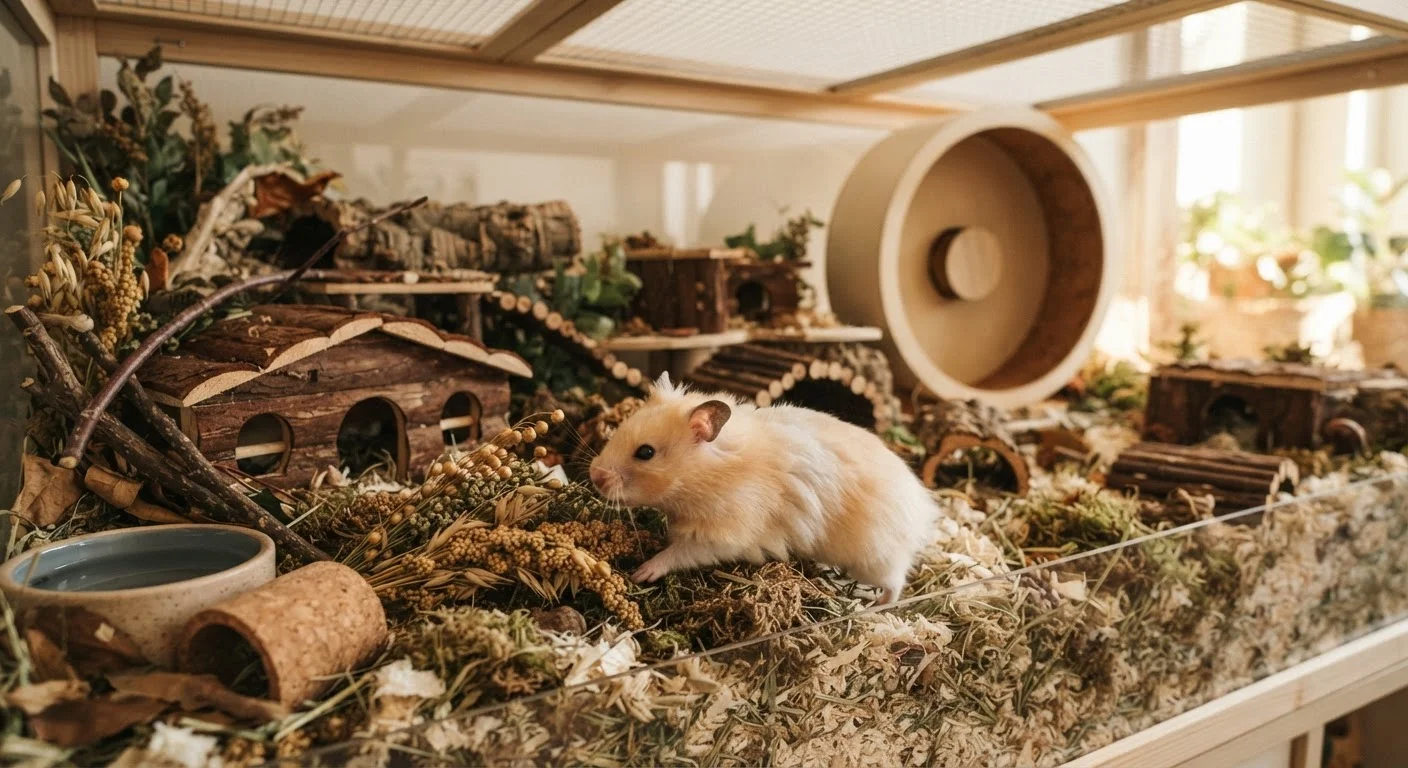
Why Standard Pet Store Cages Often Fall Short
Walk into any major pet retailer and you'll find rows of brightly colored hamster cages marketed as complete starter setups. The problem is that the vast majority of these enclosures - including many labeled for Syrian or "teddy bear" hamsters - provide far less space than hamsters actually need to thrive.
Most wire starter cages offer between 100 and 200 square inches of floor space. Hamster welfare organizations and many veterinarians who specialize in exotic or small animal care recommend a minimum of 450 square inches of unbroken floor space for a single Syrian hamster - and ideally more. That gap between what's sold and what's needed is significant, and it has real consequences for animal welfare.
Hamsters confined to undersized enclosures frequently develop what are called stereotypies - repetitive, purposeless behaviors like bar-chewing, pacing, or excessive digging at corners. These are recognized indicators of chronic stress and poor welfare. Common misconceptions about small pets often lead owners to underestimate these needs from the start.
450 sq in
Minimum recommended floor space for a Syrian hamster
Widely cited by small animal veterinarians and hamster welfare advocates; many European country guidelines set this as a legal minimum.
5-8 miles
Distance a hamster may run in a single night
Behavioral studies of wild hamsters have documented extensive nightly ranging behavior, underscoring the importance of adequate wheel size and exercise opportunity.
6 inches
Minimum bedding depth for burrowing
Recommended by exotic animal veterinarians and supported by behavioral research showing burrowing is essential for hamster psychological wellbeing.
The Non-Negotiable Role of Bedding Depth
Burrowing is not optional behavior for hamsters - it is a core biological drive. In the wild, Syrian hamsters (native to arid regions of Syria and Turkey) dig elaborate tunnel systems that can extend several feet underground. These burrows serve as sleeping chambers, food caches, and refuges from predators and temperature extremes.
In captivity, hamsters need the opportunity to express this drive. That means providing at least 6 inches of loose, safe bedding across the entire floor of their enclosure - not just a corner or a nesting box. Paper-based bedding and kiln-dried aspen shavings are generally considered safe choices. Cedar and pine shavings should be avoided, as they contain aromatic oils that can irritate a hamster's respiratory system.
Owners who increase bedding depth often report a dramatic reduction in stress behaviors. A hamster that previously bar-chewed constantly may stop entirely once given sufficient depth to burrow. This single change can make a bigger welfare difference than almost any other modification.
Consider a Storage Bin as an Enclosure
Large clear plastic storage bins (around 40 gallons or more) can make excellent, affordable hamster enclosures. They offer far more floor space than most commercial cages, allow for deep bedding, and are easy to clean. Drill ventilation holes in the lid and sides to ensure adequate airflow - this is a widely used approach in the hamster enthusiast community.
Wheels, Hides, and Enrichment That Actually Matters
Exercise wheels are not a luxury - hamsters can run 5 to 8 miles in a single night in the wild, and captive hamsters maintain a strong drive to do the same. A wheel that is too small forces the hamster to arch its back while running, which can contribute to spinal issues over time. Syrian hamsters need a solid-surface wheel of at least 10-11 inches in diameter. Wire or barred wheels pose an injury risk to feet and legs and should be avoided entirely.
Beyond the wheel, enrichment should mimic foraging and exploration. Consider:
- Multiple hides - hamsters feel safer with covered spaces to retreat to
- Scatter feeding - hiding food throughout the bedding instead of using a bowl encourages natural foraging behavior
- Tunnels and cork logs - provide additional hiding and exploration opportunities
- Sand baths - many hamsters enjoy rolling in chinchilla sand, which also supports coat health
Enrichment should be rotated periodically to maintain novelty. A hamster that has thoroughly explored its environment may benefit from rearranging items or introducing new textures and objects.
Diet, Solitary Housing, and the Full Picture
A hamster's diet should go beyond a single commercial pellet. A quality seed-and-grain mix - ideally one formulated specifically for hamsters rather than a generic rodent blend - can serve as a base. Supplement this with fresh vegetables a few times per week, occasional protein sources like plain cooked egg or mealworms, and limited fruit as a treat due to its sugar content.
On the subject of housing: Syrian hamsters must always live alone. They are naturally solitary and territorial animals. Housing two together - even briefly - can result in severe fighting. Some dwarf hamster species (Roborovski, Campbell's, Winter White) are occasionally kept in same-sex pairs, but this requires careful monitoring for aggression and the ability to separate them quickly if conflict arises.
If you're preparing for a hamster for the first time, our small pet preparation checklist can help you verify you have everything in place before bringing one home. For a look at how other small pets have their own distinct space needs, see how rabbit housing decisions compare in complexity and scope.
This article provides general educational information about hamster care and is not a substitute for guidance from a veterinarian experienced with small animals.
Frequently Asked Questions
Most hamster welfare organizations recommend at least 450 square inches of unbroken floor space for a Syrian hamster. Many experts and European welfare standards suggest even larger enclosures - 600 square inches or more. The typical small wire cages sold in pet stores often provide only 100-200 square inches, which is well below this threshold.
Syrian hamsters are solitary animals and must be housed alone. Keeping two Syrians together will almost certainly result in fighting, serious injury, or death. Dwarf hamster species are sometimes kept in same-sex pairs, but even then, conflicts are common and should be monitored closely.
Hamsters are instinctive burrowers and need at least 6 inches of loose, safe bedding - paper-based or aspen shavings work well. Some owners provide 10 or more inches, which allows for more naturalistic tunneling behavior and significantly reduces stress-related behaviors.
Syrian hamsters need a solid-surface wheel with a diameter of at least 10-11 inches to run without arching their back, which can cause spinal problems. Dwarf hamsters can use slightly smaller wheels, typically 8 inches. Wire or mesh wheels should be avoided due to injury risk.
Hamsters require less daily interaction than dogs or cats, but they are not low-maintenance in terms of setup and environmental needs. Proper enclosure size, enrichment, daily feeding, and regular spot-cleaning all require consistent attention. See our <a href="/pets-animals/small-pets/common-myths-about-small-pets-that-affect-how-people-care-for-them">guide to common small pet myths</a> for more on this misconception.
A well-rounded hamster diet includes a quality seed-and-grain mix or pellets as a base, supplemented with fresh vegetables, small amounts of protein like boiled egg or plain cooked chicken, and occasional fruits as treats. Foraging for food hidden in their bedding also provides important mental stimulation.
The content provided on our blog site traverses numerous categories, offering readers valuable and practical information. Readers can use the editorial team’s research and data to gain more insights into their topics of interest. However, they are requested not to treat the articles as conclusive. The website team cannot be held responsible for differences in data or inaccuracies found across other platforms. Please also note that the site might also miss out on various schemes and offers available that the readers may find more beneficial than the ones we cover.