

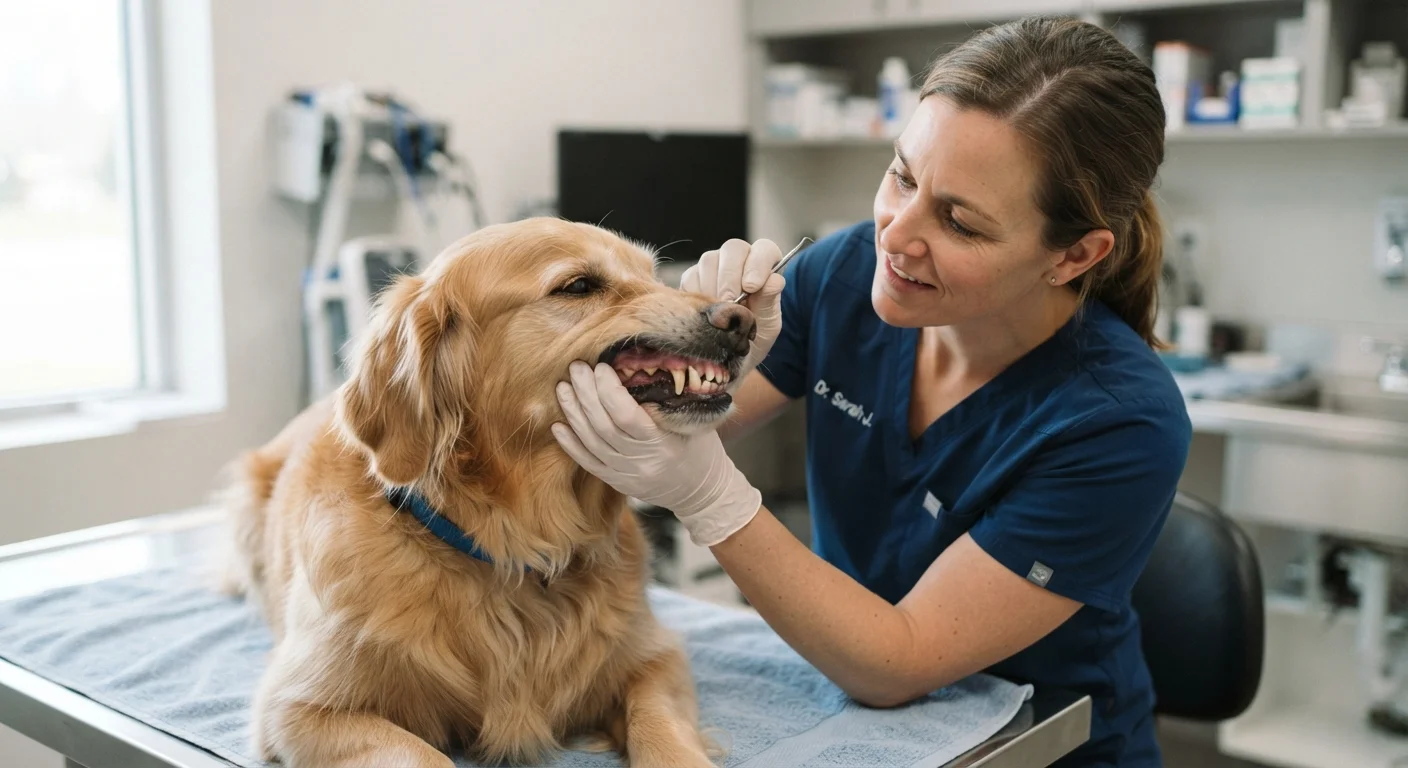
Why Dental Disease Goes Unnoticed for So Long
Dogs are stoic animals. Evolutionary instinct drives them to conceal weakness, which means a dog with a mouth full of infected gum tissue may still eat, play, and greet you at the door as if nothing is wrong. This masking behavior is one reason dental disease advances so far before most owners realize there is a problem. Our article on signs your dog may be in pain explains this tendency in broader detail.
The progression from healthy mouth to serious disease happens gradually. Plaque - a soft film of bacteria - forms on teeth within hours of eating. Left undisturbed, it mineralizes into tartar (calculus) within 24 to 48 hours. Tartar provides a rough surface that accelerates further bacterial attachment, and the cycle compounds. Over months and years, bacteria migrate below the gumline, triggering inflammation and tissue destruction that the dog may never visibly react to.
Bad Breath Is Not Normal
Many owners assume persistent bad breath - sometimes called 'dog breath' - is simply normal. In reality, noticeable halitosis is almost always a sign of bacterial activity in the mouth, most often from plaque and tartar buildup or active gum infection. A dog with a healthy, clean mouth should not have a consistently strong odor. If your dog's breath is noticeably unpleasant, mention it at your next veterinary visit.
How Periodontal Disease Progresses Stage by Stage
Understanding the four grades of periodontal disease helps explain why catching it early matters so much:
- Grade 1 - Gingivitis: The gums are inflamed and may bleed with gentle probing, but no bone or ligament loss has occurred. This is the only stage that is fully reversible.
- Grade 2 - Early periodontitis: Up to 25% of the supporting bone around a tooth has been lost. Pockets form between the tooth and gum where bacteria accumulate.
- Grade 3 - Moderate periodontitis: Between 25% and 50% of supporting bone is destroyed. Teeth may become mobile. Pain at this stage is significant.
- Grade 4 - Advanced periodontitis: More than 50% of bone support is gone. Teeth are frequently loose or missing. Jaw fractures are possible in small breeds. Bacteria can enter the bloodstream and reach internal organs.
The systemic risks at Grade 4 are well-documented: chronic oral bacteria have been associated with changes in the heart valves, kidneys, and liver. This is one reason veterinarians treat dental care as a whole-body health issue rather than a cosmetic concern.
~80%
Dogs with dental disease by age three
Veterinary organizations broadly cite that the majority of dogs show signs of periodontal disease by their third birthday.
24-48 hrs
Time for plaque to harden into tartar
Once plaque mineralizes into tartar, it can no longer be removed by brushing alone and requires professional scaling.
4 grades
Severity stages of periodontal disease
Veterinary dentistry classifies periodontal disease from Grade 1 (reversible gingivitis) to Grade 4 (severe bone loss and systemic risk).
Brushing: The Most Effective Tool You Can Use at Home
Daily toothbrushing is the single most impactful thing an owner can do to slow plaque progression between professional cleanings. The goal is mechanical disruption of the plaque film before it hardens. Even brushing three to four times per week provides meaningful benefit, though daily remains the professional recommendation.
Key principles for success:
- Use the right products. Dog-specific toothbrushes - including finger brushes - and enzymatic pet toothpaste are designed for the task. Human toothpaste contains fluoride and xylitol, both of which are toxic to dogs.
- Build tolerance gradually. Start by letting your dog lick the toothpaste off your finger. Progress to touching the teeth with the brush before any scrubbing motion. Some dogs accept brushing within a week; others take longer.
- Focus on the outer surfaces. The buccal (cheek-facing) surfaces of the upper molars and canine teeth accumulate plaque fastest. The tongue naturally helps clean inner surfaces.
- Stay consistent. The benefit of brushing is cumulative. Missing sessions allows plaque to reharden, so regularity matters more than perfection.
Make Brushing a Daily Habit Early
The earlier in a dog's life you introduce toothbrushing, the more readily they accept it. Pair each session with something your dog enjoys - a small treat or brief play - to build a positive association. Even a 30-second brushing session focused on the outer surfaces of the back teeth delivers meaningful benefit over time.
Professional Cleanings and What to Expect
Home brushing supports dental health but does not replace professional care. A veterinary dental cleaning performed under general anesthesia allows the vet to scale above and below the gumline, probe each tooth for pocket depth, take dental X-rays, and extract teeth that cannot be saved. Without anesthesia, none of these steps is safely or thoroughly achievable.
Owners are sometimes anxious about anesthetic procedures, particularly for older dogs. Veterinary teams perform pre-anesthetic bloodwork to assess organ function and tailor protocols to minimize risk. For senior dogs specifically, care adjustments after age seven - including more frequent dental monitoring - are often recommended. Your veterinarian can explain the risk-benefit considerations for your dog's individual health status.
Annual wellness visits are also the natural checkpoint for oral health assessment. Our overview of what happens at a dog's annual vet visit explains what vets examine and why those appointments matter for catching disease early.
Diet plays a supporting role as well. The texture and composition of food can influence how quickly plaque builds up. Comparing wet food and dry kibble - including their dental health implications - can help you make feeding choices that complement your dog's oral care routine.
This article is for general informational purposes only and is not a substitute for professional veterinary advice. Always consult a licensed veterinarian for guidance specific to your dog's health.
Frequently Asked Questions
Bad breath is often the first noticeable sign, but it is far from the only one. Look for yellow or brown buildup along the gumline, red or swollen gums, pawing at the mouth, or dropping food while eating. Because dogs mask discomfort instinctively, a veterinary oral exam is the most reliable way to assess severity.
Grade 1 dental disease - gingivitis - can be fully reversed with a professional cleaning and consistent home care. Grades 2 through 4 involve damage to bone and ligaments that cannot be undone, though progression can be slowed with treatment and ongoing maintenance.
Most veterinarians recommend at least one professional dental cleaning per year for the average adult dog. Small breeds and dogs prone to rapid tartar accumulation may benefit from more frequent cleanings. Your vet can assess your individual dog's needs during annual checkups.
Anesthesia-free cleanings can remove visible surface tartar but cannot address disease beneath the gumline, which is where the most serious damage occurs. Veterinary dental organizations generally do not recommend them as a substitute for a full anesthetic cleaning and examination.
Use a toothbrush designed for dogs and toothpaste formulated for pets - human toothpaste contains ingredients that are harmful to dogs. Start slowly, letting your dog get used to the taste and sensation over several sessions. Aim to brush at least a few times per week, though daily is ideal.
Dry kibble has a mild mechanical effect on tooth surfaces, but it is not a reliable substitute for brushing. Many pieces crumble before producing meaningful abrasion. Our guide on <a href="/pets-animals/dog-care/wet-food-vs-dry-kibble-feeding-tradeoffs-every-dog-owner-should-understand">wet food vs. dry kibble</a> covers the dental and nutritional tradeoffs in more detail.
The content provided on our blog site traverses numerous categories, offering readers valuable and practical information. Readers can use the editorial team’s research and data to gain more insights into their topics of interest. However, they are requested not to treat the articles as conclusive. The website team cannot be held responsible for differences in data or inaccuracies found across other platforms. Please also note that the site might also miss out on various schemes and offers available that the readers may find more beneficial than the ones we cover.