

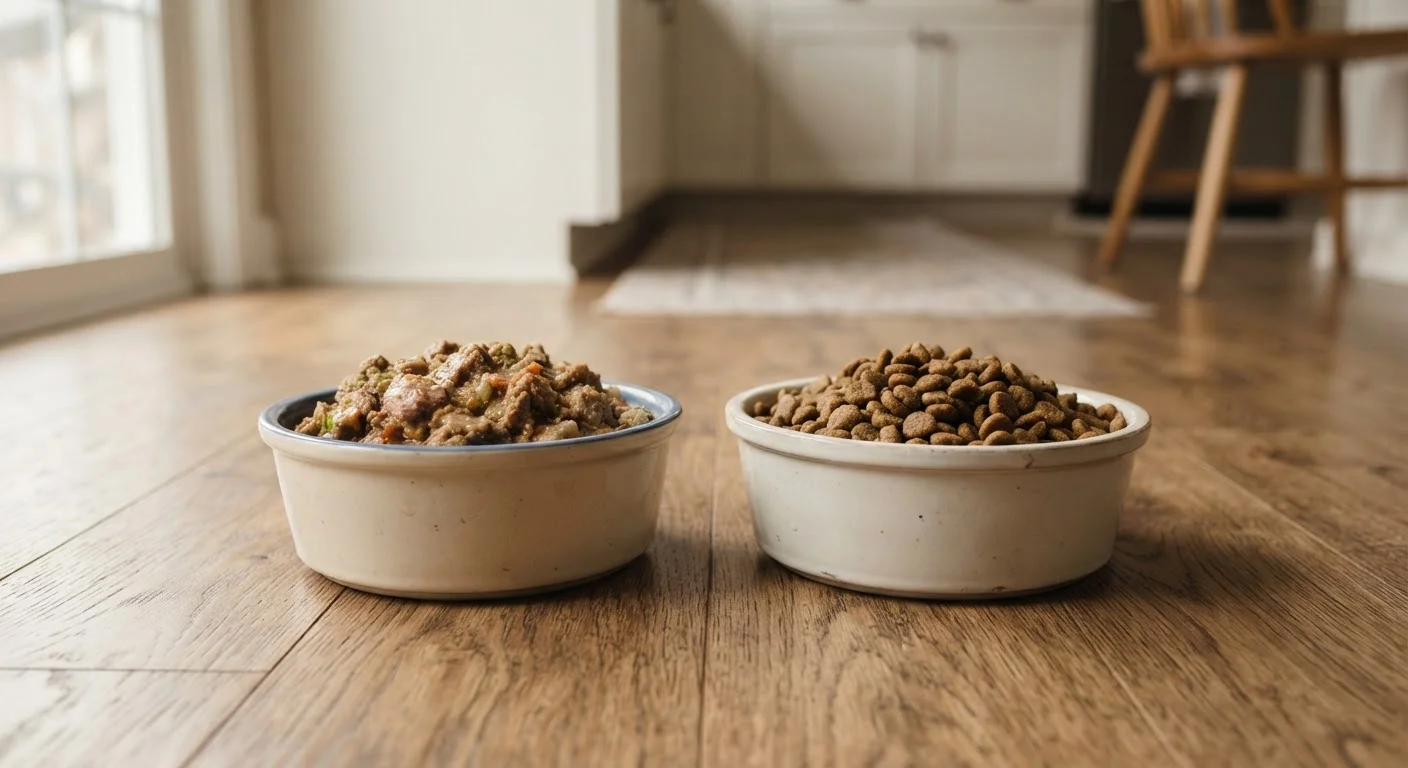
Option A
Wet Food (Canned)
The high-moisture, palatable option for picky or health-challenged dogs.
Best for: Dogs needing extra hydration, seniors with dental pain, or picky eaters who refuse kibble.
Option B
Dry Kibble
The convenient, cost-effective everyday staple for most dogs.
Best for: Owners who value affordability, dental abrasion benefits, and easy portion control.
What's Actually Inside Each Format
The most fundamental difference between wet and dry dog food isn't flavor - it's water content. Canned wet food typically contains 70-80% moisture, while dry kibble sits at roughly 8-12%. Everything else - protein, fat, fiber, vitamins, and minerals - is concentrated within that remaining dry matter. When comparing nutritional labels, this distinction matters enormously: a cup of wet food and a cup of kibble are not nutritionally equivalent on their face, which is why feeding guidelines are measured by caloric content rather than volume.
Kibble is made by cooking ingredients at high heat under pressure (a process called extrusion), which shapes and dries the food into shelf-stable pieces. Wet food is typically cooked inside sealed cans or pouches, preserving more of the food's original texture and aroma. Both formats can meet complete and balanced nutritional standards set by the Association of American Feed Control Officials (AAFCO), so the format itself doesn't determine quality - the ingredient profile does.
| Criterion | Wet Food (Canned) | Dry Kibble |
|---|---|---|
| Moisture content | 70-80% | 8-12% |
| Cost per calorie | Higher | Lower |
| Shelf life (unopened) | 1-5 years | 12-18 months |
| Storage after opening | Refrigerate, use in 1-2 days | Room temp, resealable bag |
| Palatability | Generally higher aroma/texture appeal | Variable; some dogs less enthused |
| Dental abrasion benefit | None | Minimal for most dogs |
| Ease of portioning | Can be imprecise with large cans | Easy to measure by cup or weight |
| Best life stage fit | Seniors, picky eaters, ill dogs | Most life stages; convenient for all |
Hydration, Kidney Health, and Urinary Concerns
Dogs aren't driven to drink water as instinctively as cats are, but hydration still plays a meaningful role in kidney function and urinary tract health. Wet food contributes substantially to a dog's daily fluid intake, which can be especially useful for dogs that tend to drink sparingly or those with a history of urinary crystals or kidney disease. Veterinarians sometimes recommend transitioning dogs with chronic kidney disease toward higher-moisture diets - though any such change should happen in partnership with your vet rather than unilaterally.
For otherwise healthy dogs, dry kibble doesn't pose a hydration risk as long as fresh water is always available. Most dogs self-regulate water intake well enough when fed kibble. That said, dogs in hot climates, working dogs, and seniors may benefit from the additional moisture wet food naturally provides. If you're unsure whether your dog is adequately hydrated, a simple skin-turgor test (gently tenting the skin at the back of the neck - it should spring back immediately) is a starting point, though a vet exam gives a more complete picture.
70-80%
Moisture content in typical wet dog food
Compared to roughly 10% in dry kibble, wet food contributes meaningfully to a dog's daily fluid intake.
~80%
Dogs over age 3 with some dental disease
The American Veterinary Dental College estimates most dogs show signs of periodontal disease by age three, regardless of food format.
3-4x
Approximate cost difference per calorie
Wet food commonly costs several times more per calorie than an equivalent dry kibble, though prices vary widely by brand and formulation.
Dental Health: What the Evidence Actually Shows
One of the most persistent claims in dog food marketing is that dry kibble scrubs teeth clean through mechanical abrasion. The reality is more nuanced. While some larger kibble pieces do create mild abrasion on tooth surfaces, most dogs chew so quickly - or swallow pieces nearly whole - that the cleaning effect is minimal. The Veterinary Oral Health Council (VOHC) certifies specific dental diets and chews that meet defined plaque and tartar reduction standards, and not all kibbles qualify.
Wet food, by contrast, doesn't provide abrasion at all and can leave more residue on tooth surfaces. However, dental disease in dogs progresses for many reasons beyond food format - genetics, oral microbiome, and the presence or absence of brushing all play larger roles. Daily tooth brushing with a dog-safe toothpaste remains the most evidence-backed preventive measure, regardless of what format you feed. Owners relying solely on kibble for dental care may be giving themselves false reassurance.
Cost, Storage, and Everyday Practicality
For most households, kibble wins on economics. A large bag of dry food delivers more calories per dollar than an equivalent caloric amount of canned food, and it stores easily at room temperature for weeks without refrigeration. Once opened, a can of wet food must be refrigerated and used within a day or two, which can complicate meal planning and increases the chance of waste - especially for smaller dogs who don't finish a full can at one sitting.
Wet food pouches in single-serve sizes reduce spoilage but often cost more per serving than larger cans. For owners of small breeds, single-serve pouches or peel-top cans can make wet feeding more practical. A mixed feeding approach - using kibble as the base and adding a small amount of wet food for palatability - is a common middle ground that controls cost while still delivering some of the moisture and flavor benefits wet food offers.
For dogs with specific age-related needs, our guide on senior dog nutrition and care walks through how dietary priorities shift over time. Similarly, owners wondering how these tradeoffs apply to cats can explore wet versus dry food for cats for a species-specific breakdown.
Mixing Wet and Dry Food Is Generally Safe
Many owners combine wet and dry food in the same bowl without issue. The key is adjusting total caloric intake so you're not inadvertently overfeeding. If you add wet food to your dog's existing kibble ration without reducing portion size, weight gain can follow. Use a food scale or your vet's caloric targets as your guide rather than eyeballing the bowl.
The content provided on our blog site traverses numerous categories, offering readers valuable and practical information. Readers can use the editorial team’s research and data to gain more insights into their topics of interest. However, they are requested not to treat the articles as conclusive. The website team cannot be held responsible for differences in data or inaccuracies found across other platforms. Please also note that the site might also miss out on various schemes and offers available that the readers may find more beneficial than the ones we cover.