

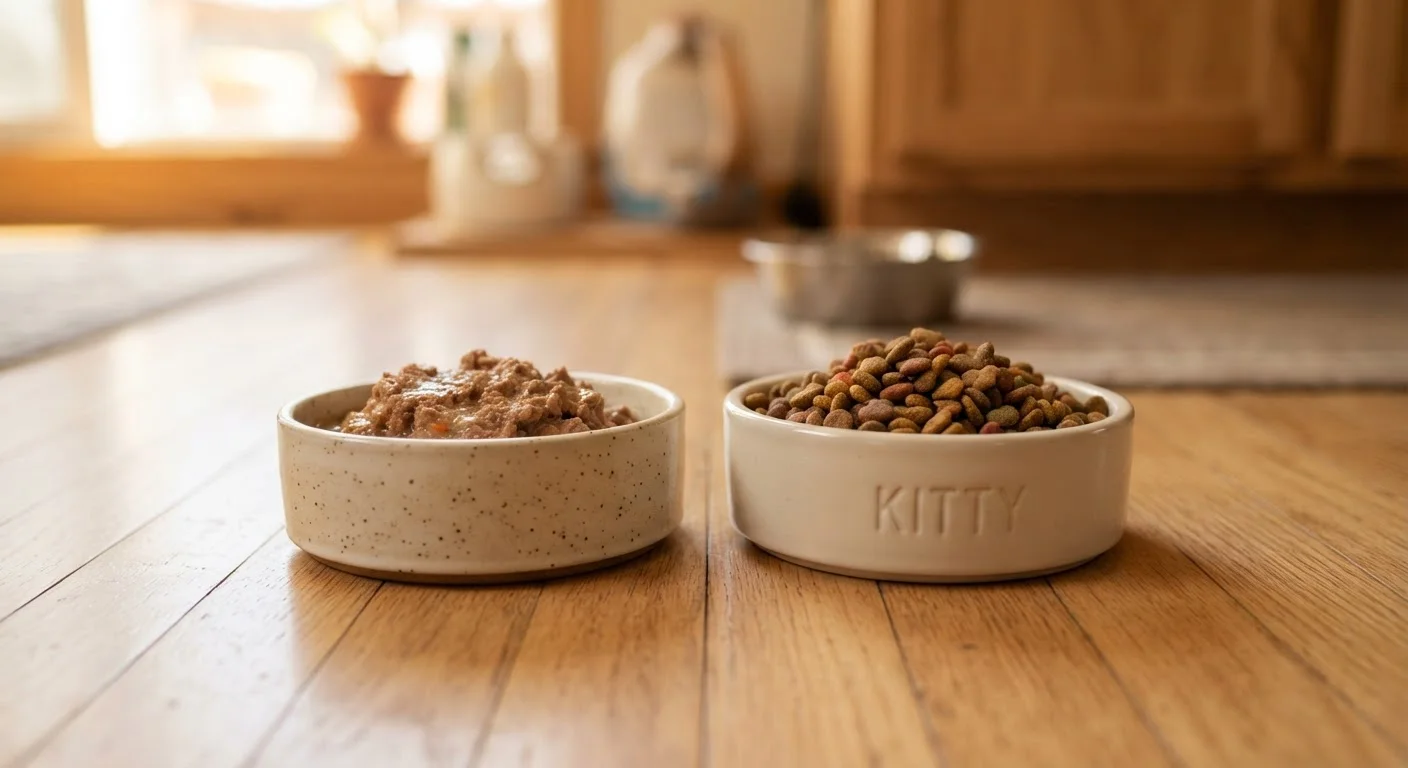
Option A
Wet (Canned) Cat Food
The moisture-rich, highly palatable option.
Best for: Cats with urinary tract issues, picky eaters, seniors, or any cat that doesn't drink enough water on its own.
Option B
Dry (Kibble) Cat Food
The convenient, calorie-dense everyday staple.
Best for: Owners seeking long shelf life, easier portion control, and a lower per-meal cost for healthy, well-hydrated cats.
Why the Format of Cat Food Actually Matters
Unlike dogs, cats evolved in arid environments and obtain much of their water through prey. This means cats have a naturally weak thirst drive and may not compensate for low dietary moisture by drinking more water - even when a bowl is readily available. The practical consequence is that the format of food your cat eats has a direct bearing on daily hydration, not just calorie and protein intake.
Understanding the structural differences between wet and dry food helps clarify which trade-offs are relevant to your specific cat. For a deeper look at how nutritional needs shift through life stages, see our guide on what cats need to eat at every life stage.
| Criterion | Wet (Canned) Food | Dry (Kibble) Food |
|---|---|---|
| Moisture content | 70-80% | ~10% |
| Cost per serving | Higher | Lower |
| Shelf life (opened) | 24-48 hours refrigerated | Weeks at room temperature |
| Calorie density | Lower per volume | Higher per volume |
| Palatability for picky cats | Generally higher | Variable |
| Urinary health support | Strong (dilutes urine) | Weaker without added water intake |
| Weight management ease | Easier (lower calorie density) | Requires careful portioning |
| Feeding convenience | More hands-on | More hands-off |
Hydration and Urinary Health
Wet food typically contains 70-80% moisture, while dry kibble sits around 10%. For cats with a history of urinary crystals, bladder stones, or chronic kidney disease, veterinarians frequently recommend wet food - or at least incorporating it - because higher dietary moisture helps produce more dilute urine, which reduces mineral concentration and the risk of crystal formation.
Dry food alone isn't inherently dangerous for healthy cats, but owners relying solely on kibble should ensure a clean, accessible water source at all times. Some cats prefer running water, which is why pet fountains are a common recommendation for kibble-fed households.
70-80%
Moisture in typical wet cat food
Compared to roughly 10% in dry kibble, this difference in water content can meaningfully affect a cat's daily hydration and urinary tract health.
~2×
Relative cost of wet vs. dry per calorie
Wet food generally costs substantially more per calorie than dry kibble, making format choice a real budget consideration for multi-cat households.
10-30%
US cats affected by urinary tract issues
Urinary and kidney conditions are among the most common health concerns in domestic cats, underscoring why dietary moisture is a key veterinary consideration.
Nutrition, Palatability, and Weight Management
Both wet and dry foods can be formulated to meet the AAFCO nutritional standards for cats when manufactured correctly. The key differences show up in calorie density, protein concentration by dry matter, and texture.
Dry food is calorie-dense - a small volume contains more calories than an equivalent volume of wet food. This can make portion control harder, particularly in multi-cat households or for cats prone to overeating. On the other hand, cats that need to gain weight or burn significant energy may do well with the caloric efficiency of kibble.
Palatability varies by individual cat, but wet food's stronger scent and softer texture often make it easier to entice finicky eaters or seniors with reduced sense of smell. If your cat experiences recurring vomiting or digestive upset, the food's moisture and fiber content may play a role - our article on hairballs, vomiting, and digestive upset outlines when those symptoms warrant a vet visit.
Cost, Convenience, and Practical Considerations
Dry food wins on most practical dimensions. It's significantly cheaper per calorie, stores at room temperature for weeks or months, and can be left in a bowl for grazing without the risk of bacterial growth that comes with uneaten wet food. For multi-cat households or owners with unpredictable schedules, these factors carry real weight.
Wet food, by contrast, must be refrigerated after opening and generally used within 24-48 hours. It's more expensive per serving, and some cats refuse refrigerator-cold food - meaning you may need to warm it slightly to body temperature before serving. Automatic feeders designed for wet food exist but are more complex and expensive than standard dry-food dispensers.
A mixed approach - sometimes called combination feeding or rotational feeding - lets owners capture some benefits of each format. Offering one wet meal daily while leaving measured dry food available addresses hydration concerns while keeping costs and logistics manageable. This is also an approach your veterinarian can help tailor to your cat's specific caloric needs. For owners building a full care routine, the indoor cat care roadmap covers feeding as part of a broader wellness picture.
This article provides general educational information about cat nutrition and is not a substitute for personalized veterinary advice. Always consult your veterinarian before making significant dietary changes, especially if your cat has existing health conditions.
The content provided on our blog site traverses numerous categories, offering readers valuable and practical information. Readers can use the editorial team’s research and data to gain more insights into their topics of interest. However, they are requested not to treat the articles as conclusive. The website team cannot be held responsible for differences in data or inaccuracies found across other platforms. Please also note that the site might also miss out on various schemes and offers available that the readers may find more beneficial than the ones we cover.