

Why Mental Enrichment Isn't Optional
Cats are predatory animals with sharp instincts for hunting, problem-solving, and territorial exploration. When those instincts have nowhere to go, the result isn't a calm, content pet - it's a bored one. Boredom in cats tends to express itself in ways owners find frustrating: destructive scratching, middle-of-the-night zoomies, over-grooming, or redirected aggression toward housemates or people.
Indoor cats in particular face this challenge. Without the sensory variety of the outdoors - changing smells, moving prey, unpredictable terrain - the home environment can feel static and understimulating. Our guide to the case for and against letting cats outdoors covers the trade-offs of outdoor access in detail. For owners who keep cats inside, the responsibility to provide that stimulation falls entirely on the home setup and daily routine.
The good news: cats don't need expensive equipment or elaborate installations. What they need is intentional variety - experiences that activate their senses, challenge their minds, and trigger natural behaviors in a safe context. The ideas below cost little or nothing and adapt easily to small spaces.
Use puzzle feeders instead of a standard bowl
Hiding or dispersing your cat's meals so they have to work for food is one of the most reliably effective enrichment strategies available. Cats are built to hunt before they eat, and eliminating that effort entirely - by placing food in an open bowl - removes a significant chunk of daily mental activity.
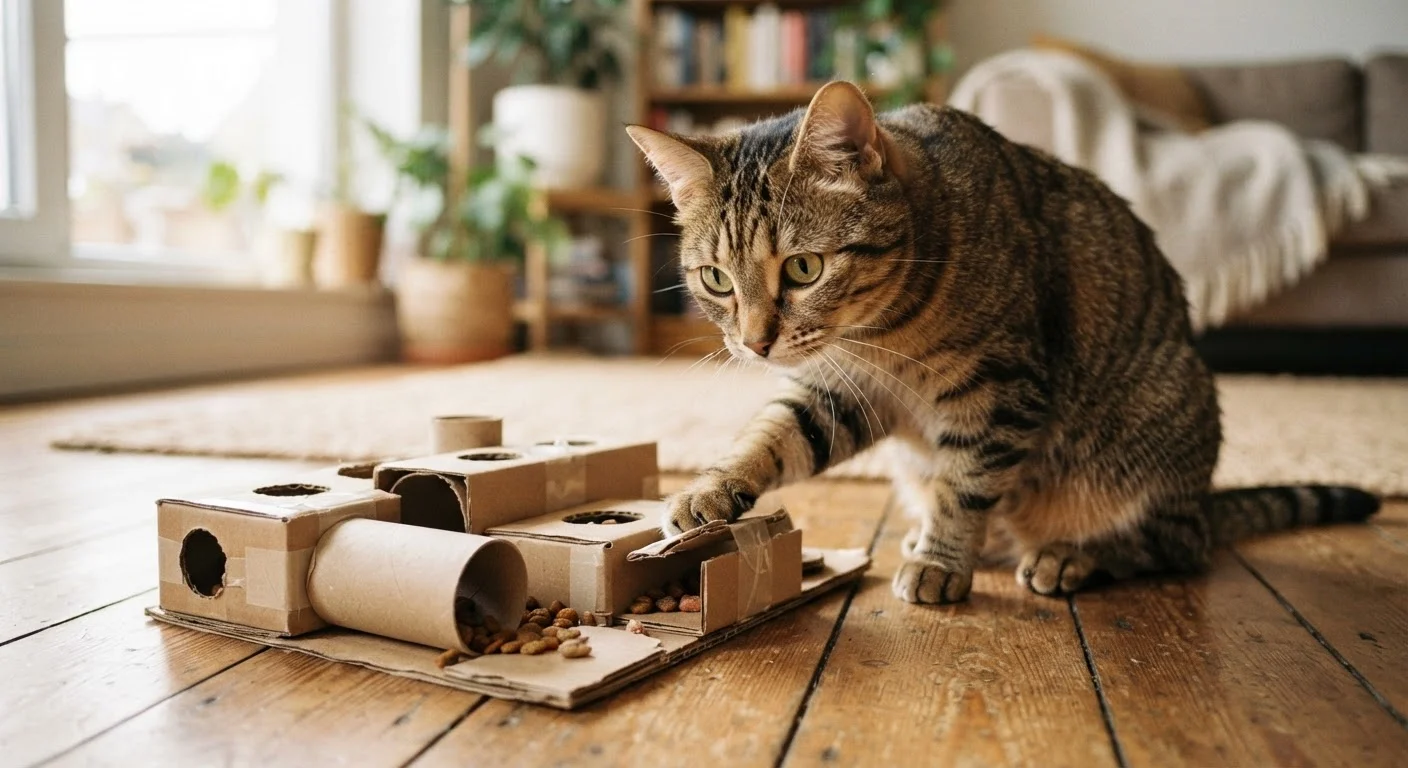
Puzzle feeders, snuffle mats, or food-stuffed toys require cats to use their paws, nose, and problem-solving skills to access their meals. You can also make a DIY version using an egg carton, a muffin tin covered with tennis balls, or kibble scattered across a bath mat. Start with simpler configurations and increase difficulty as your cat catches on.
Eating from a puzzle feeder replaces the hunt cats are wired to perform before every meal.
Create a dedicated window-watching station
A perch positioned at a window with a reasonable view - a bird feeder outside, street activity, rustling trees - gives a cat hours of passive stimulation with no effort from you beyond the initial setup. Cats use visual tracking and environmental monitoring as core daily activities in the wild, and window access satisfies that drive directly.
A stable shelf, a suction-cup window perch, or even a piece of furniture pushed close to a low window works well. Adding a bird feeder just outside the glass amplifies the effect considerably. Make sure the screen is secure if the window opens.
A window with an active view outside is one of the simplest, highest-return enrichment setups available.
Rotate toys rather than leaving them all out
A toy left on the floor for days loses its novelty quickly. Cats investigate unfamiliar objects - once something becomes familiar, it effectively disappears from their awareness. Keeping a small collection and rotating which two or three are available each week preserves novelty without requiring you to buy anything new.
Store toys out of sight between rotations. When a previously hidden toy reappears, your cat is likely to engage with it as though it's new. Crinkle balls, feather wands, and small stuffed mice are all easy to rotate this way.
Rotation makes old toys feel new again - novelty is what drives engagement, not price.
Introduce scent enrichment periodically
Cats rely heavily on scent for information about their world, and the indoor home environment tends to smell exactly the same every day. Introducing new, safe scents gives the olfactory system real work to do.
Dried herbs like valerian, silver vine, or catnip (not all cats respond to catnip - sensitivity is genetic) can be placed in a sock or small cloth pouch for the cat to investigate. Safe dried botanicals, untreated pine cones, or even a piece of cloth rubbed on outdoor surfaces can produce similar interest. Always verify that any plant material you introduce is non-toxic to cats before offering it.
Scent enrichment costs almost nothing and engages a sensory channel that toys and play often ignore.
Schedule brief, daily interactive play sessions
No enrichment strategy fully replaces direct interaction between a cat and its owner. Wand toys, laser pointers (always finish with a physical toy the cat can catch), and crinkle tunnels engage the full predatory sequence - stalk, chase, pounce, capture - in a way passive enrichment cannot replicate.
Aim for at least one session of ten to fifteen minutes per day, ideally around the same time. Cats are crepuscular, meaning they're naturally most active at dawn and dusk, so those windows often produce the most engaged play. Consistency builds anticipation, which is itself a form of mental engagement.
Daily interactive play completes the predatory sequence that passive toys and feeders alone cannot fulfill.
Offer cardboard boxes and paper bags for exploration
Cats investigate enclosed spaces instinctively - it satisfies territorial and hunting behaviors simultaneously. A new cardboard box on the floor, a paper grocery bag with the handles removed, or a crinkled newspaper spread across the floor can occupy a cat for a surprisingly long time.
These items are free, require no setup, and can simply be left out for a day or two before being discarded. Rotating them - bringing in a new box when the old one has lost its interest - keeps the effect going indefinitely. Avoid plastic bags, which present a suffocation hazard.
A plain cardboard box engages territorial and exploratory instincts that cost-heavy enrichment setups often miss.
Making Enrichment a Sustainable Habit
The most effective enrichment strategy is one you'll actually maintain. Short, consistent play sessions - even ten to fifteen minutes daily - are more beneficial than occasional hour-long efforts. Rotating which activities you offer each week prevents habituation and keeps things genuinely interesting for your cat.
Try a Two-Week Rotation Schedule
Organize your enrichment activities into two alternating weeks - different puzzle configurations in week one, new scent items and a fresh cardboard box in week two. This keeps your effort low while ensuring your cat experiences genuine variety. Even small changes, like rearranging where a toy appears, register as new information to a cat.
Keep in mind that a cat's enrichment needs shift with age. Kittens may need several active play sessions per day, while senior cats often prefer shorter, lower-impact engagement - our guide to senior cat care outlines what changes to expect and watch for. For a comprehensive look at keeping an indoor cat healthy at any life stage, the Indoor Cat Care owner's roadmap is a useful reference.
Mental engagement is a daily responsibility, not a one-time setup. Even small adjustments - moving a food dish, rotating a toy box, opening a window - signal to your cat that the environment is alive and worth exploring.
The content provided on our blog site traverses numerous categories, offering readers valuable and practical information. Readers can use the editorial team’s research and data to gain more insights into their topics of interest. However, they are requested not to treat the articles as conclusive. The website team cannot be held responsible for differences in data or inaccuracies found across other platforms. Please also note that the site might also miss out on various schemes and offers available that the readers may find more beneficial than the ones we cover.