

Our Verdict
There is no single right answer to whether cats should go outdoors. The decision depends on where you live, your cat's individual temperament, and how much risk you are prepared to manage. Supervised access, enclosed outdoor spaces, and strong indoor enrichment can each address different parts of the equation without forcing an all-or-nothing choice.
Owners who live in low-traffic, lower-predator areas and can provide routine veterinary preventive care may find supervised or limited outdoor access a reasonable fit for an active, curious cat.
Why the Outdoor Question Matters More Than It Might Seem
Deciding whether to allow your cat outdoors is one of the most consequential choices you will make as an owner - and one that gets surprisingly little careful thought. It touches on your cat's physical health, behavioral wellbeing, and life expectancy, as well as your responsibilities to local wildlife and neighbors. The answer is rarely obvious, and it varies meaningfully based on where you live and the individual cat in front of you.
It is also worth questioning some inherited assumptions. The idea that cats need to go outside to be happy is widely held but not straightforwardly supported by evidence. For a deeper look at common beliefs that do not always hold up to scrutiny, see what veterinary science actually supports on some widely held cat beliefs.
The Real Benefits of Outdoor Access
Outdoor access does deliver genuine advantages for many cats, and dismissing them entirely does not serve owners well.
Provides natural exercise and physical activity
Outdoor cats typically walk, climb, and run far more than indoor cats, which can support a healthy weight and strong muscle tone.
Satisfies predatory instincts through real stimuli
Hunting behavior - stalking, pouncing, catching - is hardwired in cats. Outdoor environments give these drives a natural outlet that toys alone rarely replicate fully.
Reduces boredom-driven behavioral problems
Cats that have access to varied outdoor environments tend to show fewer signs of frustration-related behaviors, such as excessive vocalization, destructive scratching, or aggression.
Offers sensory richness that indoor spaces lack
Changing smells, sounds, textures, and sights in an outdoor environment provide continuous low-level cognitive stimulation that even well-equipped indoor spaces can struggle to match.
The physical and behavioral enrichment that comes from an outdoor environment is difficult to fully recreate indoors, though it is far from impossible. If your cat is showing signs of understimulation - restlessness, attention-seeking behavior, or destructive play - outdoor access is one response, but not the only one. See practical indoor enrichment ideas for approaches that work without outdoor exposure.
The Risks You Are Taking On
The case against unsupervised outdoor access is substantial, and it is grounded in documented outcomes rather than overprotectiveness.
Significantly shorter average lifespan documented
Veterinary and animal welfare organizations consistently note that free-roaming outdoor cats have shorter average lifespans than indoor cats, largely due to trauma, predation, and disease exposure.
Exposure to infectious disease and parasites
Outdoor cats are at higher risk for feline leukemia virus (FeLV), feline immunodeficiency virus (FIV), upper respiratory infections, and a heavy parasite burden including fleas, ticks, and intestinal worms.
Traffic and physical trauma are leading causes of injury
Road traffic is one of the most common causes of serious injury and death in outdoor cats, particularly in suburban and semi-urban neighborhoods.
Impact on local wildlife, especially birds
Research published by wildlife organizations estimates that free-roaming domestic cats kill billions of birds and small mammals annually in the US, raising meaningful conservation and community concerns.
Risk of getting lost, stolen, or trapped
Outdoor cats may wander beyond familiar territory, become disoriented, or be picked up by well-meaning neighbors - microchipping and identification are essential but do not eliminate this risk entirely.
2-5 years
Estimated lifespan gap: outdoor vs. indoor cats
Multiple veterinary and animal welfare sources estimate free-roaming outdoor cats live significantly fewer years on average than indoor-only cats.
1.3-4B
Birds killed annually by US free-roaming cats
A widely cited study published in Nature Communications estimated this range based on population and predation rate modeling.
These risks do not make outdoor access impossible to justify, but they do make a strong argument for thinking carefully about the form it takes. Free-roaming access in a dense urban area or near a busy road carries a very different risk profile than supervised time in a rural yard with few hazards.
Finding a Workable Middle Ground
A Middle Path: Supervised and Enclosed Outdoor Access
Many owners find that a catio (an enclosed outdoor enclosure attached to the home) or leash-walking with a properly fitted harness gives cats meaningful outdoor time without free-roaming risks. These options require upfront effort but can substantially address the enrichment benefits of outdoor access. Not every cat will adapt to a harness, so gradual introduction is key.
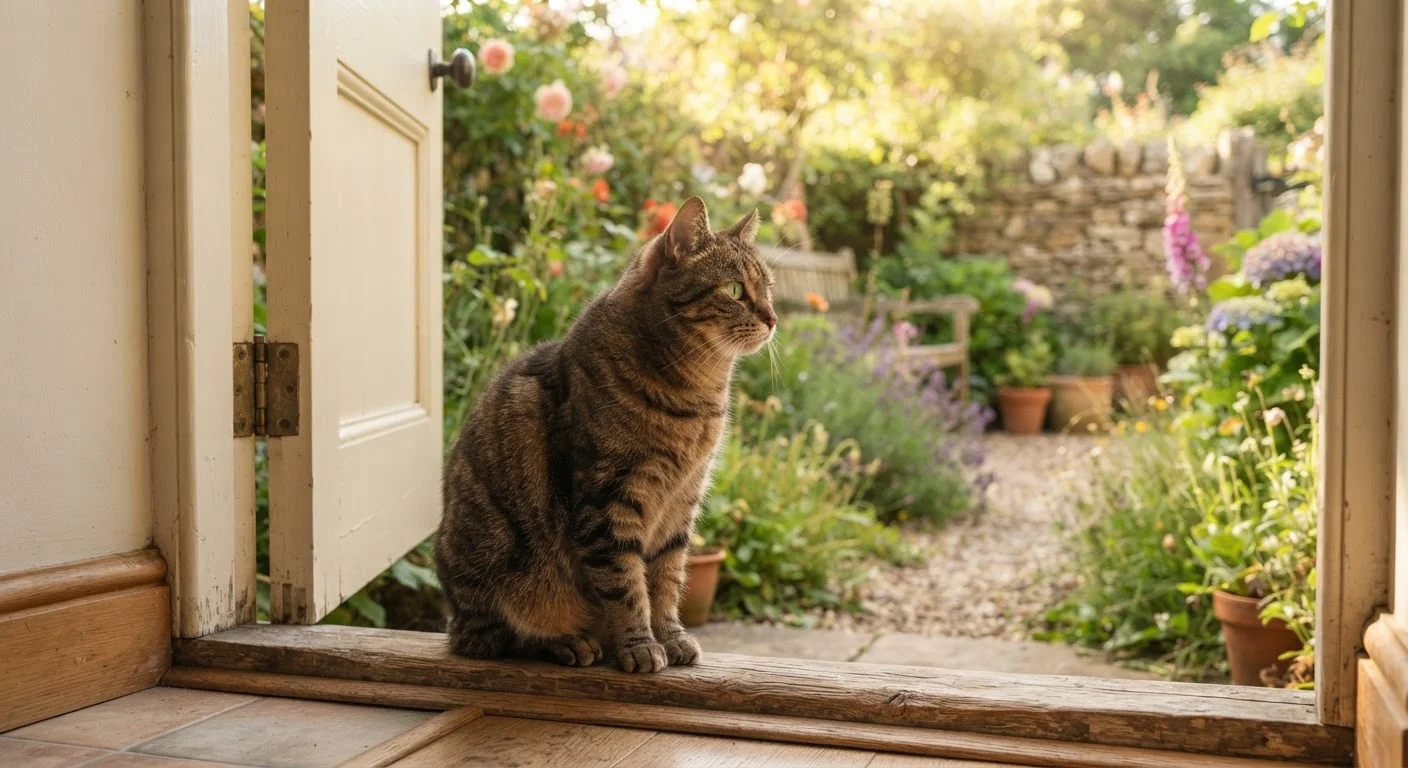
Enclosed outdoor spaces - catios, screened porches, or garden runs - are increasingly popular precisely because they thread this needle. Your cat gets fresh air, natural light, and sensory stimulation; you maintain control over the hazards they are exposed to. Leash-walking is another option that some cats adapt to well, though it requires patience during training.
For owners committed to keeping cats fully indoors, the priority becomes building an environment rich enough to meet behavioral needs. Window perches with bird feeders positioned outside, puzzle feeders, regular interactive play sessions, and vertical climbing structures can each make a real difference. Our complete indoor cat care guide covers this in depth.
Whatever you decide, core preventive care - vaccinations, parasite control, and microchipping - becomes especially important if any outdoor access is permitted. Speak with your veterinarian about what your specific cat needs given their health status and your local environment.
The content provided on our blog site traverses numerous categories, offering readers valuable and practical information. Readers can use the editorial team’s research and data to gain more insights into their topics of interest. However, they are requested not to treat the articles as conclusive. The website team cannot be held responsible for differences in data or inaccuracies found across other platforms. Please also note that the site might also miss out on various schemes and offers available that the readers may find more beneficial than the ones we cover.