

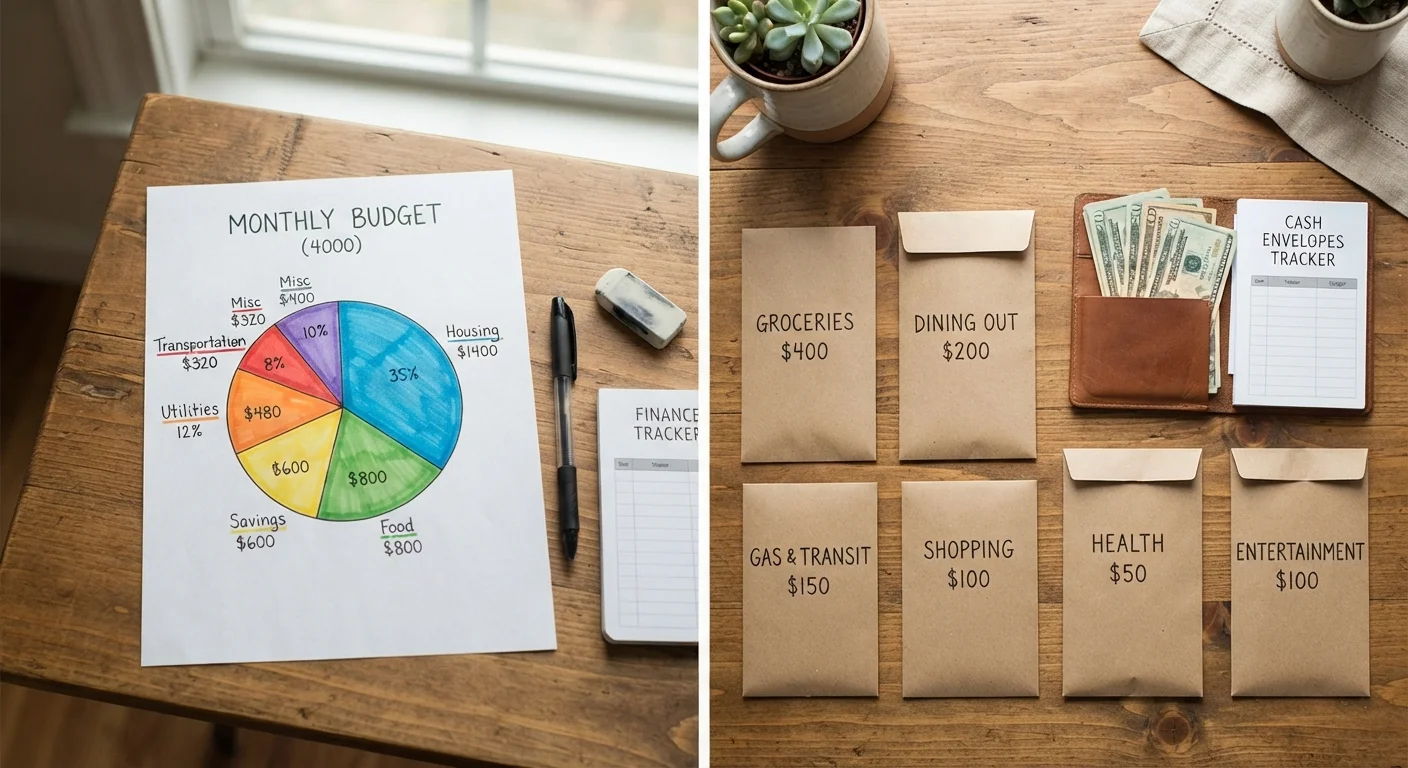
Option A
The 50/30/20 Rule
The flexible, percentage-based framework for the big picture.
Best for: People who want a simple, low-maintenance structure that leaves room for lifestyle flexibility without tracking every dollar.
Option B
Envelope Budgeting
The hands-on, category-by-category cash control system.
Best for: People who struggle with overspending in specific categories and want a tactile, firm spending limit they can feel in real time.
How Each Framework Actually Works
Understanding what each system asks of you day-to-day is the foundation for picking one you'll stick with.
The 50/30/20 rule divides your monthly after-tax income into three broad buckets: 50% toward needs (rent, utilities, groceries, insurance), 30% toward wants (dining out, subscriptions, travel), and 20% toward savings and debt repayment beyond minimums. It's a framework, not a rigid prescription - the percentages are targets that you review monthly rather than guardrails you monitor transaction by transaction. For a deeper contrast with another percentage-free method, see how zero-based budgeting compares.
Envelope budgeting works differently at the mechanical level. You withdraw cash at the start of each pay period and physically divide it into labeled envelopes - one for groceries, one for gas, one for entertainment, and so on. When an envelope is empty, spending in that category stops until the next funding cycle. The method was popularized before digital banking, but many households now apply it using dedicated spending accounts or apps that mimic the envelope structure. For a balanced look at what using physical cash really involves in today's world, our envelope method deep-dive covers both sides.
| Criterion | 50/30/20 Rule | Envelope Budgeting |
|---|---|---|
| Setup time | 30-60 minutes initially | 1-2 hours per pay period |
| Number of categories | 3 broad buckets | 6-15+ specific envelopes |
| Overspending prevention | Passive - flagged at review | Active - stops at empty envelope |
| Works with digital payments | Yes, easily | Requires adaptation |
| Best income type | Stable, predictable income | Variable or irregular income |
| Monthly maintenance | Low - monthly review | High - every pay period |
| Flexibility | High - broad categories | Low - fixed per category |
| Behavioral reinforcement | Moderate - awareness-based | Strong - physical feedback |
Psychological Differences That Matter
Both systems work - but they work through different psychological levers, and that distinction often determines which one sticks.
The 50/30/20 rule operates on awareness and intention. You're not stopped from spending; you're encouraged to stay conscious of which bucket a purchase comes from. This suits people who are generally disciplined but want a framework to benchmark against. The looser structure, however, means that small daily purchases can quietly erode a category without any immediate signal.
Envelope budgeting works through friction and finality. Running out of cash in the grocery envelope is a concrete, immediate event. Research in behavioral economics consistently finds that spending physical cash feels more psychologically costly than swiping a card - a phenomenon sometimes called the "pain of paying." That friction is a feature, not a bug, for households where abstract limits haven't worked. What still holds up in a digital age explores which parts of this psychology survive without physical cash.
~33%
Americans with a detailed household budget
Gallup polling has found that roughly one in three U.S. adults report maintaining a detailed monthly budget, suggesting most households operate without a formal system.
Pain of Paying
Cash spending feels more costly than cards
Behavioral economists Drazen Prelec and Duncan Simester documented this effect, finding that paying in cash activates a stronger sense of financial loss than card transactions.
If you and a partner budget together, the visibility of physical envelopes can also reduce conflict by making limits feel external and shared rather than imposed by one person. Budgeting as a couple covers more strategies for aligning two different spending styles.
Practical Trade-Offs: Setup, Maintenance, and Flexibility
Neither framework is entirely frictionless. Here's where each one asks the most of you.
The 50/30/20 rule demands an honest accounting of what qualifies as a "need" versus a "want" - a line that can blur. A streaming subscription could be either, depending on your household. The method also struggles to flag problems in real time; you may only realize a category drifted at month-end review. On the upside, it pairs naturally with budgeting apps or a simple spreadsheet, and takes less than an hour a month to maintain once set up. For help choosing the right tool to track it, see paper budgets vs. spreadsheets vs. apps.
Envelope budgeting demands more upfront effort: you need to define every spending category, determine appropriate amounts, and actually handle cash - or find a digital system that replicates the structure credibly. It also creates logistical friction for online purchases, subscriptions, and bill pay, which rarely fit neatly into a cash envelope. Despite those limitations, many households find the forced intentionality worth the extra steps, particularly in early stages of building a budget habit.
Hybrid Approaches Are Valid
You don't have to pick one system and follow it perfectly. Many households use the 50/30/20 framework for high-level planning, then apply envelope-style limits only to the two or three categories where they most consistently overspend. A hybrid approach that actually gets used beats a pure system that gets abandoned. Experiment, and adjust based on what the data from your own spending tells you.
This article is for general informational and educational purposes only and does not constitute personalized financial advice. Consider speaking with a qualified financial professional about your specific situation.
The content provided on our blog site traverses numerous categories, offering readers valuable and practical information. Readers can use the editorial team’s research and data to gain more insights into their topics of interest. However, they are requested not to treat the articles as conclusive. The website team cannot be held responsible for differences in data or inaccuracies found across other platforms. Please also note that the site might also miss out on various schemes and offers available that the readers may find more beneficial than the ones we cover.