

Our Verdict
Cash envelope budgeting remains a genuinely effective tool for controlling discretionary spending, particularly for people who struggle to connect digital transactions with real money leaving their account. However, it is not a complete budgeting system on its own in a world where so many expenses - bills, subscriptions, online shopping - exist entirely outside the cash economy. Most households will see the best results by pairing envelope-style discipline in high-risk spending categories with digital tracking for everything else.
Best for people who consistently overspend in categories like groceries, dining out, or entertainment, and who find that seeing a dwindling envelope creates the accountability that apps and spreadsheets have not.
What Is the Cash Envelope Method?
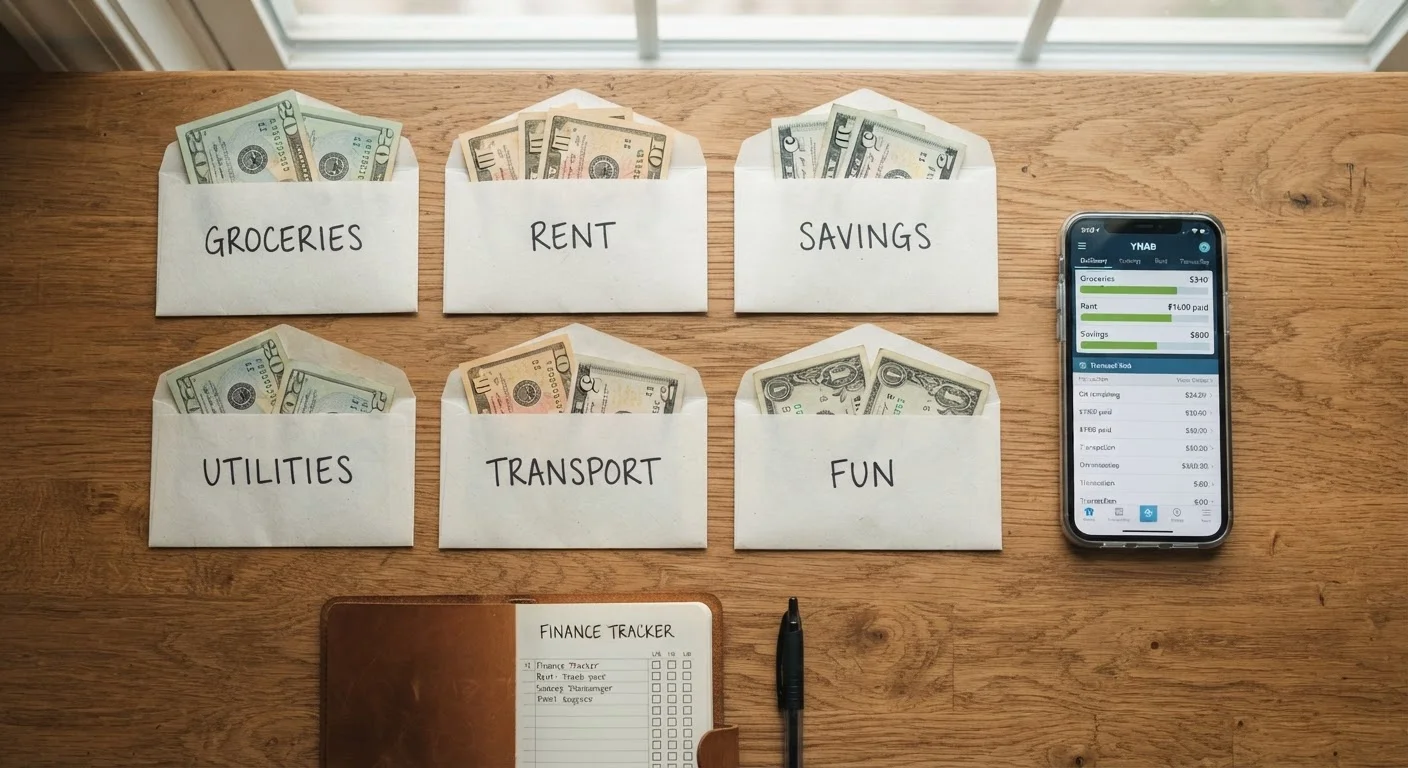
The cash envelope method is a zero-based budgeting technique where you divide your monthly take-home income into spending categories - groceries, gas, dining out, entertainment, clothing - and allocate a set amount of physical cash into a labeled envelope for each one. When an envelope is empty, spending in that category stops until the next funding period. Nothing is borrowed from another envelope without a deliberate, conscious decision.
The system was popularized decades ago and gained mainstream attention through personal finance educators who emphasized behavioral change over pure math. Its core insight is simple: spending physical cash feels different from swiping a card or tapping a phone, and that friction can prevent the small, repeated overspending that derails otherwise sound budgets.
For a broader look at how this approach stacks up against percentage-based methods, see our comparison of envelope budgeting and the 50/30/20 rule.
What Still Works: The Real Advantages
Creates tangible spending limits that are hard to ignore
Physical cash running out in an envelope is an unmistakable signal in a way that a low account balance notification is not. This concreteness makes the system self-enforcing for many people.
Reduces impulse and emotional spending
The act of counting out bills activates a stronger awareness of cost than tapping a card. Behavioral research suggests this friction meaningfully reduces unplanned purchases.
No technology or internet access required
The system works without a smartphone, app subscription, or data connection - making it reliable and accessible for anyone, regardless of comfort with technology.
Provides real-time category visibility at a glance
You always know exactly how much remains in any spending category simply by opening the envelope - no logging, syncing, or reconciliation needed.
Builds deliberate spending habits over time
Repeatedly making conscious decisions about which envelope to use retrains spending reflexes, a habit that can persist even after someone transitions to a digital system.
Research in behavioral economics consistently supports what envelope users report anecdotally: paying with cash activates a stronger sense of loss than digital payment methods. A study published in the Journal of Consumer Research found that the abstract nature of credit and debit transactions reduces the psychological pain of spending - meaning people who pay digitally tend to spend more than those who pay with cash for the same goods. The envelope method exploits this effect deliberately.
The system also excels at clarity. There is no end-of-month surprise with an envelope; you can see exactly how much remains at any point. This real-time visibility - without requiring an app, internet connection, or data entry - is an underrated advantage for people who find budgeting software overwhelming or hard to maintain consistently.
What Doesn't Work: The Real Disadvantages
Incompatible with most digital and online payments
Online shopping, subscription services, and automated bill pay cannot be handled with physical cash, meaning the system requires a supplementary tracking method for a large portion of most budgets.
Lost or stolen cash is unrecoverable
Unlike debit or credit accounts, which carry federal consumer protections against unauthorized transactions, physical cash lost or stolen offers no path to recovery.
Inconvenient for regular ATM withdrawals and bank trips
Funding envelopes requires scheduled cash withdrawals, which adds time and logistical friction - and may mean paying ATM fees depending on your bank.
Difficult to coordinate between partners or family members
When multiple people share budget categories and spending responsibilities, physical envelopes create access and coordination challenges that a shared digital account avoids.
Misses rewards, purchase protections, and transaction records
Cash purchases earn no credit card rewards, offer no built-in dispute resolution, and leave no automatic spending record - benefits that digital payment methods provide by default.
Does not cover the full household budget
Fixed costs like rent, insurance, and utilities typically cannot be paid in cash, so envelope budgeting on its own is always a partial system rather than a complete financial plan.
The most significant structural limitation is that a large and growing portion of American household spending simply cannot be paid in cash. Mortgage or rent payments, utility auto-pays, streaming subscriptions, online retailers, and most recurring bills operate exclusively through electronic transfer. This means envelope budgeting can only ever cover a slice of your total budget without supplementary tracking.
Security is another practical concern. Cash lost or stolen is gone permanently. A wallet containing several funded envelopes represents a meaningful financial loss with no recourse - a risk that digital accounts, which carry federal consumer protections, do not share.
Digital Envelope Apps: A Middle-Ground Option
Several budgeting apps replicate the envelope method's category-allocation logic entirely within your phone or browser. You assign a fixed dollar amount to each spending category at the start of the month, and the app deducts from the relevant 'envelope' as you log transactions. This approach suits people whose spending is largely card- or app-based but who still want the discipline of hard category limits. The trade-off is that logging transactions takes effort, and the psychological friction of physical cash is absent.
If you're managing a joint household, envelope logistics add another layer of complexity. Our guide on budgeting as a couple with different spending styles addresses how to align on shared systems when partners have different habits.
Building a Hybrid Approach That Holds Up
For most households, the practical answer is not a binary choice between all-cash and all-digital. A targeted hybrid preserves what the envelope method does well while acknowledging the realities of modern payment infrastructure.
One workable framework: use physical envelopes only for the two or three spending categories where you historically overspend - common culprits include groceries, dining out, and personal spending money. Handle fixed, predictable bills (rent, insurance, loan payments) through automated digital payments tracked in a simple spreadsheet or app. This keeps the behavioral friction where it matters most without requiring you to carry envelopes to pay your electric bill.
Digital envelope systems - apps that replicate the category-allocation logic without physical cash - offer a middle path for people who spend heavily online. They lack the tactile friction of real cash but impose the same hard category limits. Whether that trade-off works depends on your personal spending triggers.
For a side-by-side look at paper, spreadsheet, and app-based budgeting tools, the comparison of budgeting formats is a useful starting point. You can also explore foundational strategies at our Budgeting Basics hub.
~18%
US adults who primarily use cash for purchases
According to Pew Research Center data, the share of Americans who use cash for all or almost all of their purchases has declined sharply in recent years, reflecting the digital payment shift.
Less
Spending reported when paying with cash vs. cards
Multiple behavioral economics studies, including work cited in the Journal of Consumer Research, find that consumers consistently spend less when transactions involve physical currency rather than card or digital payment.
This article provides general financial education and is not personalized financial advice. Consider consulting a qualified financial professional for guidance tailored to your specific situation.
The content provided on our blog site traverses numerous categories, offering readers valuable and practical information. Readers can use the editorial team’s research and data to gain more insights into their topics of interest. However, they are requested not to treat the articles as conclusive. The website team cannot be held responsible for differences in data or inaccuracies found across other platforms. Please also note that the site might also miss out on various schemes and offers available that the readers may find more beneficial than the ones we cover.