

Our Verdict
Cash envelope budgeting is a genuinely effective tool for reining in variable, discretionary spending - but it is not a complete financial system on its own. Its physical friction is both its greatest strength and its biggest obstacle in a world where so much commerce happens online. Used selectively or as part of a broader budget, it can produce real behavioral change.
Best for cash-oriented spenders, beginners who want immediate spending feedback, and anyone who has repeatedly overspent on variable categories despite tracking digitally.
What Is the Cash Envelope Method?
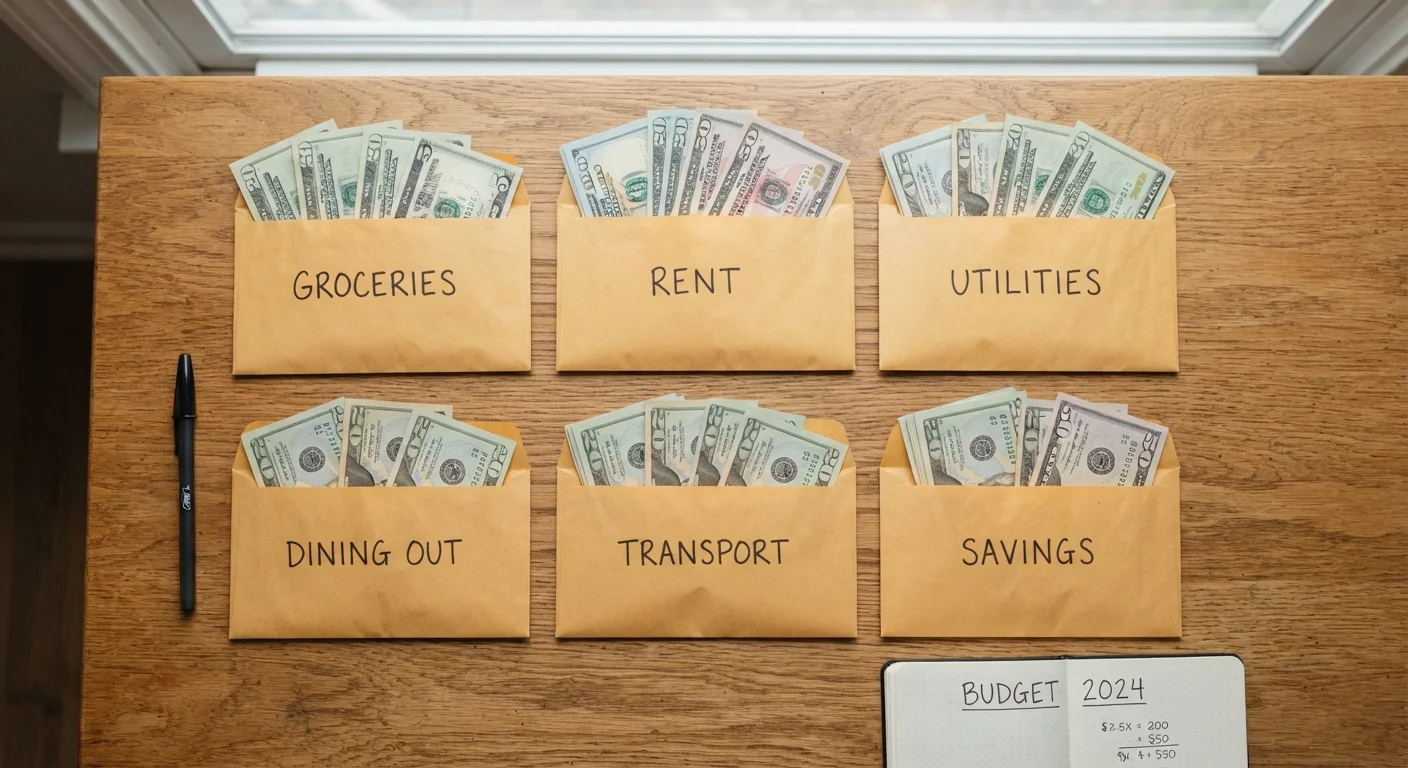
The cash envelope method is a zero-based budgeting technique where you divide your take-home pay into labeled envelopes - one for each spending category. Common envelopes include groceries, dining out, gas, entertainment, and personal care. When an envelope is empty, spending in that category stops until the next refill date.
The system was popularized by personal finance educators as a way to make budgets physical and visceral rather than abstract. Unlike a budgeting app that logs spending after the fact, an envelope forces a decision before money leaves your hand. For a broader comparison of budgeting tools, see paper, spreadsheet, and app-based options.
Most practitioners apply the envelope system only to variable, discretionary categories. Fixed expenses - rent, car payments, insurance - are typically paid by check, bank transfer, or autopay as usual.
The Pros: Why It Works for Many Households
The envelope method's core advantage is behavioral, not mathematical. Research in consumer psychology consistently shows that paying with cash produces more deliberate, restrained spending than swiping a card - a phenomenon sometimes called the "pain of paying." That friction is a feature, not a bug.
Creates immediate, tangible spending limits
Once an envelope is empty, the budget enforces itself - no app notification or willpower required. This hard stop is difficult to replicate digitally.
Reduces impulse and discretionary overspending
Studies in behavioral economics suggest cash payments feel more "real" than card swipes, leading consumers to spend more carefully and make fewer unplanned purchases.
Requires no technology or subscription
A pen, paper, and envelopes are the only materials needed, making this accessible to anyone regardless of smartphone access or tech comfort level.
Makes the budget visual and concrete
Seeing exactly how much money remains in a grocery envelope mid-month is more motivating than reviewing a spreadsheet balance. The physical format reduces abstraction.
Helps beginners internalize spending habits quickly
New budgeters often gain more insight in one month of envelope budgeting than from months of passive expense tracking, because every transaction is actively felt.
~18%
Reduction in spending when paying with cash
Multiple consumer behavior studies have found that people tend to spend meaningfully less when transacting in cash versus credit, due to the increased psychological salience of physical money leaving their hands.
41%
Americans living paycheck to paycheck
A long-running series of Federal Reserve surveys has found that a substantial share of U.S. households have limited financial cushion, underscoring why a strict category-based system can help prevent overspending before it happens.
For couples navigating different spending styles, a shared set of envelopes can also serve as a neutral, visual boundary. Rather than arguing over a bank statement, both partners see exactly how much remains. Budgeting as a couple involves aligning on shared priorities - and a physical system can make those conversations concrete.
The Cons: Where the Method Falls Short
No budgeting system is perfect, and cash envelopes carry genuine practical downsides in today's economy. Many essential transactions - online shopping, streaming subscriptions, utility autopay, and digital bill pay - simply cannot be handled with physical cash.
Incompatible with online and digital payments
Subscriptions, online shopping, and bill autopay cannot be managed with physical cash, meaning the system must be supplemented with another method for a significant portion of modern spending.
Cash carries theft and loss risk
Unlike a debit or credit card, lost or stolen cash is generally unrecoverable. Carrying several hundred dollars across multiple envelopes increases that exposure.
Inconvenient to maintain week-to-week
Visiting a bank or ATM to withdraw categorized cash every pay period is a real time cost, and making change between envelopes mid-month can become complicated.
Difficult to use with irregular or variable income
Freelancers, gig workers, or anyone with fluctuating pay may struggle to pre-fund envelopes consistently, since the system works best when income arrives in predictable amounts.
Does not earn rewards or build credit
Households that would otherwise use a rewards card or responsibly managed credit card forgo those benefits entirely when operating on a cash-only basis.
Security is another concern: carrying significant amounts of cash creates risk of loss or theft that a debit or credit card's fraud protections would cover. For an honest assessment of what survives from the envelope method in a largely cashless world, cash envelope budgeting in a digital age explores where the method still holds up.
Who It Works Best For - and When to Try Something Else
The envelope method tends to produce the strongest results for a specific profile: someone who earns a relatively predictable income, shops primarily at physical stores, and has identified one or two variable categories where spending reliably gets away from them.
It is less suited to households with irregular incomes, frequent online purchases, or complex shared finances across multiple accounts. If you find yourself needing more structural flexibility, comparing zero-based budgeting with the 50/30/20 rule can help you evaluate whether a different framework fits better. A side-by-side comparison of the 50/30/20 rule and envelope budgeting is also worth reading before committing.
Hybrid Envelope Budgeting Is a Valid Option
You do not have to go fully cash-based for the envelope method to help. Many budgeters apply physical envelopes only to two or three high-risk categories - groceries, dining out, or entertainment - while using digital tools or autopay for fixed bills. This targeted approach captures the behavioral benefit of cash friction without requiring you to abandon card payments entirely. Starting narrow and expanding only if needed is a reasonable way to test the system.
Many households land on a hybrid: two or three envelopes for the categories most prone to overspending, combined with digital tracking or autopay for everything else. This captures the behavioral benefit of physical cash without forcing an impractical cash-only lifestyle. These kinds of small adjustments are exactly what everyday money wins are built on.
This article is for general informational purposes only and does not constitute personalized financial advice. Consider consulting a qualified financial professional for guidance suited to your specific situation.
The content provided on our blog site traverses numerous categories, offering readers valuable and practical information. Readers can use the editorial team’s research and data to gain more insights into their topics of interest. However, they are requested not to treat the articles as conclusive. The website team cannot be held responsible for differences in data or inaccuracies found across other platforms. Please also note that the site might also miss out on various schemes and offers available that the readers may find more beneficial than the ones we cover.