

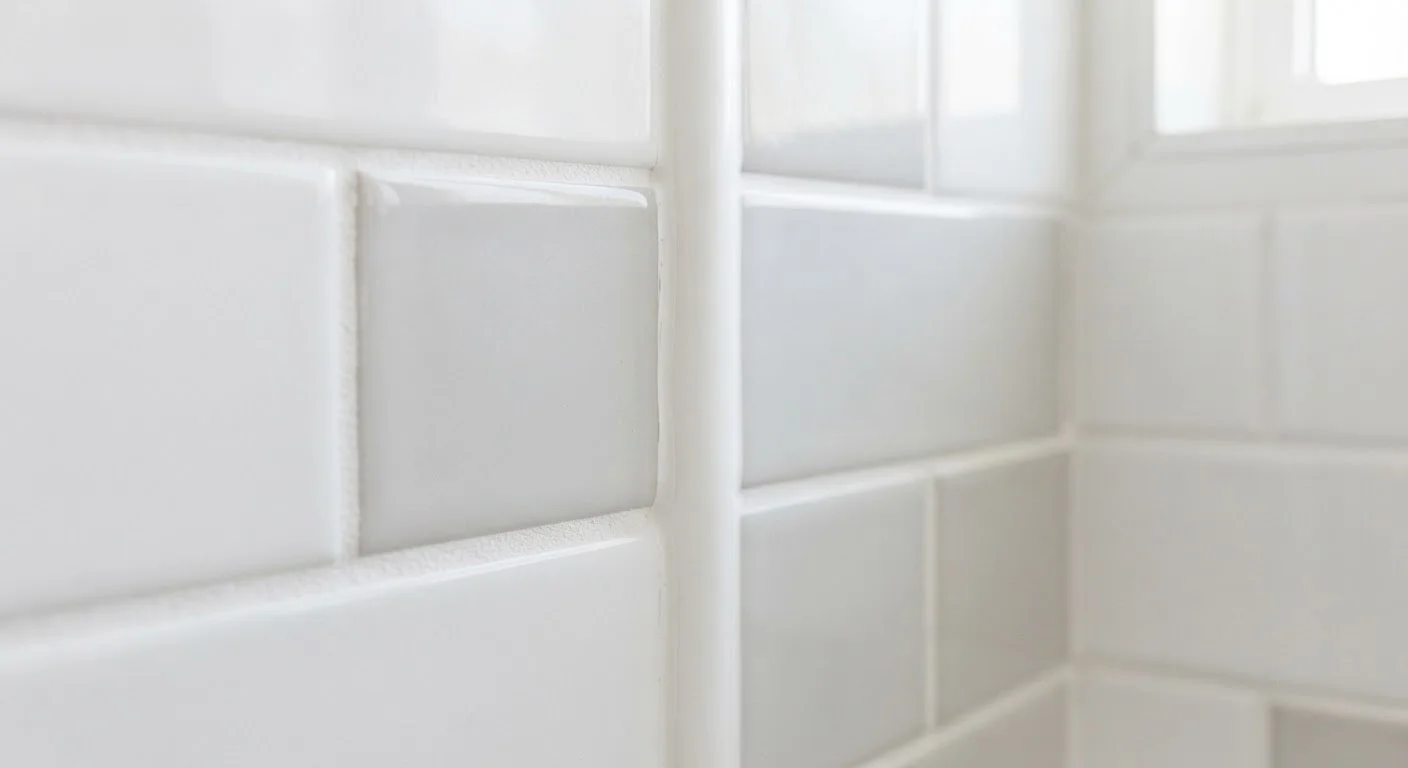
Option A
Grout
The rigid, durable standard for tile field joints.
Best for: Filling the uniform gaps between tiles on walls, floors, and backsplashes where surfaces don't flex or change planes.
Option B
Caulk
The flexible sealant built for movement and transitions.
Best for: Sealing joints at corners, plane changes, and fixture perimeters where slight movement or expansion occurs.
Why Getting This Wrong Costs You Later
Homeowners often treat grout and caulk as interchangeable - after all, both fill gaps between tiles. But they behave in fundamentally different ways, and placing either one in the wrong joint leads to predictable problems: cracking, water infiltration, and eventually mold or structural damage behind the tile.
Grout is a cement-based (or epoxy-based) material that cures hard and rigid. That rigidity is exactly what you need between tiles that are bonded to the same flat surface - it locks everything in place and resists foot traffic or wall impacts. But rigidity becomes a liability anywhere that slight movement occurs.
Caulk is a flexible polymer sealant - typically silicone or siliconized latex - that moves with the building. It stretches and compresses without breaking, which is why it's specified anywhere two different surfaces, planes, or materials come together. Understanding why caulk eventually fails helps you appreciate why its placement matters: even good caulk in the wrong location won't hold for long.
| Criterion | Grout | Caulk |
|---|---|---|
| Composition | Cement- or epoxy-based, rigid when cured | Silicone or latex polymer, flexible when cured |
| Movement tolerance | None - cracks under flex | High - stretches and compresses |
| Correct joint type | Field joints between tiles, same plane | Corners, plane changes, perimeter seams |
| Water resistance | Moderate (porous; requires sealing) | High when fully cured and intact |
| Typical lifespan | 10-20+ years with proper sealing | 5-10 years before reapplication needed |
| Difficulty to remove/repair | Requires grout saw or oscillating tool | Relatively easy with a utility knife |
| Color matching | Wide range of premixed colors | Color-matched options available from most grout brands |
Where Each Material Belongs
The industry rule is straightforward once you understand it: grout fills field joints; caulk fills change-of-plane joints and perimeter joints.
Use Grout For:
- Spaces between tiles on the same flat surface (floor field, wall field, backsplash field)
- Any joint that is uniform in width and surrounded entirely by tile on a single plane
- Decorative mosaic or pattern work where tiles share one bonded substrate
Use Caulk For:
- Inside corners where two tiled walls meet (the vertical seam in a shower corner)
- The joint where a tiled wall meets the bathtub rim, shower pan, or floor
- The seam where a backsplash meets the countertop
- Around fixtures - toilet bases, faucet escutcheons, and soap dish edges
- Any joint where tile meets a dissimilar material such as wood, drywall, or a metal threshold
In wet areas especially, getting this right matters beyond aesthetics. Many homeowners assume grout and tile alone repel water, but the reality is that perimeter joints are a primary entry point for moisture when sealed with the wrong material.
#1
Location where shower tile leaks originate
Building science research consistently identifies perimeter joints - not grout field joints - as the most common point of water infiltration in tiled showers.
5-10 yrs
Typical caulk lifespan in wet areas
Bathroom caulk in high-moisture environments generally requires reapplication every five to ten years, depending on product type and surface movement.
24-48 hrs
Minimum grout cure time before sealing
Most cement-based grout manufacturers recommend waiting at least 24 to 48 hours before applying a penetrating sealer, though cure times vary by product.
Practical Application Tips
Knowing which material goes where is only half the task. Applying either one correctly determines how long the installation holds up.
Grout Application
Work grout diagonally across tile joints using a rubber float, pressing firmly to pack the joints fully. Remove excess promptly with a damp sponge before it hardens on the tile face. Allow grout to cure fully before sealing - unsanded grout typically cures in 24 to 48 hours, though sanded grout and epoxy grout may require longer. Check the manufacturer's guidance for your specific product.
Caulk Application
Cut the caulk tube nozzle at a shallow angle - a smaller opening gives you better control. Apply in one steady pass without stopping. Smooth immediately with a wet finger or a caulk tool, then allow to cure undisturbed. Silicone caulk may take 24 hours or more to fully cure; keep the area dry during that time.
For color matching, most grout manufacturers now offer color-matched caulk products so that caulked corners blend visually with grouted field joints. This small investment goes a long way toward a professional-looking result.
Surface preparation matters just as much as material choice. Both grout and caulk require clean, dry, dust-free surfaces. In a repair situation, fully remove the old material - including any residue - before applying fresh filler. Similar principles apply to wall repairs: a fresh bond is always stronger than one applied over a compromised surface.
Epoxy Grout: A Special Case
Epoxy grout is an alternative to cement-based grout that offers superior stain resistance and doesn't require sealing. However, it still belongs only in field joints - it is rigid like standard grout and will crack in change-of-plane applications. Epoxy grout also has a shorter working time and can be harder to apply, so it's worth researching the technique before your first use.
The content provided on our blog site traverses numerous categories, offering readers valuable and practical information. Readers can use the editorial team’s research and data to gain more insights into their topics of interest. However, they are requested not to treat the articles as conclusive. The website team cannot be held responsible for differences in data or inaccuracies found across other platforms. Please also note that the site might also miss out on various schemes and offers available that the readers may find more beneficial than the ones we cover.