

Start here
Why Insulation Matters More Than Most Homeowners Realize
Learn the materials
The Main Types of Insulation and Where Each Is Used
Understand the rating system
Understanding R-Value: The Number That Guides Every Decision
Map your home
Where Insulation Goes in a Home
Decide your approach
DIY vs. Professional Installation: Knowing the Line
Why Insulation Matters More Than Most Homeowners Realize
Insulation does one fundamental job: it slows the movement of heat. In winter, it keeps warmth inside. In summer, it keeps radiant heat out. That single function affects your monthly energy bills, the air quality in your home, and how evenly comfortable every room feels year-round.
Most homes - particularly those built before the 1980s - are under-insulated by today's standards. Upgrading insulation is consistently cited by energy professionals as one of the highest-return improvements a homeowner can make. For a broader look at improvements with lasting financial benefit, see our article on energy efficiency upgrades that pay for themselves.
Insulation also plays a secondary role in moisture and air quality management. When properly installed alongside good air sealing, it reduces drafts, limits condensation points, and can help keep allergens and outdoor pollutants from infiltrating living spaces.
Insulation and Indoor Air Quality
A well-insulated, tightly sealed home needs intentional ventilation to maintain healthy indoor air quality. If you're significantly upgrading your insulation and air sealing, talk to a contractor about whether mechanical ventilation - such as a heat recovery ventilator (HRV) - is appropriate for your home. Building tighter without planning for fresh air exchange can concentrate pollutants indoors.
The Main Types of Insulation and Where Each Is Used
Not all insulation is the same material or format. Each type has a distinct application.
Thermal envelope
The boundary of walls, roof, floor, windows, and doors that separates your conditioned living space from the outside. Insulating this boundary well is the core goal of any energy-efficiency project.
R-value
A measure of how well a material resists heat flow. Higher R-values mean better insulating performance per inch of thickness.
Air sealing
The process of blocking gaps, cracks, and penetrations in a home's structure that allow air - and heat - to move freely in or out. Works hand-in-hand with insulation.
Vapor barrier
A material (often plastic sheeting or foil facing) placed on the warm side of insulation to slow the movement of moisture vapor, which can otherwise condense inside walls and cause mold.
Rim joist
The horizontal band of framing lumber that sits on top of the foundation wall, enclosing the floor structure. It's a frequent source of drafts and heat loss in older homes.
Dense-pack
A blown-in insulation technique where material is packed tightly into closed wall cavities through small access holes, creating both thermal resistance and an air barrier.
- Fiberglass batts - The familiar pink or yellow rolls sold at home improvement stores. They're sized to fit between standard wall studs and floor joists, making them a practical choice for open-stud walls during a renovation or new build.
- Mineral wool (rock wool) batts - Similar in form to fiberglass but denser, more resistant to fire, and slightly better at blocking sound. Often used in party walls and around mechanical rooms.
- Blown-in (loose-fill) cellulose or fiberglass - Shredded material blown in with a machine, ideal for filling attic floors evenly or reaching into tight cavities without tearing out walls. Cellulose is made from recycled paper and treated for fire resistance.
- Rigid foam board - Sheets of polystyrene or polyisocyanurate used where moisture resistance matters: basement walls, exterior sheathing, and under concrete slabs. Provides continuous coverage without gaps at studs.
- Spray polyurethane foam (SPF) - Applied as a liquid that expands and hardens. Two-component spray foam creates an air barrier alongside thermal resistance, making it highly effective - but it requires professional application due to hazardous off-gassing during installation.
Understanding R-Value: The Number That Guides Every Decision
R-value measures a material's resistance to heat flow. The higher the R-value, the more effectively the material slows heat transfer. Every insulation product carries an R-value per inch, and total R-value depends on how thick the material is installed.
R-value requirements vary by climate zone and by where in the home the insulation is installed. Attics, being the most vulnerable surface area, typically require the highest values - often R-38 to R-60 in colder regions. Walls commonly call for R-13 to R-21. Basement walls and crawl spaces have their own requirements. The U.S. Department of Energy publishes zone-based recommendations that are a useful starting reference.
One important caveat: R-value only measures conductive heat resistance. It doesn't account for convective heat loss through air leaks. This is why insulation and air sealing around doors and windows must be addressed together for real results. For a plain-language definition of R-value alongside other key terms, see the home improvement glossary.
Pair Insulation With Air Sealing
Insulation slows heat conduction, but air leaks carry heat right past it. Before adding insulation in an attic, seal around light fixtures, plumbing penetrations, and top plates with caulk or canned foam. This combination delivers far better results than insulation alone.
Where Insulation Goes in a Home
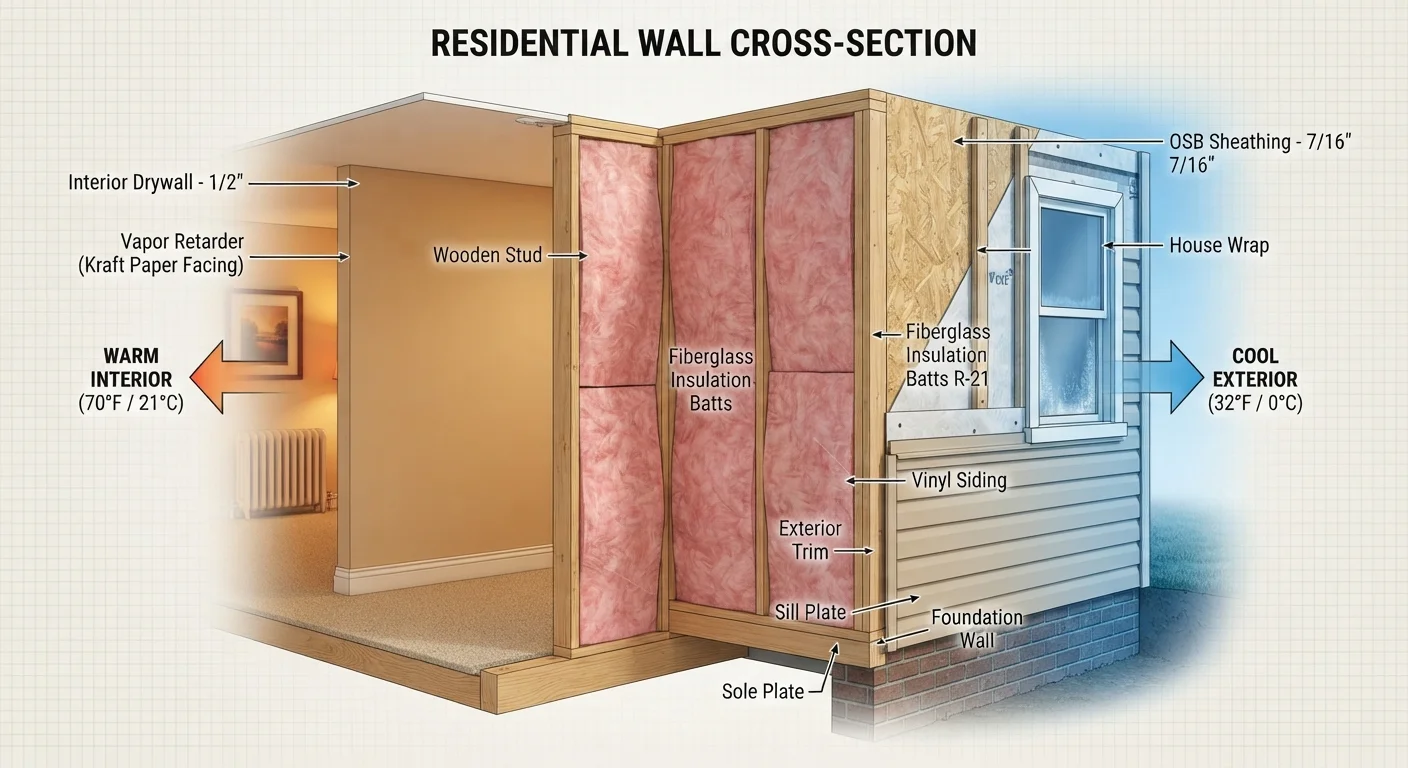
A home's thermal envelope - the boundary between conditioned interior space and unconditioned exterior - is the framework for deciding where insulation belongs.
- Attic floor or roof deck: The attic is where heat escapes fastest. Blown-in insulation over joists or batts between rafters are common approaches depending on whether the attic is vented or unvented.
- Exterior walls: Fiberglass or mineral wool batts fit into open-stud cavities during construction or renovation. Existing closed walls can be retrofitted with dense-pack blown-in insulation through small holes drilled from the exterior.
- Basement walls and rim joists: Rigid foam or spray foam is well-suited here because moisture resistance is critical. The rim joist - the band of wood sitting atop the foundation - is a common heat-loss culprit and is often overlooked.
- Crawl spaces: Insulation goes between floor joists above an open crawl space. In sealed crawl spaces, rigid foam on the walls is more effective.
- Under slabs: New construction sometimes includes rigid foam beneath concrete floors for improved ground-floor comfort.
Keeping up with the condition of these systems is part of good year-round home care - see our seasonal maintenance checklist for a practical framework.
DIY vs. Professional Installation: Knowing the Line
Some insulation work is genuinely manageable for a prepared homeowner. Other tasks carry risks that make professional help the right call.
Generally DIY-accessible:
- Adding batts to an accessible attic floor with existing joists
- Replacing or adding faced batts in an open basement ceiling
- Installing rigid foam board on an interior basement wall (with appropriate fire-rated drywall cover afterward)
- Sealing small gaps with canned spray foam at penetrations and rim joists
Leave to a licensed professional:
- Two-component spray polyurethane foam - requires specialized equipment and respiratory protection
- Dense-pack blown-in for closed wall cavities - done improperly, it can bow or crack wall surfaces
- Any work near electrical panels, knob-and-tube wiring, or recessed can lights - fire hazards and code issues apply
- Attic insulation over or near existing mechanical systems
Before starting any project, check with your local building department about permit requirements. Many jurisdictions require permits for significant insulation upgrades, and a home energy audit can help you prioritize where the most impactful work lies. Good insulation also complements a well-maintained HVAC system - a topic covered in our guide to HVAC filters and ratings.
This article is for general informational purposes only. Consult a licensed contractor or building professional before beginning any insulation project, particularly work involving electrical systems, gas lines, or structural elements.
Frequently Asked Questions
Common signs include uneven room temperatures, high heating or cooling bills, and walls or floors that feel cold to the touch in winter. An energy auditor can use a blower door test and thermal imaging to pinpoint exactly where heat is escaping.
In most cases, yes - particularly in attics. You can lay new batts or blown-in insulation over existing material as long as the existing insulation is dry, undamaged, and not compressed. Always check for moisture or mold before adding more.
Insulation does reduce sound transmission between rooms and from outside, but its primary purpose is thermal resistance. Dense-pack cellulose and mineral wool perform noticeably better for sound control than standard fiberglass batts.
The U.S. Department of Energy recommends attic insulation levels between R-38 and R-60 for most climate zones, with colder northern climates needing higher values. Your local building department can confirm what's required for your area.
Fully cured spray foam is generally considered inert and safe. However, during and immediately after application it releases fumes that require proper ventilation and respiratory protection. Installation should be handled by trained professionals.
Requirements vary by location. Adding insulation to an existing attic often requires no permit, but new construction or significant renovation work typically does. Always check with your local building department before starting.
The content provided on our blog site traverses numerous categories, offering readers valuable and practical information. Readers can use the editorial team’s research and data to gain more insights into their topics of interest. However, they are requested not to treat the articles as conclusive. The website team cannot be held responsible for differences in data or inaccuracies found across other platforms. Please also note that the site might also miss out on various schemes and offers available that the readers may find more beneficial than the ones we cover.