

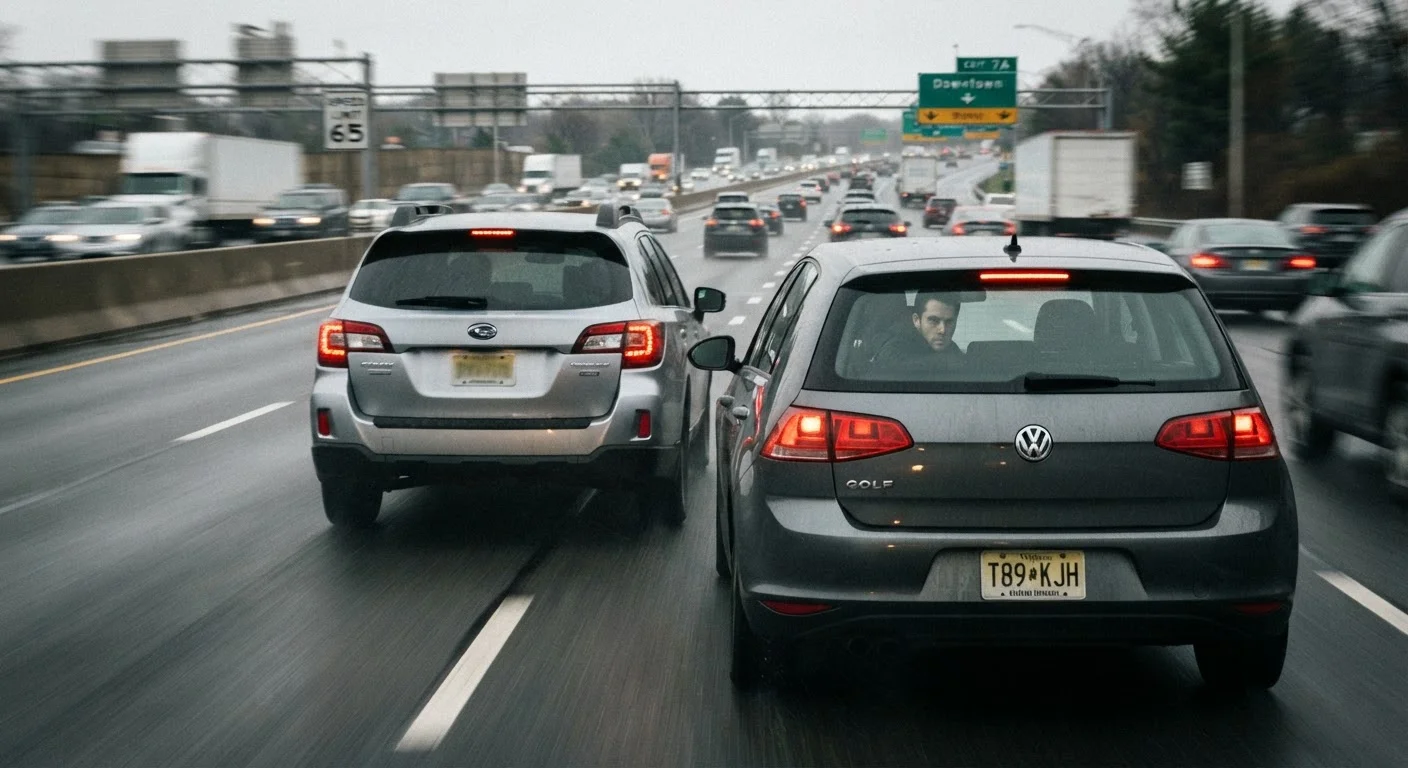
The Real Cost of Following Too Closely
Rear-end collisions are one of the most frequently reported crash types on American roads, and following too closely is consistently identified as a leading contributing factor. Despite this, many drivers treat a short following gap as a minor habit rather than a genuine hazard. The physics of stopping distance tell a different story.
When a driver decides to brake, two things happen before the vehicle slows at all. First, there is perception time - the fraction of a second between seeing a hazard and registering it consciously. Then comes reaction time - the physical act of moving a foot from the accelerator to the brake pedal. Combined, these typically consume between 1.5 and 2.5 seconds. At 60 mph, a vehicle travels roughly 88 feet every second. That means a car can cover well over 150 feet before braking even begins.
Add actual braking distance on top, and total stopping distance at 60 mph on dry pavement can exceed 300 feet for a typical passenger vehicle. Most tailgating drivers are operating with a gap of 50 feet or less - a fraction of what physics demands.
~29%
Share of US crashes involving rear-end collisions
Rear-end crashes are consistently among the most common crash types reported in federal traffic safety data, with following-too-closely cited as a primary factor.
300+ ft
Typical total stopping distance at 60 mph
On dry pavement with average perception and reaction time, a standard passenger vehicle requires well over 300 feet to come to a complete stop from 60 mph.
1.5-2.5 sec
Average driver perception-reaction time
Traffic safety research places typical combined perception and reaction time in this range, translating to significant travel distance before braking begins.
Understanding this gap between perception and pavement is the foundation of defensive driving - recognizing that hazards rarely give advance warning.
Common Myths About Tailgating - Corrected
Despite the clear physics, a range of persistent myths lead drivers to underestimate the danger of tailgating. The following myth-fact pairs address the most common ones directly.
Myth
If you can see the car in front of you clearly, you're leaving enough space.
Fact
Visibility has little to do with stopping distance. A clear view does not reduce the time your vehicle needs to stop.
Seeing a vehicle clearly gives you no extra stopping room. What matters is the physical gap between your front bumper and the vehicle ahead. At 65 mph, even a driver who reacts instantly needs hundreds of feet to stop - far more than most drivers judge visually. Human beings consistently underestimate speed-related distances, which is why a gap that looks comfortable can be dangerously small.
Myth
Tailgating only matters at high speeds - in city traffic it's fine to follow closely.
Fact
Low-speed rear-end collisions cause a large share of whiplash injuries and property damage claims every year.
City and suburban driving involves frequent sudden stops at intersections, school zones, and crosswalks - often with less predictability than highway driving. A driver following one car length behind at 30 mph has minimal margin if the car ahead stops abruptly for a pedestrian or a light change. Whiplash injuries from low-speed impacts can be serious and long-lasting, and repair costs from even minor rear-end collisions are significant.
Myth
Experienced drivers can follow more closely because their reaction times are faster.
Fact
Human reaction time varies within a relatively narrow range regardless of experience. Experience improves hazard anticipation, not reflexes.
Even trained racing drivers have reaction times measured in fractions of a second - not dramatically different from everyday drivers. What experience genuinely improves is hazard reading: noticing brake lights two cars ahead, recognizing risky situations earlier, and maintaining safer gaps instinctively. Experienced defensive drivers typically leave more space, not less, precisely because they understand stopping physics better.
Myth
Staying close behind another vehicle puts pressure on them to move faster or change lanes, solving the problem.
Fact
Tailgating as a pressure tactic routinely backfires and escalates into dangerous situations or road rage incidents.
Research on driver behavior indicates that drivers who feel pressured from behind often slow down, brake unpredictably, or become distracted - the opposite of the intended outcome. Beyond ineffectiveness, using following distance as a social pressure tool is classified as aggressive driving and can trigger road rage escalation in other drivers. It also places the tailgating driver at maximum legal and financial liability if a crash occurs. See where aggressive driving ends and road rage begins for more context.
Myth
Modern vehicles with automatic emergency braking (AEB) make following distance less important.
Fact
AEB systems reduce crash severity in some situations but are not a substitute for adequate following distance and have well-documented limitations.
Automatic emergency braking (AEB) is a valuable safety aid, but manufacturers and safety regulators consistently emphasize that it is a supplemental system - not a replacement for attentive driving. AEB performance varies across vehicle models and conditions; systems can be less effective in heavy rain, snow, low light, or when the vehicle ahead is stationary. Relying on AEB to compensate for tailgating puts both driver and technology in a situation neither is designed to handle safely.
Conditions That Make Tailgating Even More Dangerous
Dry daylight conditions represent the best-case scenario for stopping distance. In practice, roads are frequently wet, visibility is reduced, or drivers are fatigued - all of which extend stopping distance and compress the margin for error.
On wet pavement, braking distances can increase by 50% or more compared to dry roads. On ice or snow, they can multiply several times over. Night driving adds reduced depth perception and slower hazard recognition to the equation, compounding an already tight stopping window.
Heavy vehicles such as trucks and SUVs also require longer stopping distances than compact cars due to greater momentum, meaning the vehicle behind a large truck needs an even larger gap - not a smaller one.
Wet and Icy Roads Demand Far Larger Gaps
On wet pavement, stopping distances can increase by 50% or more compared to dry conditions. On ice or packed snow, braking distances may multiply several times over, making even a three-second gap dangerously short. If conditions are poor, increase your following distance substantially - four to six seconds or more - and reduce speed before curves and intersections where stopping demand is highest.
Distraction compounds the problem significantly. A driver who is mentally elsewhere - daydreaming, adjusting navigation, or eating - may add another full second or more to perception-reaction time. That extra second at highway speed equals roughly another 90 feet of travel before braking starts. For more on how distraction operates beyond phone use, see why distracted driving isn't just about phones.
Using the Two-Second Rule - and When to Exceed It
The two-second following rule is the standard minimum taught in driver education across the US. To apply it, pick a fixed point on the road ahead - a sign, a lane marking - and count from the moment the vehicle in front passes it. If your vehicle reaches that same point before you finish counting two full seconds, you are too close.
Critically, two seconds is a dry-road, alert-driver minimum. Safety organizations and traffic engineers broadly recommend three to four seconds in adverse conditions, and even longer in heavy rain, fog, or on gravel surfaces. When towing a trailer, hauling a heavy load, or driving a vehicle with worn brakes, extending that gap further is prudent.
Tailgating is also classified as aggressive driving in many US jurisdictions - not merely a courtesy issue. Traffic laws in numerous states explicitly prohibit following too closely, and violations can carry fines, points on a license, and potential civil liability in a crash. Habitual tailgating often reflects broader patterns of aggressive road behavior that erode overall driver safety.
For a clear reference on how following distance rules interact with speed limits and right-of-way, see our quick rules reference for everyday traffic situations.
This article provides general driver safety information for educational purposes. Always follow applicable traffic laws and consult official state driving resources for jurisdiction-specific requirements.
The content provided on our blog site traverses numerous categories, offering readers valuable and practical information. Readers can use the editorial team’s research and data to gain more insights into their topics of interest. However, they are requested not to treat the articles as conclusive. The website team cannot be held responsible for differences in data or inaccuracies found across other platforms. Please also note that the site might also miss out on various schemes and offers available that the readers may find more beneficial than the ones we cover.