

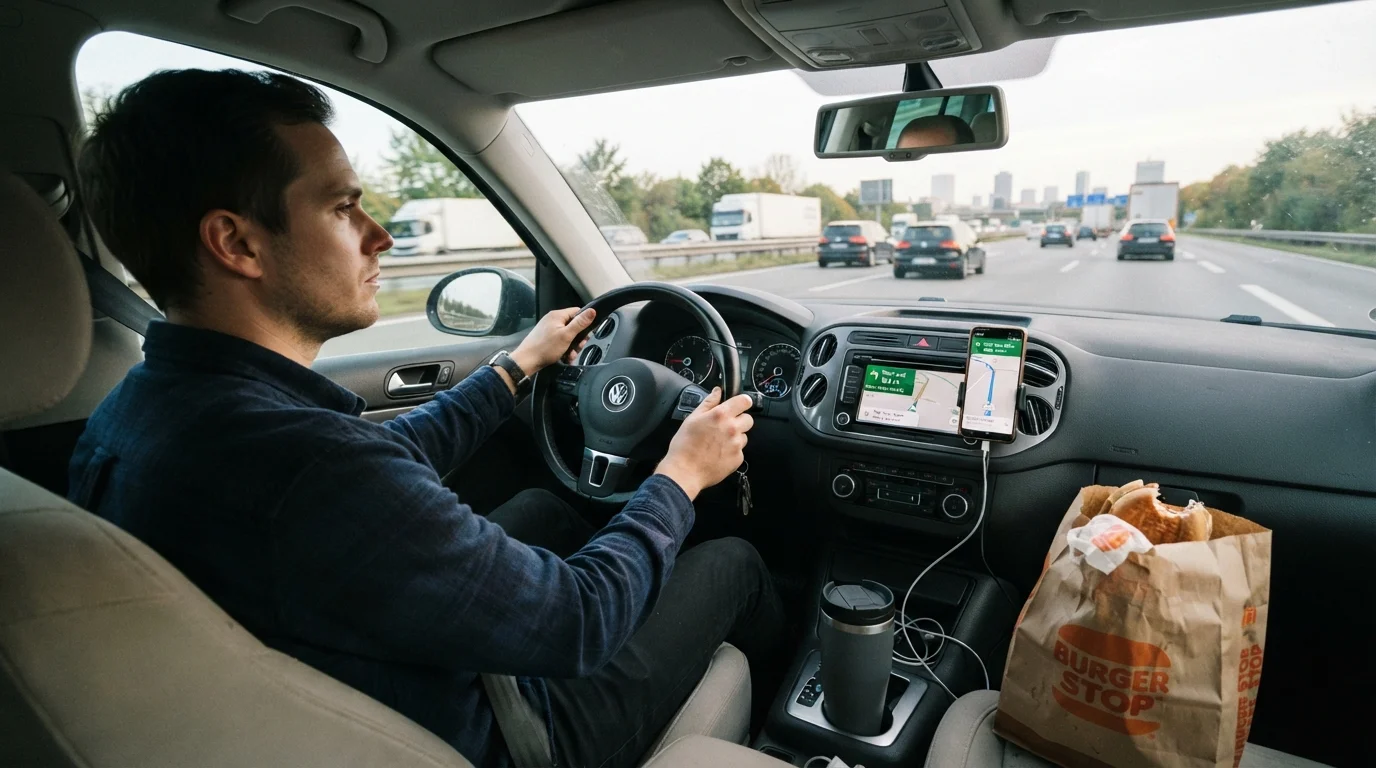
The Distraction Problem Is Broader Than the Headlines Suggest
Anti-distraction campaigns have done important work spotlighting phone use, but narrowing the conversation to a single device understates the problem significantly. Distracted driving is defined by what happens to attention - not by which object interrupts it. Every year, crashes involving drivers who were eating, talking to passengers, daydreaming, or fiddling with climate controls contribute to thousands of preventable injuries and fatalities across the United States.
Understanding distraction as a category - with visual, manual, and cognitive dimensions - helps drivers identify risks they may have been dismissing entirely. The myths below address the most common and consequential misconceptions.
Myth
Distracted driving is essentially a smartphone problem. If you put your phone down, you're driving safely.
Fact
Phones are one source of distraction among many. Eating, grooming, adjusting the radio, talking to passengers, and internal daydreaming all impair driving performance.
Smartphones receive the most media and legislative attention, but the NHTSA categorizes distraction into three types: visual (eyes off the road), manual (hands off the wheel), and cognitive (mind off the task of driving). A driver eating a sandwich scores high on all three. A driver arguing with a passenger can be severely cognitively distracted with both hands on the wheel and eyes forward. Treating phone abstinence as the complete solution gives drivers a false sense of security.
Myth
Glancing away for just one or two seconds is too brief to be dangerous at normal speeds.
Fact
At 55 mph, a two-second glance covers roughly 160 feet - more than half the length of a standard city block - with no meaningful driver input.
Speed transforms brief inattention into large uncontrolled distances. At highway speed, a driver looking down to unwrap a snack or check a navigation prompt for two seconds travels the equivalent of a 16-story building's height without watching the road. Obstacles, braking traffic, or pedestrians can appear and require a response in that span. This is why transportation researchers emphasize that there is no truly "safe" moment to look away while moving at speed.
Myth
Built-in infotainment systems are designed for drivers, so using them while moving is perfectly safe.
Fact
In-vehicle touchscreens and voice systems can demand significant visual and cognitive attention, sometimes more than a handheld phone.
AAA Foundation research has found that some built-in voice-command systems impose higher cognitive workload than a handheld phone call due to system errors, confusing prompts, and multi-step interactions. Entering a destination into a navigation system while driving is one of the most distracting tasks a driver can perform. The safest practice is to set navigation and media preferences before moving, treating any mid-drive interaction as a genuine risk rather than a design-endorsed convenience.
Myth
Daydreaming or "zoning out" at the wheel isn't really distraction - your body is still driving.
Fact
Mind-wandering is a form of cognitive distraction that impairs hazard detection, reaction time, and decision-making even when a driver looks straight ahead.
Studies examining eye-tracking data show that a cognitively distracted driver can appear to scan the road normally while actually processing very little of what their eyes capture - a phenomenon sometimes called "looked but failed to see." Fatigue, stress, and monotonous highway driving all increase the likelihood of mind-wandering. This overlap between distraction and drowsiness is why both are treated as serious crash risk factors. Our related guide on driver fatigue covers how to recognize when your alertness has dipped below safe levels.
Myth
If you've been driving for years without an incident while multitasking, you must be good at it.
Fact
Experience does not confer immunity to distraction. Crash-free years are partly a product of chance and low-traffic exposure, not verified multitasking skill.
Human beings are poor judges of their own cognitive capacity while distracted. Research consistently shows that people who rate themselves as skilled multitaskers tend to perform worse on objective attention-task tests than those who rate themselves as average. Long driving experience improves certain automatic skills - steering, lane-keeping on familiar roads - but does not improve the brain's ability to process two demanding streams of information simultaneously. Habitual distraction is one of the quiet habits that gradually erode road safety without any obvious warning sign until something goes wrong.
Practical Steps That Address All Types of Distraction
Once drivers recognize that distraction extends well beyond phones, a few habits help manage the full spectrum of risk:
- Set up before you move: Program navigation, adjust mirrors, connect Bluetooth, and settle passengers and pets before pulling into traffic.
- Eat before or after the trip: Drive-through food is a leading source of mid-drive visual and manual distraction. Parking to eat adds only minutes but removes a meaningful risk.
- Use conversation awareness: Emotionally intense conversations - arguments, difficult news, stressful work calls - impose heavy cognitive loads. It's reasonable to pause a call or delay a hard conversation until the vehicle is stationary.
- Recognize fatigue as a distraction amplifier: Tired drivers are more prone to mind-wandering and slower to notice when their attention has slipped. Our article on night driving challenges covers how fatigue compounds visibility problems after dark.
Hands-Free Doesn't Mean Risk-Free
Many drivers assume switching to a Bluetooth headset or voice-activated system eliminates distraction. It doesn't. Studies indicate that hands-free phone conversations still meaningfully slow reaction time and narrow a driver's field of attention. Reserving non-essential calls for when the vehicle is parked remains the safest habit.
Similarly, the risk of following too closely compounds when a driver is distracted - reduced attention means reduced reaction time, which demands even more stopping distance. See our guide on why tailgating is more dangerous than most drivers realize for the physics behind safe following gaps.
Distraction Doesn't Require a Device
Research from the AAA Foundation for Traffic Safety identifies cognitive distraction as dangerous even when both hands are on the wheel and eyes are on the road. A driver mentally rehearsing a conversation or worrying about work can miss stop signs, pedestrians, and lane changes. No device needs to be present for impairment to occur.
Building genuine attentional habits - not just avoiding a specific device - is what moves a driver from compliant to consistently safe.
The content provided on our blog site traverses numerous categories, offering readers valuable and practical information. Readers can use the editorial team’s research and data to gain more insights into their topics of interest. However, they are requested not to treat the articles as conclusive. The website team cannot be held responsible for differences in data or inaccuracies found across other platforms. Please also note that the site might also miss out on various schemes and offers available that the readers may find more beneficial than the ones we cover.