

Our Verdict
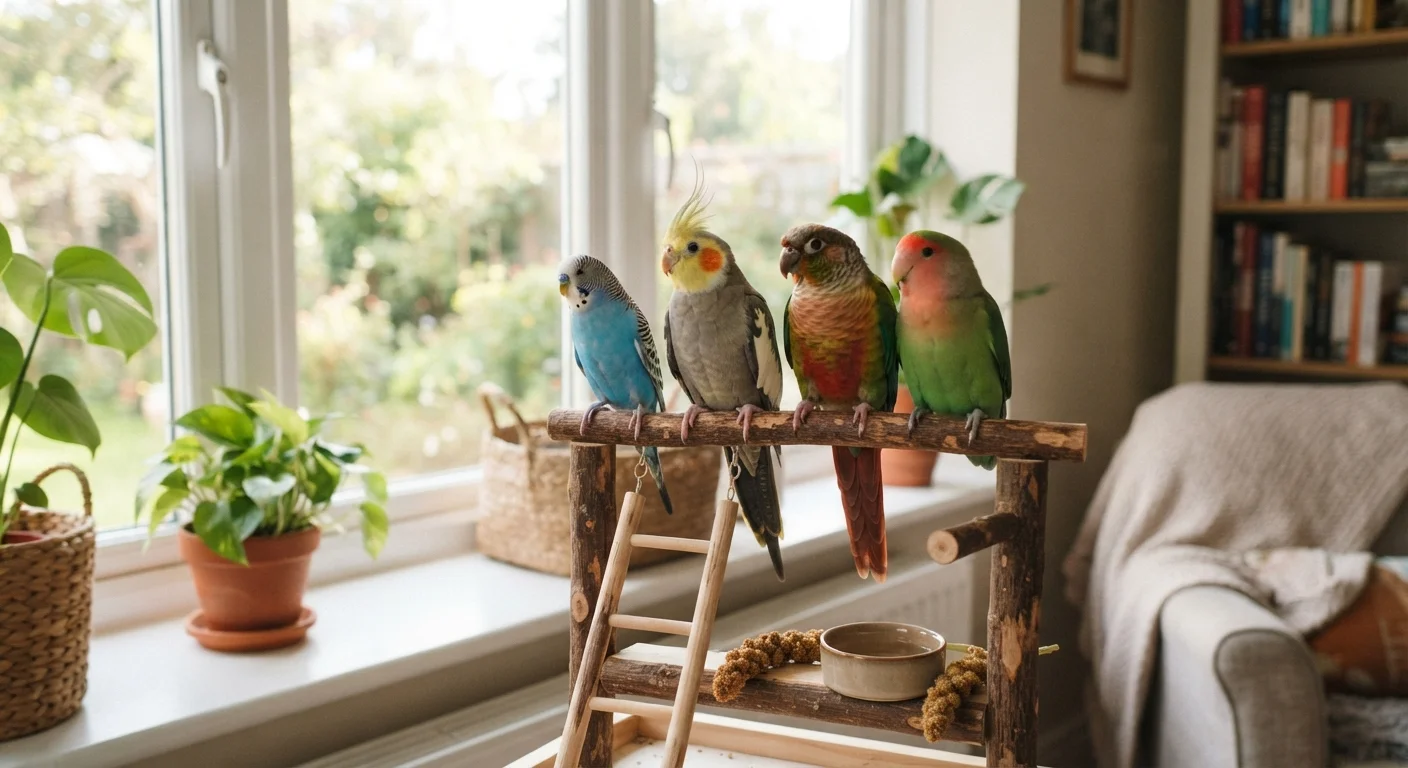
No single bird species is universally best - the right match depends on your living space, household noise tolerance, and how much daily interaction you can offer. Budgies suit space-limited or quieter households; cockatiels offer a gentle middle ground; lovebirds work for committed solo-bird owners; and conures fit active households ready for high energy.
| Best for | Recommended |
|---|---|
| Apartment dwellers or noise-sensitive households | Budgie |
| First-time bird owners wanting a calm, affectionate companion | Cockatiel |
| Owners who can give consistent one-on-one daily attention | Lovebird |
| Active households comfortable with a bold, vocal personality | Conure |
Why Species Choice Matters Before You Bring a Bird Home
Choosing a pet bird isn't just about which one looks appealing at the shop. Each species carries a distinct personality profile - and mismatches between bird behavior and household environment are among the most common reasons birds are surrendered to rescues. Before you commit, it's worth mapping your daily schedule, home layout, and noise tolerance against what each species genuinely needs.
The four species covered here - budgies (parakeets), cockatiels, lovebirds, and conures - are among the most popular pet birds in American households. They're all manageable in size, but they are not interchangeable. Use this comparison to find the closest fit, then work through a preparation checklist to confirm your home is genuinely ready.
Species Comparison: Noise, Space, and Social Needs at a Glance
The table below summarizes key traits across the four species. Use it as a starting framework - individual bird personalities always vary, and early socialization plays a significant role in behavior.
| Budgie | Cockatiel | Lovebird | Conure | |
|---|---|---|---|---|
| Noise Level | Low - soft chirps | Moderate - melodic whistles | Moderate-high - sharp chirps | High - loud, persistent calls |
| Minimum Cage Size (per bird) | 18" × 18" × 18" | 24" × 18" × 24" | 24" × 18" × 24" | 24" × 24" × 30" |
| Social Needs | Flock-oriented; pairs preferred | Adaptable; solo or paired | Intense bonding; needs daily attention | Highly social; craves constant interaction |
| Ideal for Apartments | Yes | Generally yes | With caution | Usually no |
| Lifespan (approximate) | 7-15 years | 15-20 years | 10-15 years | 15-30 years (species-dependent) |
| Difficulty for First-Time Owners | Low | Low-moderate | Moderate | Moderate-high |
| Talking Ability | Some mimicry, quiet voice | Whistles and some words | Rare, limited | Good mimicry in some species |
Noise Level: What Each Species Actually Sounds Like
Budgies are the quietest of the four. Their vocalizations are chirpy and conversational - pleasant background sound for most households. They can learn to mimic words, though their voice is soft. Ideal for apartments or homes with thin walls.
Cockatiels are moderate in volume. Males are particularly prone to whistling and calling, especially at dawn and dusk. The noise is melodic rather than harsh, but it is persistent. Most neighbors in a house won't be bothered; apartments may be trickier.
Lovebirds are surprisingly loud for their small size. They produce sharp, high-pitched chirps and can be persistent when they want attention. Don't let the compact frame fool you - lovebirds punch above their weight in the sound department.
Conures are the loudest of this group. Green cheek conures are on the quieter end within the conure family, but sun conures and jenday conures produce a screech that can carry through walls. If your household or building has low noise tolerance, a conure requires serious consideration.
Test Your Noise Tolerance Before Committing
If possible, spend time with the species you're considering at a bird rescue or avian sanctuary before adopting. Hearing a sun conure's call in person - rather than through a video - often changes a prospective owner's mind quickly. Rescues often allow supervised visits, and the staff can walk you through what daily noise levels realistically look and sound like in a home setting.
Space and Cage Requirements
Cage size is often underestimated. A bird spends the majority of its life in or immediately around its cage, so this is a welfare priority, not a luxury.
- Budgies: Minimum cage dimensions of roughly 18" wide × 18" deep × 18" tall for one bird, longer is better than taller since they fly horizontally. A pair needs proportionally more width.
- Cockatiels: At least 24" × 18" × 24" per bird, with horizontal bar spacing no greater than ¾ inch to prevent head entrapment.
- Lovebirds: Similar footprint to cockatiels; bar spacing of ½ inch is critical given their smaller heads and tendency to squeeze.
- Conures: Larger conure species need cages of at least 24" × 24" × 30" - more for sun or jenday conures who are active and need room to move.
All four species require daily out-of-cage time in a bird-safe room. This is not optional. Consult an avian vet about flight time recommendations appropriate for your specific bird's health and wing condition. If your home has cats, dogs, or young children, review how to keep small pets safe in a shared household before allowing free flight.
Social Needs: Alone, Paired, or Flock-Minded?
Budgies are naturally flock birds and generally do best in pairs or small groups. A single budgie can thrive with significant human interaction, but a bonded pair is often more behaviorally stable - and they entertain each other when you're busy.
Cockatiels are adaptable. They bond closely with humans and can live happily as solo birds with consistent attention. They also do well in pairs, though two males may occasionally compete through singing rather than aggression.
Lovebirds have a complicated reputation. Contrary to popular belief, a single lovebird can form a strong bond with its owner - but only if that owner provides frequent, daily interaction. A neglected solo lovebird may become territorial or feather-destructive. Bonded pairs, however, can sometimes redirect all social interest toward each other and become less handleable.
Conures crave attention and can become demanding if their social needs aren't met. They're among the most interactive of these four species and thrive in households where someone is home for much of the day. Screaming behavior in conures is often a response to perceived abandonment or boredom, not innate temperament.
All four species benefit from mental enrichment - foraging toys, rotating perch textures, and puzzle feeders. Enrichment reduces stress-related behaviors across every species listed here.
Making Your Final Decision
Honest self-assessment is more useful than enthusiasm when choosing a bird. Ask yourself: How many hours per day is someone genuinely home? Does your building have noise rules? Do you have other pets that could pose a risk during free-flight time? Are you prepared for a 10-20+ year commitment depending on species?
Once you've matched a species to your situation, an avian veterinarian should be your first call - not just for health checks but for species-specific husbandry guidance. Diet, lighting, humidity, and sleep schedules all differ by species and significantly affect long-term health.
If you're still working through your overall small-pet setup, the housing considerations explored in the rabbit hutch vs. free-roam comparison illustrate how environment design shapes animal welfare - the same principle applies fully to birds.
This article is for general informational purposes only and does not constitute veterinary advice. Always consult a licensed avian veterinarian for guidance specific to your bird's health, diet, and care needs.
The content provided on our blog site traverses numerous categories, offering readers valuable and practical information. Readers can use the editorial team’s research and data to gain more insights into their topics of interest. However, they are requested not to treat the articles as conclusive. The website team cannot be held responsible for differences in data or inaccuracies found across other platforms. Please also note that the site might also miss out on various schemes and offers available that the readers may find more beneficial than the ones we cover.