

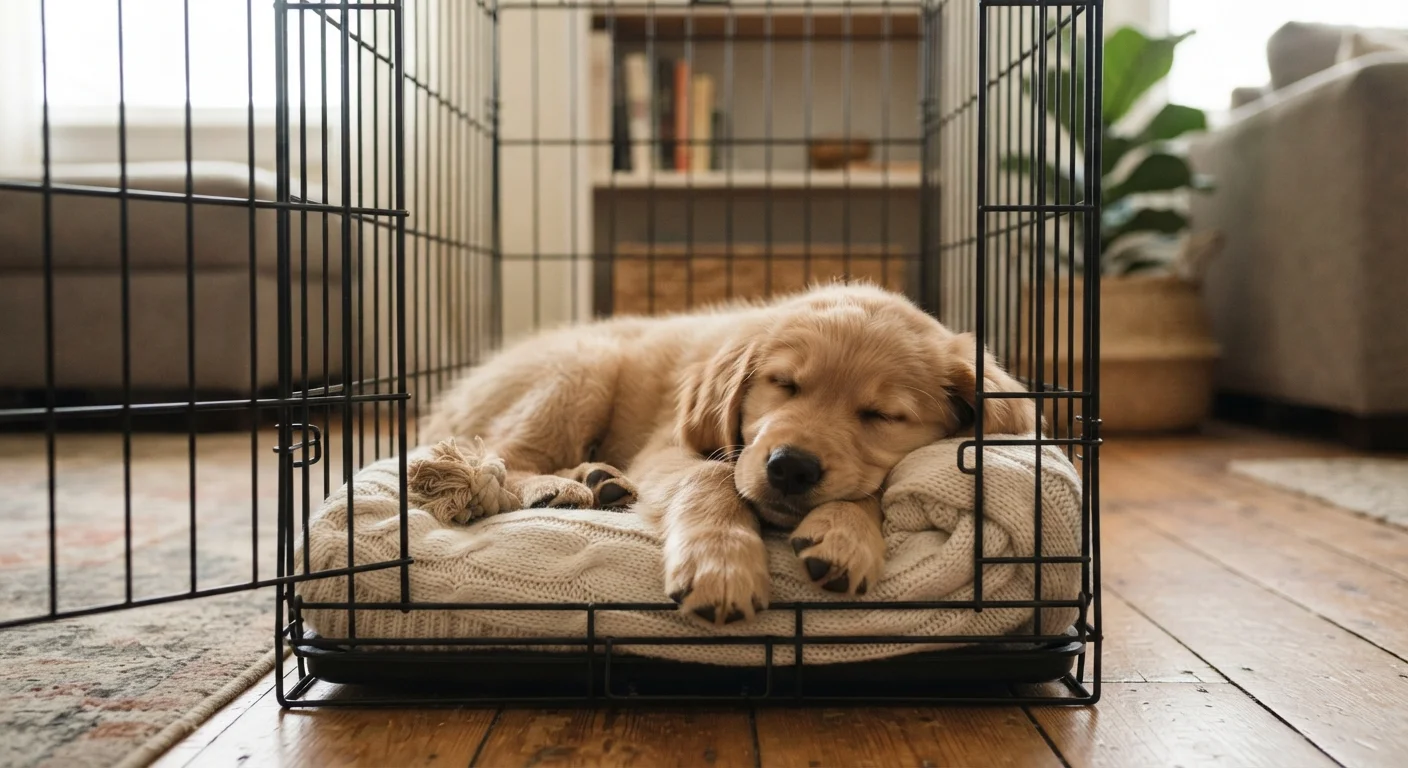
Why Crate Training Gets a Bad Reputation
Few dog training topics generate as much emotional debate as crate training. Many well-meaning owners picture a cramped cage and assume their dog must feel imprisoned. That instinct comes from a good place - no one wants to cause their pet distress - but it often leads owners to skip a tool that, used correctly, builds a dog's confidence and supports faster housetraining.
The myths surrounding crates don't just cause hesitation; they can lead owners to make concrete mistakes that genuinely do make the process harder. Understanding what the evidence actually says helps you avoid those pitfalls and set your dog up for success from day one.
Before diving in, keep in mind that crate training is a skill that benefits from patience and positive reinforcement principles. The two go hand in hand.
Myth
Crates are cruel - putting a dog in one is the same as punishing or imprisoning them.
Fact
Dogs are descended from den-dwelling animals. A properly sized, comfortably fitted crate satisfies a natural instinct for a safe, enclosed resting space.
The 'crate as cage' comparison assumes dogs experience confinement the way humans would. In practice, many dogs actively seek out small, enclosed spaces - under beds, behind furniture, inside closets. A crate replicates that denning instinct rather than working against it. The key word is properly introduced: a crate that a dog has been gradually acclimated to typically becomes a self-chosen retreat, not a source of fear.
Myth
You can only crate train a puppy - adult dogs are too set in their ways to accept one.
Fact
Dogs can learn to accept and enjoy a crate at any age. Adult dogs often adapt with less difficulty than young puppies because they have better impulse control.
Puppies get the most press around crate training because housetraining is urgent early on, but adult dogs are fully capable of learning new associations. An older dog may actually settle more calmly because they're past the high-energy, easily-distracted puppy phase. The process is the same at any age: gradual introduction, positive associations, and short initial sessions that expand over time.
Myth
A bigger crate is always more comfortable and kinder to the dog.
Fact
A crate that's too large can undermine housetraining because dogs will sleep in one corner and eliminate in another.
For housetraining purposes, the crate should be just large enough for the dog to stand up, turn around, and lie down comfortably. When dogs have excess space, they lose the natural reluctance to soil their sleeping area - which is the behavioral mechanism that makes crate training effective for housetraining. Many wire crates include a divider panel specifically for this reason, allowing the space to grow with the dog.
Myth
If a dog cries or whines in the crate, you should ignore it completely - comforting them only reinforces the behavior.
Fact
Distress in the crate usually signals that the introduction was moved forward too quickly, not that the dog is 'manipulating' you.
The advice to ignore all crate vocalizations is a persistent oversimplification. Persistent, escalating distress - not the occasional whimper as a dog settles - often means you've advanced to a stage the dog isn't ready for. The appropriate response is usually to return to an earlier, more comfortable step, not to wait out escalating anxiety. That said, mild fussing that stops quickly when the dog settles is different from sustained distress; a certified trainer or veterinary behaviorist can help you read the difference.
Myth
Once a dog is crate trained, they can be left in it for most of the day without any issues.
Fact
Crates support a dog's wellbeing as part of a balanced routine - they are not a substitute for exercise, socialization, or human interaction.
Even dogs that are comfortable in a crate have limits on how long they should be confined. General guidance from veterinary and training professionals suggests adult dogs should not be crated for more than four to six hours at a stretch during the day. Puppies need even more frequent breaks. Extended confinement without adequate exercise and interaction can contribute to anxiety, destructive behavior, and physical discomfort. The crate is a tool, not a solution for an under-exercised dog.
Getting Crate Training Right From the Start
Most crate training failures aren't about the crate - they're about the introduction. Dogs that are pushed into the crate and immediately left alone, especially for extended stretches, develop negative associations fast. The fix is almost always the same: slow down and rebuild trust one small step at a time.
Never Use the Crate as Punishment
Sending a dog to their crate as a consequence for unwanted behavior directly undermines the goal of making it a safe, positive space. If a dog learns the crate means trouble, they'll resist entering it voluntarily. Keep crate time neutral or positive - a place to rest, not a place to serve time.
Start by placing the crate in a room where your family spends time, leave the door open, and let your dog explore it voluntarily. Toss treats or a favorite toy inside without any pressure to enter fully. Over several days, work up to short, closed-door sessions while you're still in the room, then briefly out of sight, and eventually out of the house. Each step should only advance when your dog looks relaxed - not resigned.
If you're introducing a new puppy at the same time as setting up their environment, the puppy-proofing checklist is a useful companion resource for managing those first nights safely.
4-6 hrs
Max daytime crate time for adult dogs
Veterinary and training organizations generally advise against crating adult dogs for more than four to six consecutive hours during the day.
1-3 wks
Typical crate acclimation window
Most dogs with a gradual, positive introduction become comfortable in their crate within one to three weeks, though individual temperament affects this timeline.
Adult dogs benefit from this same gradual process. Patience, not age, is the deciding factor. With consistent, low-pressure introductions, most dogs settle into crate comfort within one to three weeks - though individual timelines vary based on temperament and prior experiences.
This article provides general educational information for dog owners and is not a substitute for personalized guidance from a licensed veterinarian or certified dog trainer.
The content provided on our blog site traverses numerous categories, offering readers valuable and practical information. Readers can use the editorial team’s research and data to gain more insights into their topics of interest. However, they are requested not to treat the articles as conclusive. The website team cannot be held responsible for differences in data or inaccuracies found across other platforms. Please also note that the site might also miss out on various schemes and offers available that the readers may find more beneficial than the ones we cover.