

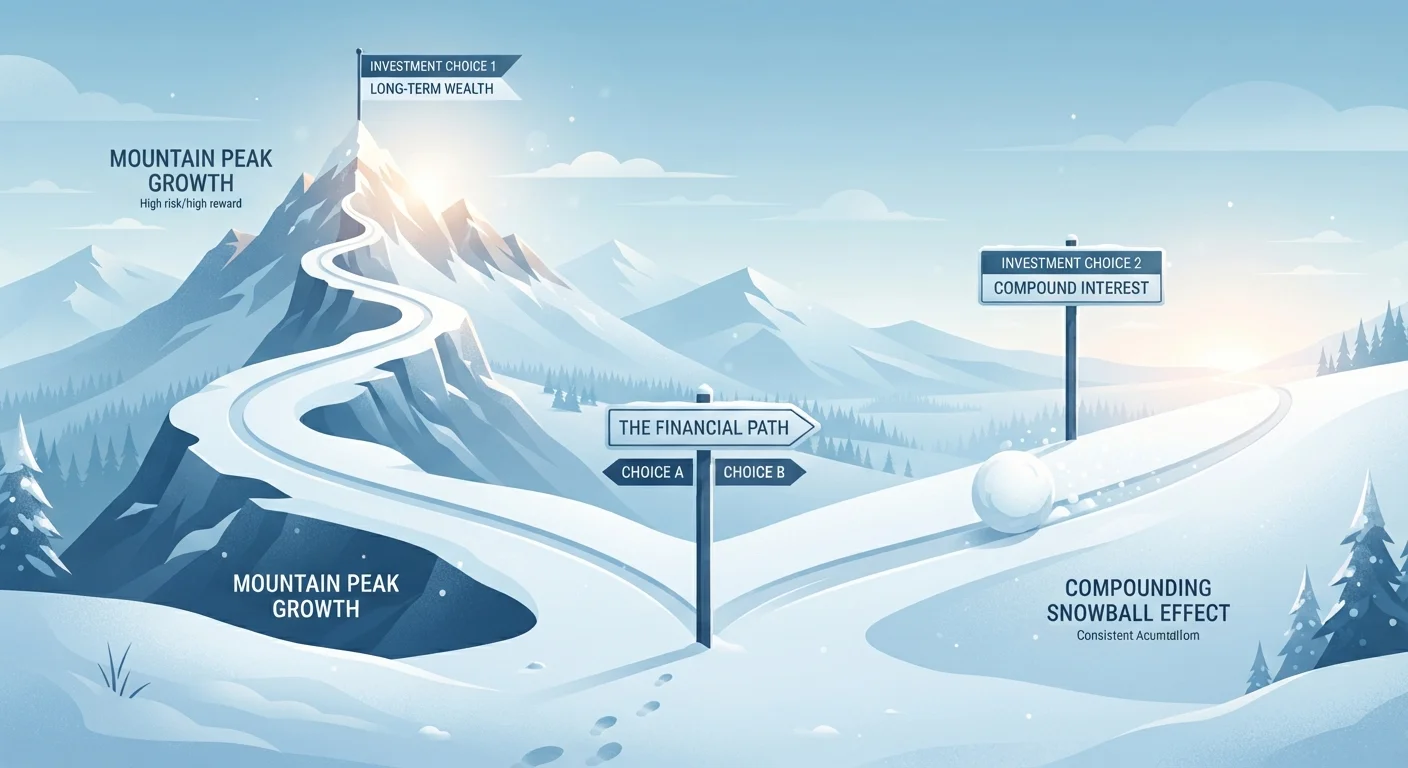
Option A
Debt Avalanche
The mathematically optimal approach to debt elimination.
Best for: People motivated by minimizing total interest paid and comfortable with delayed early wins.
Option B
Debt Snowball
The behaviorally reinforced approach built on momentum.
Best for: People who need early motivation and visible progress to stay committed to a payoff plan.
How Each Strategy Works
Both methods share the same mechanical foundation: pay the minimum on every debt each month, then direct any extra money toward one specific target account. The difference is entirely in which debt you target first.
Debt Avalanche: Rank your debts from highest interest rate to lowest. Put all extra funds toward the highest-rate balance until it's gone, then roll that payment to the next-highest rate. Because compound interest works against you in debt, eliminating the most expensive balance first limits how much interest accumulates overall.
Debt Snowball: Rank your debts from smallest balance to largest, ignoring interest rates. Focus extra payments on the smallest balance until it's cleared, then redirect that freed-up payment toward the next-smallest. Each closed account provides a psychological reward that reinforces the behavior.
Neither method requires you to earn more money or slash your lifestyle dramatically. Both simply restructure where your extra dollars go each month.
| Criterion | Debt Avalanche | Debt Snowball |
|---|---|---|
| Payoff order | Highest interest rate first | Smallest balance first |
| Total interest paid | Lower (mathematically optimal) | Potentially higher |
| Time to first account closed | Longer if high-rate debt is large | Faster - smallest balance closes first |
| Motivational style | Numbers-driven, long-term focus | Milestone-driven, momentum-based |
| Best when | High-rate balances are significant | Motivation or consistency is a challenge |
| Complexity | Requires tracking interest rates | Simple - just sort by balance |
The Real Cost Difference
The avalanche method wins on math. When you carry high-interest debt, every month that balance lingers means more interest accruing. Targeting it aggressively cuts that compounding cycle short.
Consider a simplified example: if you owe $8,000 on a 22% APR credit card and $2,000 on a 9% personal loan, the avalanche directs your extra cash at the credit card. The snowball sends it to the personal loan first. Over a multi-year payoff horizon, the avalanche approach can realistically save hundreds - sometimes thousands - of dollars in interest, depending on balances and rates.
However, the snowball's cost premium is not always as large as it appears on a spreadsheet. If eliminating that $2,000 loan frees up a minimum payment you can then redirect, the mathematical gap narrows. The key variable is consistency: a perfect avalanche plan abandoned after four months outperforms nothing.
22%+
Average credit card APR in the US
The Federal Reserve reports average credit card interest rates have exceeded 20% APR in recent years, underscoring why rate-targeting matters.
~$6,500
Average US credit card balance per holder
According to Federal Reserve consumer credit data, the average indebted US household carries meaningful revolving balances subject to high interest.
Higher
Debt elimination rate with account-focused payoff
A 2016 Journal of Marketing Research study found consumers focusing on closing individual accounts were more likely to fully eliminate their debt.
The Psychology Factor
Behavioral research - including studies cited by consumer finance researchers - suggests that human motivation doesn't respond well to distant, abstract rewards. Paying down a large, high-interest balance for 18 months before seeing any account close can feel like running on a treadmill. This is where the snowball gains practical ground.
A 2016 study published in the Journal of Marketing Research found that debt holders who focused on paying off individual accounts - rather than minimizing interest - were more likely to eliminate their total debt. The sense of completion from closing an account appears to drive continued effort. That said, the snowball's advantage is not universal: people who are highly motivated by numbers and long-term savings sometimes find the avalanche easier to stick with.
Before committing, ask yourself honestly: Do you check your balances often and feel energized by watching a number drop? The avalanche may suit you. Do you need a finished line to cross - an account at zero - to stay engaged? The snowball is probably your better fit. For a deeper look at the mental barriers that slow payoff progress, see common debt payoff myths that can derail even well-intentioned plans.
Putting a Method Into Practice
Regardless of which approach you choose, the execution steps are the same:
- List every debt - balance, minimum payment, and interest rate.
- Sort the list by rate (avalanche) or balance (snowball).
- Set all minimums on autopay so you never miss a payment on secondary accounts.
- Identify your extra dollar amount - even $50 per month accelerates payoff significantly over time.
- Direct all extra funds to your target account each month without exception.
- Roll the freed payment forward when each account closes - this compounding of payments is what gives both strategies their power.
If you're simultaneously weighing whether to save while paying down debt, that trade-off deserves separate analysis. Our article on paying off debt while saving at the same time walks through when each priority makes sense. For an end-to-end framework, the complete guide to getting out of debt covers every stage from tallying balances to staying on track.
This article is for general informational and educational purposes only and does not constitute personalized financial advice. Consult a qualified financial professional for guidance specific to your situation.
The content provided on our blog site traverses numerous categories, offering readers valuable and practical information. Readers can use the editorial team’s research and data to gain more insights into their topics of interest. However, they are requested not to treat the articles as conclusive. The website team cannot be held responsible for differences in data or inaccuracies found across other platforms. Please also note that the site might also miss out on various schemes and offers available that the readers may find more beneficial than the ones we cover.