

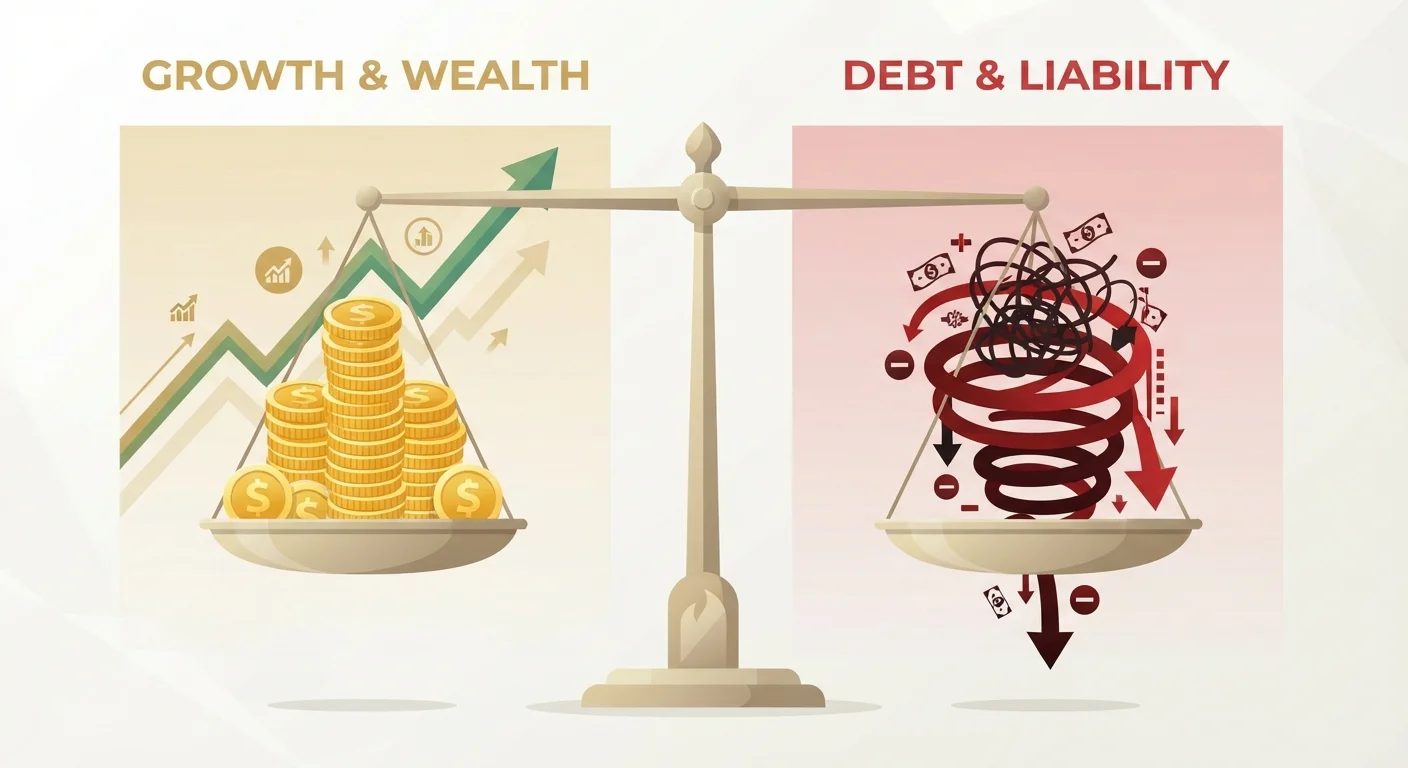
How Compounding Actually Works
The math behind compound interest is straightforward once you see it in motion. Suppose you deposit $1,000 into a savings account with a 5% annual interest rate, compounded annually. After year one, you earn $50 in interest - bringing your balance to $1,050. In year two, you earn 5% on $1,050, not $1,000. That's $52.50. By year three, you're earning interest on $1,102.50.
This self-reinforcing cycle is the core mechanic. Each period's interest becomes part of the base for the next period's calculation. The growth isn't linear - it curves upward. Over 30 years, that same $1,000 at 5% compounded annually becomes roughly $4,322, without a single additional deposit.
Compounding frequency adds another layer. A 5% annual rate compounded daily produces a higher effective yield than 5% compounded monthly or annually. This is why the APY (Annual Percentage Yield) - not the stated rate - is the number to compare when evaluating savings accounts. See our plain-language glossary of savings and debt terms for a breakdown of APY, APR, and other numbers that show up on financial disclosures.
~$4,300
Value of $1,000 after 30 years at 5% compounded annually
Illustrates how compounding multiplies a static deposit more than fourfold over three decades with no additional contributions.
20%+
Average credit card APR in the US
According to Federal Reserve data, average credit card interest rates have risen well above 20%, making daily compounding on unpaid balances increasingly costly for American households.
10 years
Advantage of starting savings a decade earlier
Financial planning research consistently shows that beginning to save ten years sooner - even with smaller amounts - frequently produces larger final balances than starting later with higher contributions.
When Compounding Works Against You
The same mechanic that builds savings can erode financial stability when it applies to debt. Credit card balances, for instance, typically compound daily. If you carry a $3,000 balance at 24% APR and make only minimum payments, compounding means your effective cost is far higher than the stated rate suggests - and the payoff timeline stretches out dramatically.
Here's why: interest charges are added to your outstanding balance. The next billing cycle, interest is calculated on the new, higher balance. If your payments don't consistently exceed the interest being generated, the principal barely moves. This is how a manageable balance can feel impossible to eliminate despite years of payments.
This dynamic is especially pronounced with high-interest revolving debt. Understanding which of your debts compound fastest - and at what rate - is a prerequisite for building a smart payoff strategy. Our article on high-interest vs. low-interest debt explains why not all debt deserves the same repayment urgency.
Practical Steps to Put Compounding on Your Side
Once you understand the mechanic, two priorities become clear: maximize time in a compounding savings vehicle, and minimize compounding debt balances as quickly as possible.
For Savings
- Start now, even with a small amount. Time is the most powerful input in the compounding equation. Waiting six months to save a larger amount often produces a worse long-term outcome than starting immediately with less.
- Choose accounts with competitive APYs. A higher compounding rate accelerates growth. High-yield savings accounts typically offer substantially better APYs than standard bank accounts.
- Automate contributions. Regular deposits mean compounding applies to a growing base, not just a static one. Automatic transfers and round-up tools are two practical ways to keep deposits consistent without relying on willpower.
For Debt
- Pay more than the minimum. Extra principal payments reduce the base on which interest compounds. Even small additional amounts matter over time.
- Prioritize the highest-rate debt first. The debt compounding fastest is costing you the most. Directing extra cash to that balance produces the fastest mathematical relief.
- Avoid letting balances age. New charges on an existing balance restart the compounding clock on additional principal. Reducing the balance - not just avoiding new charges - is the goal.
If you're weighing whether to save or pay off debt simultaneously, our guide on paying off debt while saving at the same time walks through the real trade-offs in practical terms.
Check Your Savings Account's APY, Not Just the Rate
The stated interest rate and the APY are not the same number. APY reflects how often interest compounds and gives you a true picture of annual earnings. When comparing savings accounts, always use APY as your benchmark - it accounts for compounding frequency and makes comparisons accurate.
This article is for general informational and educational purposes only and does not constitute personalized financial advice. Consult a qualified financial professional before making decisions about your specific situation.
Frequently Asked Questions
Simple interest is calculated only on your original principal. Compound interest is calculated on your principal plus any interest already earned or owed. Over time, this difference becomes substantial - compounding accelerates growth (or debt) in a way simple interest does not.
It depends on the account or loan. High-yield savings accounts often compound daily. Credit cards typically compound daily as well, which is why carrying a balance becomes costly quickly. The compounding frequency is reflected in the APY or APR disclosed by your lender or bank.
Yes. Minimum payments on high-interest debt are often calculated to barely cover the interest charges, leaving your principal largely untouched. The remaining balance continues to compound, which is how a modest credit card balance can grow significantly over time.
The earlier, the better - but there is no age at which starting stops being worthwhile. Compounding rewards time above all else, so even modest contributions made in your twenties can outperform larger contributions made in your forties given the same rate of return.
They are closely related but not identical. APY (Annual Percentage Yield) reflects the effective annual return after compounding is applied, making it the most accurate number to compare between savings accounts. Compound interest is the underlying mechanic; APY is how that mechanic is measured and disclosed.
Place your emergency fund in a high-yield savings account that compounds daily and reports a competitive APY. Even without additional deposits, your existing balance earns more than it would in a standard account. Automating regular contributions amplifies this effect significantly.
The content provided on our blog site traverses numerous categories, offering readers valuable and practical information. Readers can use the editorial team’s research and data to gain more insights into their topics of interest. However, they are requested not to treat the articles as conclusive. The website team cannot be held responsible for differences in data or inaccuracies found across other platforms. Please also note that the site might also miss out on various schemes and offers available that the readers may find more beneficial than the ones we cover.