

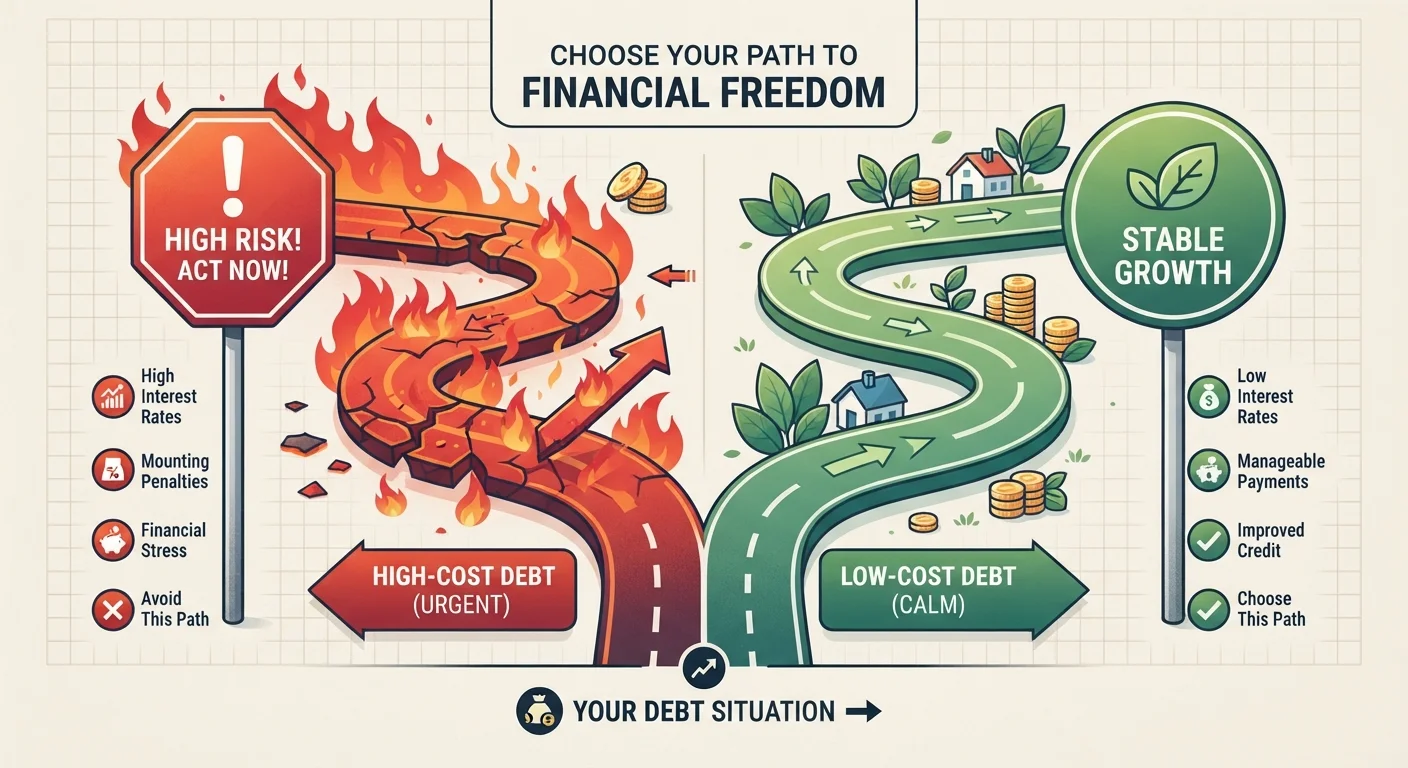
Option A
High-Interest Debt
The urgent drain on your financial progress.
Best for: Understanding which balances to tackle first to stop the fastest-growing cost in your budget.
Option B
Low-Interest Debt
The manageable obligation that can coexist with saving.
Best for: Identifying debts where a steady, minimum-payment approach may free up cash for other financial goals.
Why the Interest Rate Is the Number That Matters Most
When most people think about debt, they focus on the total amount owed. But the interest rate - expressed as an Annual Percentage Rate (APR) - is actually the more decisive number. It determines how fast a balance grows when you are not paying it down quickly enough.
Compound interest is the mechanism at work on both sides. In a savings account, it multiplies your money over time. In a debt account, it multiplies what you owe. A credit card balance at 22% APR does not sit still - it compounds, often daily, meaning even a small balance can become a significant burden within a few years if only minimum payments are made.
Low-interest debt, by contrast, grows slowly enough that maintaining scheduled payments while directing surplus income elsewhere is often a financially sound strategy. The distinction isn't about good debt versus bad debt in a moral sense - it's about which balances are costing you the most per dollar borrowed.
| Criterion | High-Interest Debt | Low-Interest Debt |
|---|---|---|
| Typical APR range | 10%-30%+ (e.g., credit cards) | 3%-7% (e.g., mortgages, federal loans) |
| Cost over time | Grows rapidly via compounding | Grows slowly; manageable with minimums |
| Payoff urgency | High - address before most other goals | Lower - can coexist with saving |
| Impact on cash flow | Significant drain if only paying minimums | Predictable, often fixed monthly cost |
| Common examples | Credit cards, payday loans, store cards | Mortgages, federal student loans, auto loans |
| Strategy recommended | Avalanche or snowball payoff method | Minimum payments; redirect surplus to savings |
How to Prioritize: A Practical Framework
Once you understand the rate-driven distinction, a clear decision framework emerges:
- List every debt with its APR - not just the balance. Sort them from highest rate to lowest.
- Pay minimums on everything to protect your credit and avoid penalties.
- Direct all surplus dollars at the highest-rate balance first. This is the core of the debt avalanche method, which minimizes total interest paid over time.
- Once high-interest debt is eliminated, redirect that freed-up cash toward building an emergency fund or contributing to a tax-advantaged savings account before accelerating payoff of low-interest balances.
Some borrowers prefer the debt snowball method - paying off the smallest balance first for a motivational win - but mathematically, targeting the highest APR saves the most money. Common debt payoff myths can cloud this judgment, so it helps to separate strategy from habit.
Where Is the Dividing Line?
There is no universal cutoff that officially separates 'high' from 'low' interest debt, but many financial educators use roughly 6-8% APR as a practical dividing line. Below that threshold, it is often reasonable to maintain scheduled payments while directing extra cash toward savings or investment. Above it, aggressive paydown usually makes mathematical sense first. Consult a qualified financial adviser to determine the approach right for your specific situation.
Student loans are a common source of confusion here. Federal student loans typically carry lower, fixed rates and offer repayment protections that private consumer debt does not. See our discussion of misunderstood student debt facts for a clearer picture of where these loans typically fall on the priority spectrum.
20%+
Average credit card APR in the US
The Federal Reserve has reported average credit card interest rates exceeding 20% APR in recent years, underscoring the cost of carrying revolving balances.
3-4x
Balance growth potential on high-interest debt
Consumer finance educators commonly illustrate that carrying a balance at 20% APR for several years can multiply the original debt several times over via compounding.
~6.5%
Typical federal student loan rate range
Federal undergraduate loan rates have generally been set in the mid-single digits, positioning them well below most consumer credit products.
This article provides general financial education and is not personalized financial advice. Consult a licensed financial adviser, accountant, or other qualified professional before making decisions about your specific debt situation.
The content provided on our blog site traverses numerous categories, offering readers valuable and practical information. Readers can use the editorial team’s research and data to gain more insights into their topics of interest. However, they are requested not to treat the articles as conclusive. The website team cannot be held responsible for differences in data or inaccuracies found across other platforms. Please also note that the site might also miss out on various schemes and offers available that the readers may find more beneficial than the ones we cover.