

Option A
Subsidized Federal Student Loans
The need-based loan where the government covers in-school interest.
Best for: Undergraduate students who demonstrate financial need and want to minimize debt growth while enrolled.
Option B
Unsubsidized Federal Student Loans
The broadly available loan where interest starts accruing from day one.
Best for: Students at any level - undergraduate or graduate - who may not qualify for subsidized aid or need additional borrowing capacity.
What Sets These Two Loans Apart
Both subsidized and unsubsidized federal student loans are Direct Loans issued by the U.S. Department of Education. They share the same interest rate for a given loan category and access to the same federal repayment plans. The single - but consequential - difference is who is responsible for interest during the in-school period.
With a subsidized loan, the federal government pays the interest while you are enrolled at least half-time, during the six-month grace period after leaving school, and during qualifying deferment periods. Your principal balance at repayment start is exactly what you borrowed - nothing more.
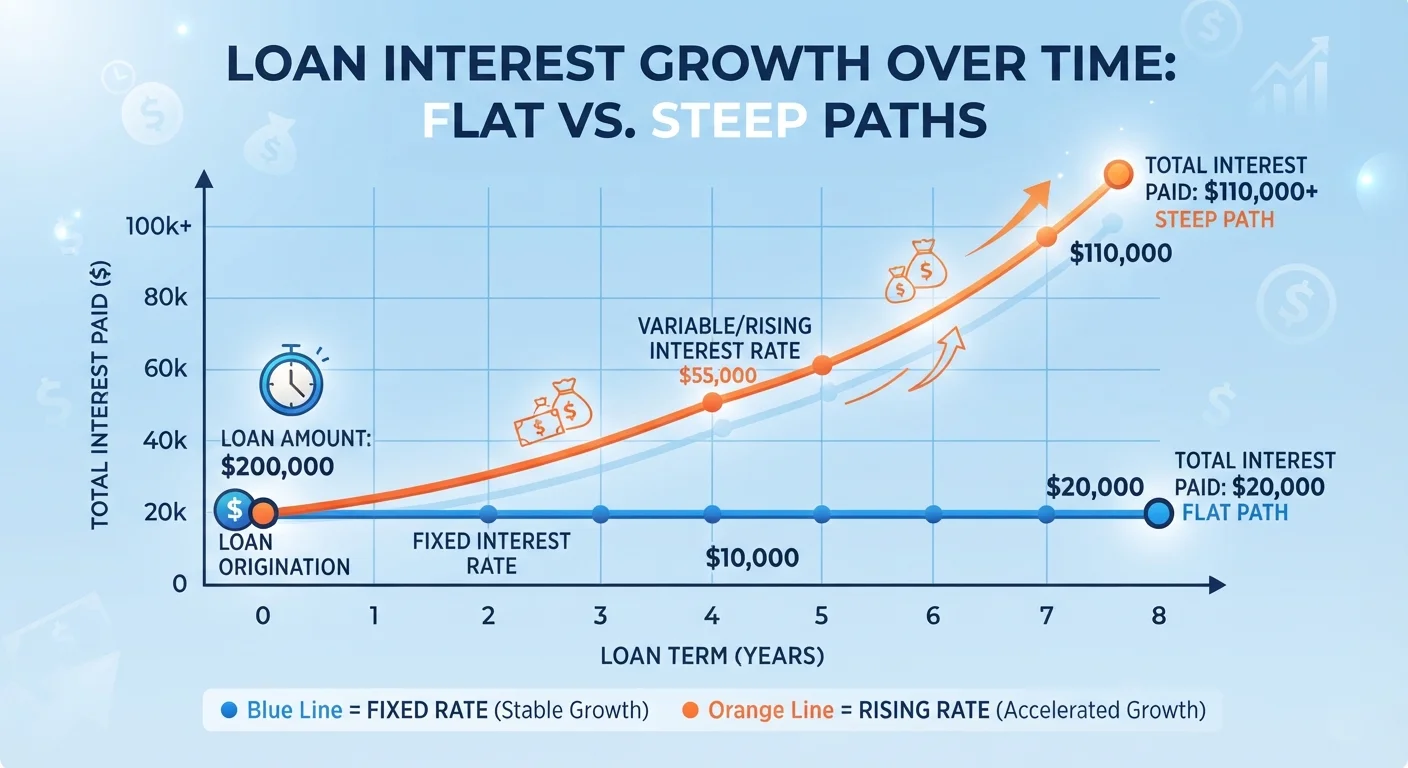
With an unsubsidized loan, interest begins accruing from the moment funds are disbursed. If you do not pay that interest as it builds, it capitalizes - meaning it is added to your principal balance. You then pay interest on a larger number. For a deeper look at how that mechanism works, see our article on how compound interest accelerates debt.
| Criterion | Subsidized Loans | Unsubsidized Loans |
|---|---|---|
| Who pays in-school interest | Federal government | Borrower (accrues daily) |
| Eligibility | Undergraduates with financial need | All students; no need requirement |
| Available to graduate students | No | Yes |
| Interest capitalization risk | None during eligible periods | Yes, if unpaid interest is not paid |
| Balance at repayment start | Equals amount borrowed | Can exceed amount borrowed |
| Interest rate (same loan category) | Identical to unsubsidized rate | Identical to subsidized rate |
| Access to income-driven repayment | Yes | Yes |
How the Interest Gap Grows Over a Repayment Timeline
Consider a student who borrows $5,500 in unsubsidized loans at the start of freshman year at a 6.53% interest rate (the 2024-25 rate for undergraduates). Over four years of school plus a six-month grace period - roughly 4.5 years - interest accrues daily. At repayment start, the outstanding interest could be close to $1,600, which then capitalizes into the principal.
That student now owes approximately $7,100 rather than $5,500. On a standard 10-year repayment plan, interest continues on the higher balance, adding hundreds more over the life of the loan compared to a subsidized borrower who began repayment at the original $5,500.
The math illustrates why loan type matters beyond the moment of borrowing. To understand the full terminology on your loan documents - including how capitalization is recorded - see our breakdown of promissory note terms.
$1,600+
Estimated interest accrued on $5,500 unsubsidized loan over 4.5 years
Based on a 6.53% annual interest rate (2024-25 undergraduate Direct Loan rate) with no payments made during school or grace period.
43 million
Americans with federal student loan debt
According to the Federal Student Aid office of the U.S. Department of Education, approximately 43 million borrowers hold federal student loans.
~60%
Share of Direct Loan borrowers holding unsubsidized loans
Federal Student Aid data consistently shows that unsubsidized loans account for the majority of Direct Loan volume, reflecting their broader eligibility.
Eligibility, Limits, and Strategic Borrowing
Subsidized loans are restricted to undergraduate students who demonstrate financial need as determined by the FAFSA. Graduate and professional students are ineligible. Annual and aggregate borrowing limits apply - for example, a dependent first-year undergraduate may borrow up to $3,500 in subsidized loans out of a $5,500 total Direct Loan limit.
Unsubsidized loans are available to undergraduates, graduate students, and professional students regardless of financial need, though annual limits still apply. Because subsidized eligibility is capped, many students end up with a mix of both loan types - making it important to understand each component of your aid package.
A practical strategy for unsubsidized borrowers: make small interest payments during school, even if you are not required to. Paying interest before it capitalizes keeps your principal at the borrowed amount and meaningfully reduces total repayment cost. If you later need to pause payments, understand the trade-offs first - deferment and forbearance affect interest differently and that distinction matters for unsubsidized balances in particular.
This article is for general educational purposes only and does not constitute personalized financial or legal advice. Loan terms, interest rates, and eligibility rules are set by federal policy and may change. Consult your school's financial aid office or a qualified financial adviser for guidance specific to your situation.
The content provided on our blog site traverses numerous categories, offering readers valuable and practical information. Readers can use the editorial team’s research and data to gain more insights into their topics of interest. However, they are requested not to treat the articles as conclusive. The website team cannot be held responsible for differences in data or inaccuracies found across other platforms. Please also note that the site might also miss out on various schemes and offers available that the readers may find more beneficial than the ones we cover.