

Our Verdict
Deferment is generally the more cost-effective pause option for borrowers who qualify, especially those with subsidized federal loans where interest may not accrue. Forbearance is widely available but almost always comes with an interest cost that quietly grows your balance. Neither option is a long-term solution - they are emergency tools best used sparingly and with a clear plan to resume payments.
Borrowers facing a temporary, documented financial hardship or life event who need short-term relief and have exhausted or are ineligible for income-driven repayment adjustments.
What Deferment and Forbearance Actually Mean
Both deferment and forbearance are formal agreements with your loan servicer that temporarily suspend or reduce your required monthly loan payment. They are not the same thing, and the distinction matters most when you calculate what the pause ultimately costs you.
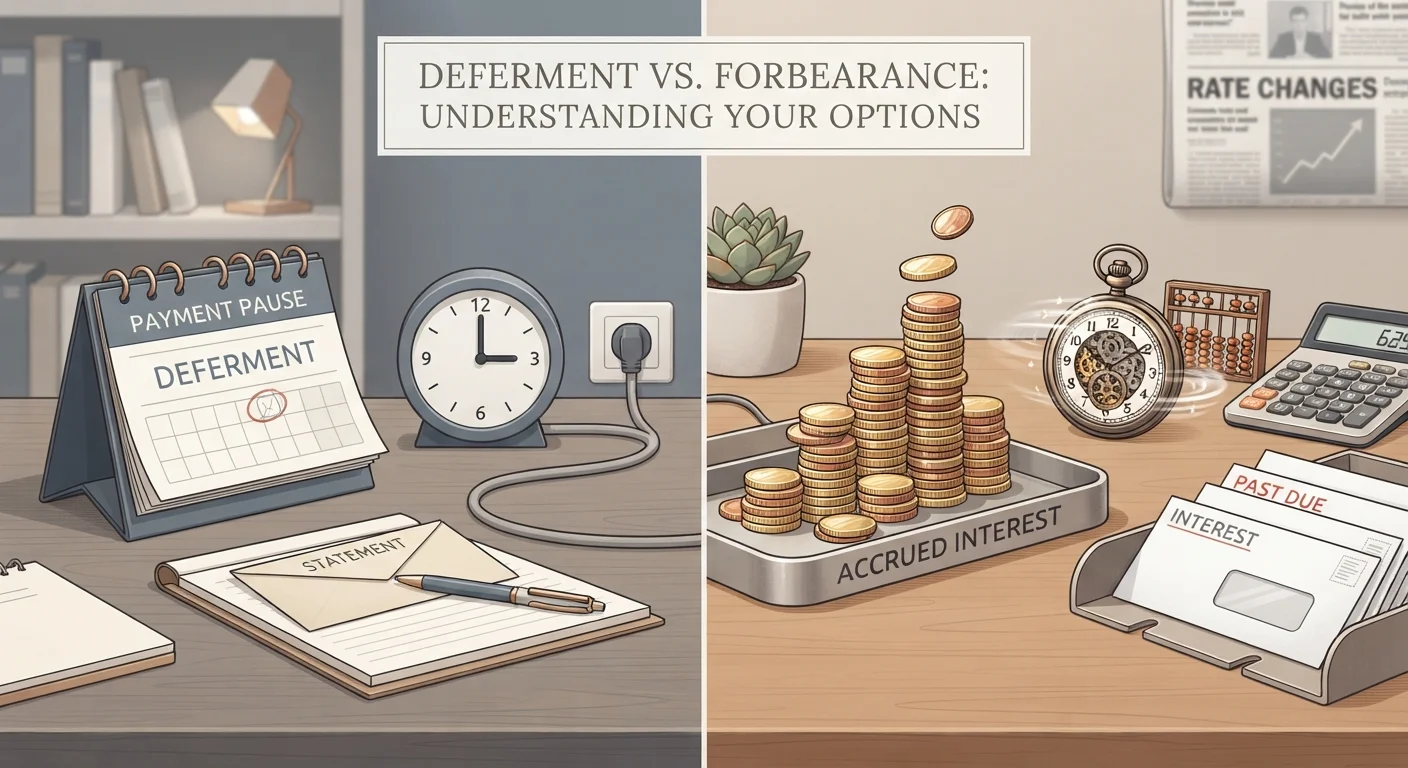
Deferment is a postponement of payments typically tied to specific qualifying circumstances - enrollment in school at least half-time, unemployment, economic hardship, or active military service, among others. The key financial advantage: on subsidized federal loans, the federal government pays the interest that accrues during an approved deferment period, meaning your balance does not grow.
Forbearance is a broader, more accessible pause that lenders can grant when borrowers face financial difficulty but may not meet strict deferment criteria. The trade-off is significant: interest continues to accrue on all loan types during forbearance, and in many cases that unpaid interest is capitalized - added to your principal balance - once the forbearance period ends. To understand how capitalization works in practice, see our guide to student loan terminology.
Private Loans Follow Different Rules
The deferment and forbearance options described in this article refer primarily to federal student loans. Private lenders vary widely in whether they offer either option, how long they last, and whether interest is capitalized. If you have private student loans, contact your lender directly to understand the specific terms they offer - do not assume federal program rules apply.
Pros and Cons of Using Deferment
Deferment is the preferable option for most federal student loan borrowers who qualify, primarily because of how it treats interest on subsidized loans.
Interest may not accrue on subsidized loans
During an approved deferment, the federal government covers interest on subsidized Direct Loans, meaning your principal balance stays the same - a meaningful financial advantage over forbearance.
Tied to specific, documented hardship categories
Eligibility criteria such as unemployment or enrollment in school give deferment a structured foundation, which can make the relief feel more stable and predictable for borrowers who qualify.
Can provide up to three cumulative years of relief
Most deferment types allow up to 36 months total across the life of the loan, offering significant runway for borrowers navigating extended periods of hardship or career transition.
The downsides of deferment are less obvious but still real. Deferment periods count toward the lifetime limits set by federal programs - generally up to three years for most deferment types combined. Using deferment now means fewer months available if hardship strikes again later. Additionally, deferment periods typically do not count as qualifying payments toward Public Service Loan Forgiveness or income-driven repayment forgiveness timelines. If you are pursuing PSLF, review our overview of what PSLF actually requires before requesting deferment.
Does not count toward forgiveness qualifying payments
Months spent in deferment generally do not count toward the 120 qualifying payments required for PSLF or the payment counts that determine forgiveness under income-driven repayment plans.
Lifetime limits can be exhausted
Federal deferment carries cumulative caps, so relying on it heavily early in repayment reduces or eliminates the safety net available for future emergencies.
Interest still accrues on unsubsidized and PLUS loans
Deferment only waives interest accumulation on subsidized loans; borrowers with unsubsidized or PLUS balances still see interest grow throughout the deferment period.
The Real Cost of Forbearance Over Time
Forbearance is easier to obtain - servicers have more discretion to grant it - but that accessibility comes at a price. Interest accrues on subsidized loans, unsubsidized loans, and PLUS loans alike during forbearance periods. When the forbearance ends and that interest capitalizes, every future interest calculation is applied to a larger principal.
~$162/mo
Monthly interest on $30,000 at 6.5% rate
Illustrative calculation based on standard simple interest formula; actual accrual depends on your specific loan balance and interest rate.
36 months
Maximum deferment period for most federal categories
Federal student loan regulations set cumulative limits on most deferment types; check with your servicer for the specific limit that applies to your loans.
100%
Loan types that accrue interest during forbearance
Unlike deferment on subsidized loans, forbearance causes interest to accrue on all federal student loan types without exception.
For example, a borrower with $30,000 in unsubsidized loans at a 6.5% interest rate accrues roughly $162 in interest per month. A 12-month forbearance adds approximately $1,944 to the balance before capitalization - and from that point forward, interest compounds on the inflated amount. The interest difference between subsidized and unsubsidized loans illustrates exactly how this compounding diverges over a repayment timeline.
Borrowers should also be aware that forbearance, like deferment, does not typically count as a qualifying repayment month for forgiveness programs. If long-term affordability is the core problem - not a short-term income gap - an income-driven repayment plan is usually a better fit than repeated forbearance.
How to Decide Which Option to Request
The decision tree is more straightforward than it might appear. Start by asking whether you meet the eligibility criteria for deferment. If you do - and especially if your loans include subsidized balances - deferment will almost always cost you less. Contact your servicer and request the specific deferment type that matches your situation; documentation is usually required.
If you do not qualify for deferment, or if you need relief immediately while gathering paperwork, forbearance can serve as a bridge. Keep the forbearance period as short as possible and make interest-only payments during the pause if your budget allows - this prevents capitalization and limits long-term damage to your balance.
In either case, use the pause to address the underlying issue: build a modest emergency fund, adjust your budget, or explore whether an income-driven plan would make regular payments more manageable going forward. Our article on paying off debt while saving simultaneously can help you weigh those priorities once you are back on track.
This article is for general informational and educational purposes only and does not constitute personalized financial or legal advice. Consult your loan servicer and, where appropriate, a qualified financial professional for guidance specific to your loan situation.
The content provided on our blog site traverses numerous categories, offering readers valuable and practical information. Readers can use the editorial team’s research and data to gain more insights into their topics of interest. However, they are requested not to treat the articles as conclusive. The website team cannot be held responsible for differences in data or inaccuracies found across other platforms. Please also note that the site might also miss out on various schemes and offers available that the readers may find more beneficial than the ones we cover.