

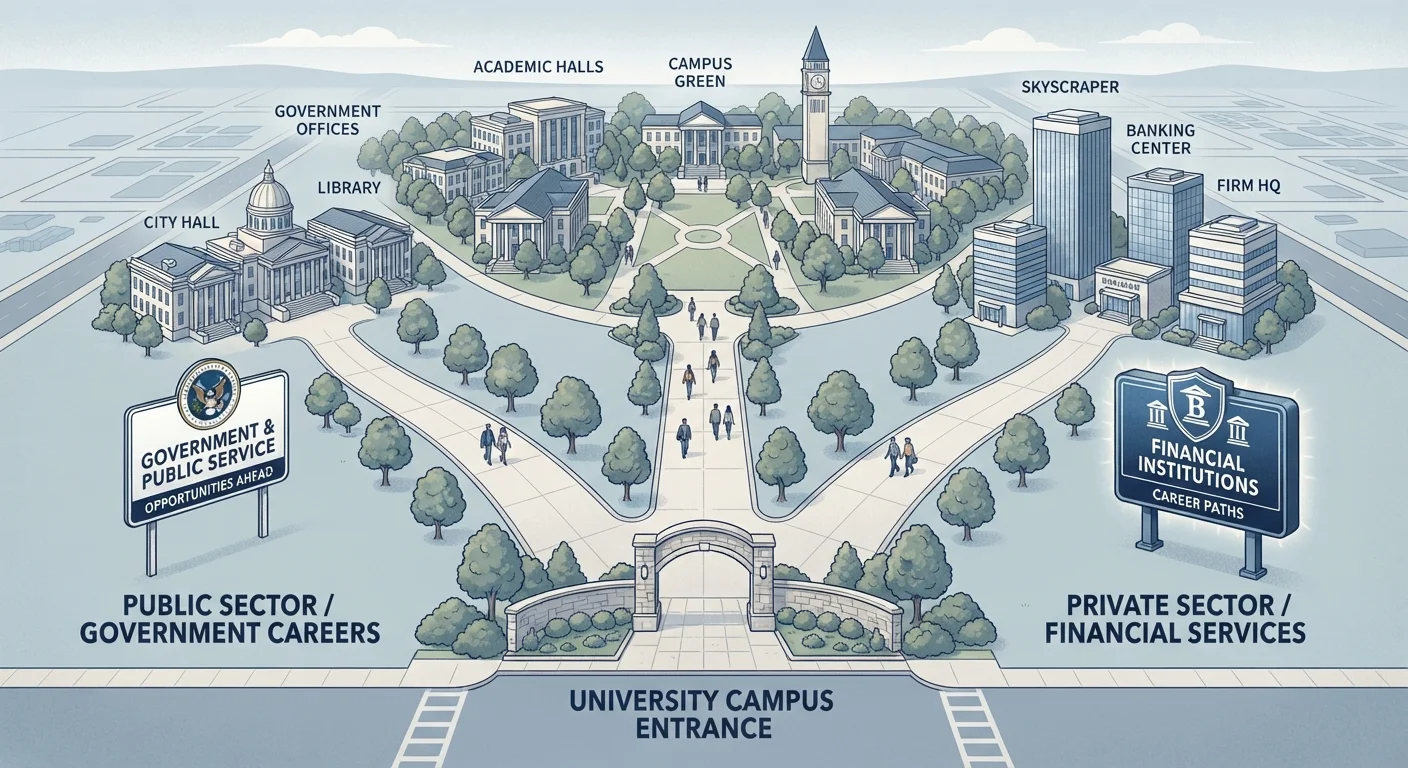
Option A
Federal Student Loans
The government-backed, borrower-protective standard.
Best for: Students who want fixed rates, flexible repayment plans, and access to income-driven options or forgiveness programs.
Option B
Private Student Loans
The credit-market alternative with fewer built-in safeguards.
Best for: Students who have exhausted federal aid and need supplemental funding, ideally with strong credit or a creditworthy co-signer.
Where Each Loan Comes From
The most fundamental difference between federal and private student loans is their source. Federal student loans are funded and administered by the U.S. Department of Education. You apply for them through the Free Application for Federal Student Aid (FAFSA), and your school's financial aid office packages them as part of your aid award. Eligibility is based primarily on enrollment status and, for need-based loans, financial circumstances - not credit history.
Private student loans are issued by non-government lenders: banks, credit unions, state-affiliated agencies, and online financial companies. Each lender sets its own terms. Applying typically involves a credit check, and many undergraduate borrowers need a creditworthy co-signer to qualify. Because there is no single governing framework, terms can vary significantly from lender to lender.
Before comparing rates or repayment options, it helps to understand the terminology on your loan documents. Our guide to student loan terms explains concepts like capitalization, grace periods, and promissory notes in plain language.
Interest Rates and How They Are Set
Federal student loan interest rates are fixed for the life of the loan and are set by Congress each year, tied to the 10-year Treasury note. Every borrower who takes out the same type of federal loan in the same academic year receives the same rate - your personal credit profile does not change it.
Private loan rates work differently. Lenders offer both fixed and variable rate options, and the rate you receive depends on your credit score, income, debt-to-income ratio, and whether you have a co-signer. Variable rates may start lower than federal rates but can rise over time, making long-term cost harder to predict.
| Criterion | Federal Student Loans | Private Student Loans |
|---|---|---|
| Issuer | U.S. Department of Education | Banks, credit unions, private lenders |
| Interest Rate Type | Fixed, set annually by Congress | Fixed or variable, credit-based |
| Credit Check Required | Generally no (except PLUS loans) | Yes, typically required |
| Income-Driven Repayment | Available | Generally not available |
| Loan Forgiveness Programs | Available (e.g., PSLF) | Not available |
| Deferment / Forbearance | Standardized federal options | Varies by lender |
| Application Process | Via FAFSA | Direct application to lender |
For context on how interest levels affect your overall repayment strategy, see our overview of high-interest vs. low-interest debt.
Repayment Options and Borrower Protections
This is where federal and private loans diverge most sharply. Federal loans come with a wide suite of repayment plans, including income-driven repayment (IDR) options that cap monthly payments as a percentage of your discretionary income. If you work in qualifying public service, you may be eligible for Public Service Loan Forgiveness (PSLF) after meeting specific requirements. Federal loans also allow deferment and forbearance during financial hardship.
Private loans offer far fewer standard protections. Some lenders provide hardship forbearance, but the terms are set by each lender and are not guaranteed. Income-driven repayment and federal forgiveness programs are not available for private loans. Once you sign a private loan agreement, your options during financial difficulty depend entirely on that lender's policies.
~92%
Share of student debt that is federal
According to Federal Reserve data, federal loans account for the large majority of outstanding student loan balances in the United States.
8
Federal income-driven repayment plan types available
The U.S. Department of Education has offered multiple IDR plan options, each with different eligibility rules and payment calculations, giving federal borrowers significant flexibility.
If you hold federal loans, understanding the full range of repayment types - including subsidized versus unsubsidized distinctions - is essential. Our article on subsidized vs. unsubsidized loans explains how interest behavior during school creates a compounding difference over time.
Making an Informed Borrowing Decision
Financial aid professionals and consumer advocates consistently recommend exhausting federal loan eligibility before taking on private debt. The built-in protections - fixed rates, income-driven plans, deferment - provide a meaningful safety net that private loans generally do not replicate.
That said, private loans are a legitimate tool when federal limits fall short of actual costs. Borrowers considering private loans should compare multiple lenders, pay close attention to whether rates are fixed or variable, and read the fine print on forbearance and co-signer release policies.
Several widely held beliefs about student debt - including assumptions about bankruptcy discharge and employer repayment programs - do not always hold up to scrutiny. Our piece on commonly misunderstood aspects of student debt covers these in detail. Additionally, both loan types can intersect with your tax situation; our overview of student loans and education tax credits explains key concepts worth knowing at filing time.
This article is for general informational and educational purposes only and does not constitute personalized financial or legal advice. Consult a qualified financial professional for guidance specific to your circumstances.
The content provided on our blog site traverses numerous categories, offering readers valuable and practical information. Readers can use the editorial team’s research and data to gain more insights into their topics of interest. However, they are requested not to treat the articles as conclusive. The website team cannot be held responsible for differences in data or inaccuracies found across other platforms. Please also note that the site might also miss out on various schemes and offers available that the readers may find more beneficial than the ones we cover.