

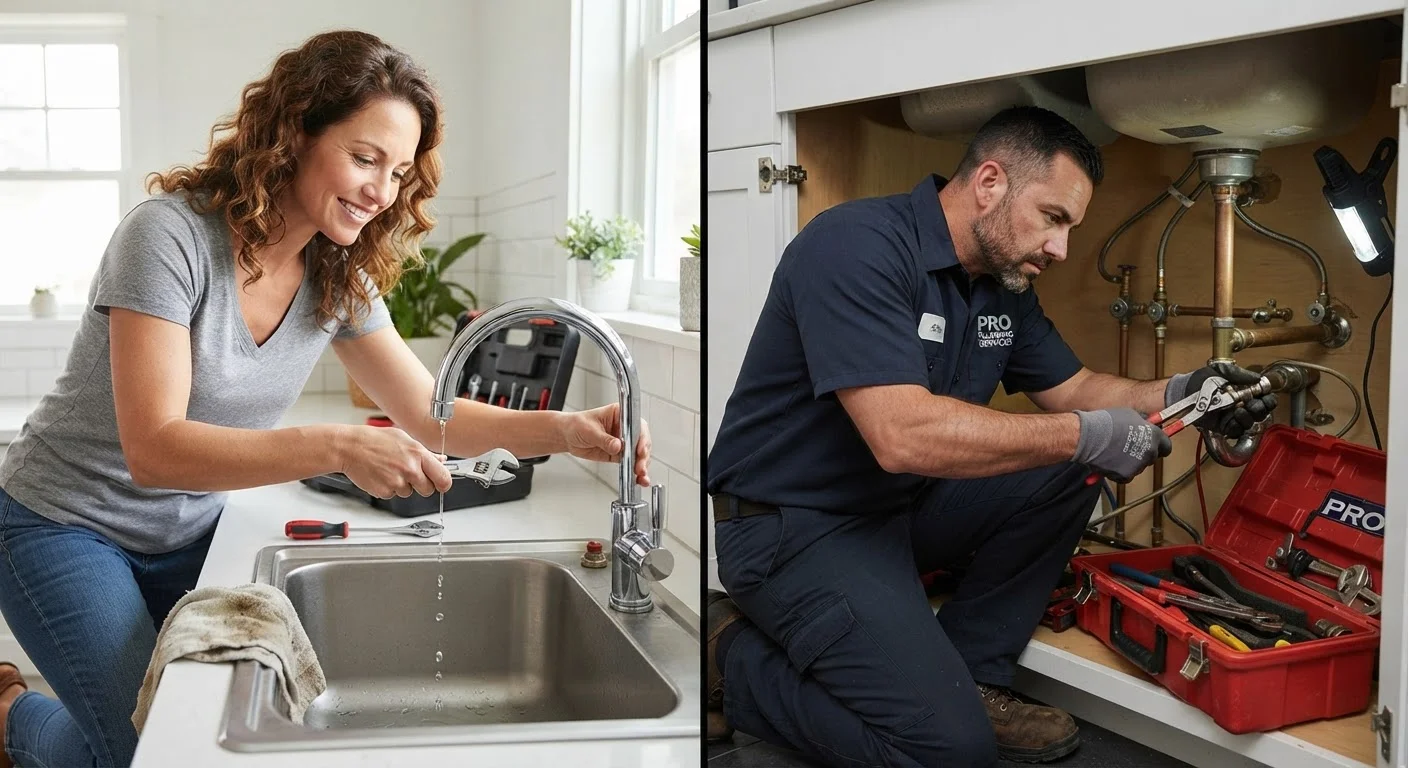
Option A
DIY Plumbing Repairs
The hands-on, cost-saving approach for low-risk fixes.
Best for: Homeowners dealing with minor leaks, clogs, or fixture replacements that don't involve the main supply line or gas.
Option B
Licensed Plumber
The trained professional for complex, code-regulated work.
Best for: Any job involving main water lines, sewage, water heaters, permits, or work behind walls and under slabs.
The Core Question: Risk, Skill, and Code
Every household eventually faces a dripping faucet, a sluggish drain, or a toilet that won't stop running. The instinct to reach for the toolbox is sound - and often entirely appropriate. But plumbing exists on a spectrum from simple to genuinely dangerous, and landing in the wrong category can turn a $20 fix into a $2,000 repair.
The right call depends on three factors: risk level (could a mistake cause flooding, mold, or injury?), skill requirement (does the job need specialized tools or training?), and code compliance (is a permit or licensed contractor legally required in your jurisdiction?). For a broader framework on making this call across home projects, see how to decide what's right for your project.
| Criterion | DIY Plumbing Repairs | Licensed Plumber |
|---|---|---|
| Typical cost | Parts only ($5-$100) | Labor + parts ($150-$500+) |
| Skill required | Basic mechanical comfort | Licensed trade training |
| Tools needed | Standard household tools | Specialized professional equipment |
| Permit required | Rarely (minor fixes) | Often (for major work) |
| Insurance implications | Risk if improper work causes damage | Work typically warrantied and insured |
| Time to complete | Minutes to a few hours | Scheduled appointment required |
| Best for | Minor fixtures, clogs, replacements | Pipes, sewage, water heaters, permits |
Plumbing Problems Most Homeowners Can Handle
These repairs sit in safe DIY territory for most adults with basic mechanical comfort and a few common tools.
- Dripping faucets: Most drips stem from a worn washer, O-ring, or cartridge - parts that cost a few dollars and swap out without cutting any pipes.
- Running toilets: The flapper, fill valve, and float are designed to be homeowner-serviceable. If your toilet runs continuously, inspect the flapper first - it's usually the culprit.
- Slow or clogged drains: A plunger or drain snake handles most sink and tub clogs. Avoid chemical drain openers regularly; they can degrade older pipes over time.
- Showerhead replacement: Unscrew the old head, apply thread-seal tape, and attach the new one. No plumbing knowledge required beyond basic hand tools.
- Toilet seat replacement: Two bolts, five minutes.
- Shutoff valve operation: Knowing how to turn off water at the fixture or main shutoff is essential before any repair - and it's a skill every homeowner should have.
10%
Homes with undetected water leaks
The U.S. Environmental Protection Agency estimates that roughly 1 in 10 homes has leaks wasting 90 or more gallons per day.
$1,000+
Average water damage repair cost
Industry estimates suggest that water damage from plumbing failures is among the most common and costly home insurance claims filed each year.
3 gallons
Water wasted per day by a dripping faucet
According to the EPA, a single faucet dripping once per second wastes more than 3,000 gallons of water annually.
Before starting any repair, shut off the water supply to the fixture or at the main, and have towels ready. Small preparation prevents bigger messes.
When to Call a Licensed Plumber
Some plumbing problems look minor on the surface but signal something much more serious underneath. Others involve systems that are regulated by local building codes for good reason.
- Burst or leaking supply pipes: Even a small pipe failure can release dozens of gallons per hour. Water intrusion behind walls leads to mold and structural decay quickly.
- Sewage backups: Raw sewage is a health hazard. Backups often indicate a blocked or damaged main sewer line - work that requires a camera inspection and professional equipment.
- Water heater issues: Gas water heaters involve combustion, venting, and gas lines. Even electric water heater repairs can involve high-voltage wiring. Most jurisdictions require permits for replacement.
- Low water pressure throughout the home: Whole-house pressure problems point to issues with the main line, pressure regulator, or municipal supply - none of which are straightforward DIY territory.
- Any work requiring a permit: Adding or relocating drains, extending supply lines, or replumbing more than one fixture typically triggers permit requirements. Unpermitted work can affect your home insurance and create problems at resale.
Deferring professional repairs can compound into serious expense. The hidden costs of deferred home maintenance explains how small neglected issues escalate over time.
Always Check Local Permit Requirements
Plumbing permit rules vary significantly by city, county, and state. What requires a permit in one jurisdiction may not in another - and vice versa. Before starting any repair beyond basic fixture work, contact your local building department or visit their website. Unpermitted plumbing work can complicate homeowners insurance claims and create disclosure obligations when you sell the property.
Comparing the Two Approaches Side by Side
The table above outlines how DIY and professional plumbing compare across the most practical decision-making criteria. Cost is an obvious factor, but it's rarely the only one worth weighing.
DIY repairs save money upfront and build homeowner confidence over time. But overstepping your skill level - or ignoring permit requirements - can cost significantly more to correct than the original professional fee. Some home maintenance myths lead homeowners to attempt repairs they shouldn't, sometimes making things worse.
A useful rule of thumb: if the repair requires you to open a wall, involve gas or high-voltage electricity, connect to the main supply or sewer, or if you'd need to rent specialized equipment you've never used, call a licensed plumber. For everything else, a confident DIY attempt - after researching the specific repair - is generally reasonable.
This article is for general informational purposes only. Local building codes, permit requirements, and safety regulations vary. Always verify requirements with your local authority having jurisdiction before beginning any plumbing work.
The content provided on our blog site traverses numerous categories, offering readers valuable and practical information. Readers can use the editorial team’s research and data to gain more insights into their topics of interest. However, they are requested not to treat the articles as conclusive. The website team cannot be held responsible for differences in data or inaccuracies found across other platforms. Please also note that the site might also miss out on various schemes and offers available that the readers may find more beneficial than the ones we cover.