

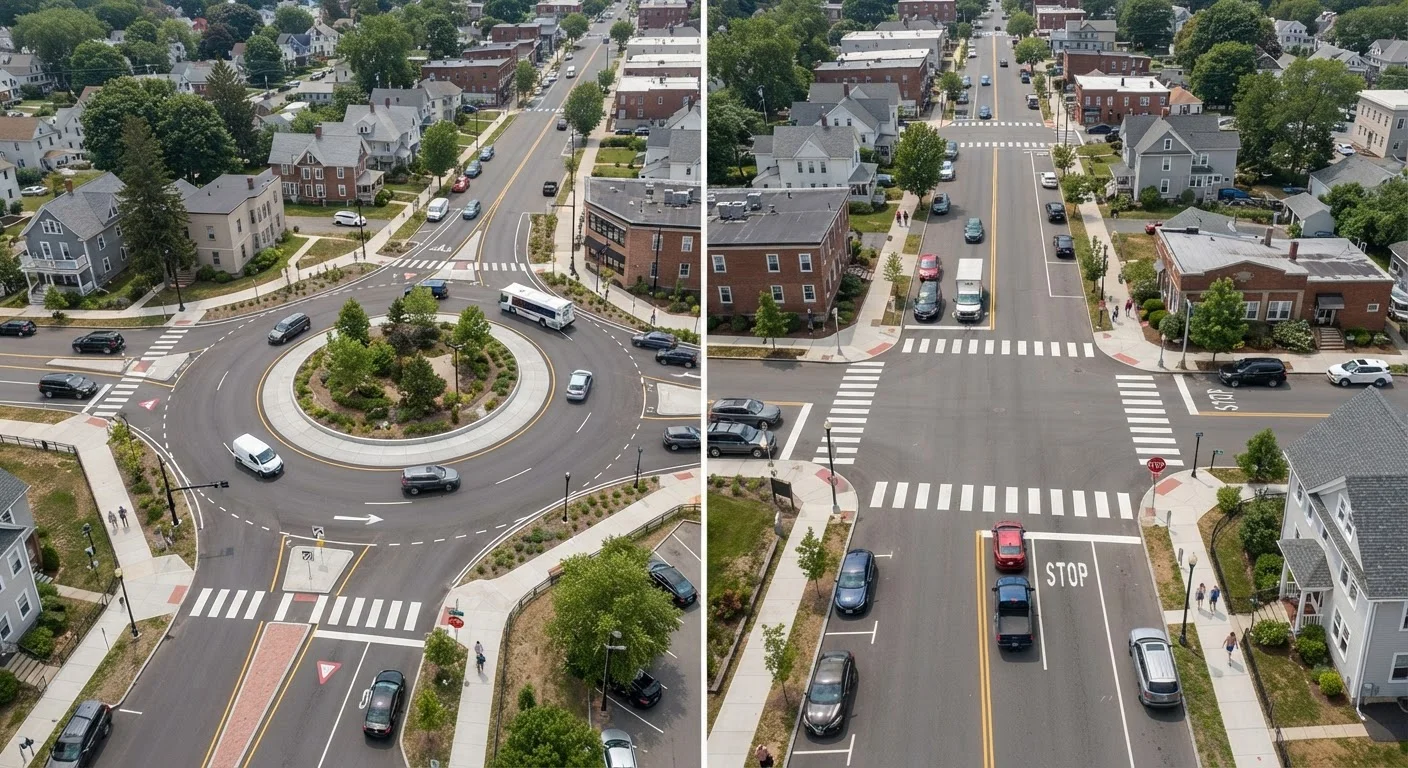
Option A
Roundabouts
The circular intersection designed to keep traffic flowing safely.
Best for: High-volume intersections where reducing severe crash types and improving traffic flow are priorities.
Option B
Four-Way Stops
The familiar, rules-based intersection most American drivers know by heart.
Best for: Lower-volume intersections where simplicity, low cost, and driver familiarity are the primary considerations.
How Each Intersection Type Works
A four-way stop requires all vehicles to come to a complete stop and yield based on established right-of-way rules: the first to arrive goes first, and when vehicles arrive simultaneously, the driver to the right has priority. This system is rule-dependent - it functions well only when all drivers apply the same conventions correctly and consistently.
A roundabout replaces that rules-based system with a geometric one. Entering drivers yield to circulating traffic already inside the ring, then merge into the counterclockwise flow and exit at their desired street. There are no signals, no opposite-direction traffic lanes, and no left turns executed across oncoming vehicles. The design itself governs behavior rather than driver decision-making alone.
Understanding this structural difference is the foundation for understanding why their safety records diverge. For a broader look at how right-of-way rules apply across different road scenarios, see our right-of-way reference guide.
The Safety Data: What Research Shows
The Insurance Institute for Highway Safety (IIHS) has studied roundabout safety extensively. Their findings indicate that converting a conventional intersection to a roundabout reduces fatal crashes by approximately 90% and injury-causing crashes by around 75%. These are substantial reductions, not marginal improvements.
The primary reason is the elimination of right-angle collisions - the T-bone crash type that occurs when one driver runs a stop sign or misjudges right-of-way. These crashes often involve one vehicle striking another at full speed on the driver's side door, making them among the most deadly. Roundabouts structurally prevent this scenario because vehicles enter at angles and travel in the same direction, converting any potential collision into a lower-speed sideswipe.
~90%
Reduction in fatal crashes at roundabouts
According to IIHS research comparing roundabouts to conventional intersections, including stop-controlled designs.
~75%
Reduction in injury crashes
IIHS data indicates injury-causing crashes fall by roughly three-quarters when intersections are converted to roundabouts.
~4,800
Roundabouts now operating in the US
The number of US roundabouts has grown substantially since the 1990s as states expand adoption based on safety evidence.
Four-way stops do reduce speeds compared to uncontrolled intersections, and they perform reasonably well at lower traffic volumes. However, they depend on every driver stopping fully and correctly reading the situation - conditions that are not always met. Distraction, impatience, and unfamiliarity with right-of-way rules all increase risk at stop-controlled intersections. These are the same habits that quietly erode driver safety in many everyday situations.
Head-to-Head Comparison
The table below summarizes how roundabouts and four-way stops compare across the dimensions that matter most to drivers and road planners alike.
| Criterion | Roundabouts | Four-Way Stops |
|---|---|---|
| Fatal crash reduction | ~90% vs. conventional intersections | Moderate improvement vs. uncontrolled |
| Right-angle collision risk | Structurally eliminated | Present if rules are violated |
| Driver rule dependency | Low - geometry governs flow | High - requires correct rule application |
| Traffic flow efficiency | High - continuous movement | Lower - full stops required |
| Installation cost & space | Higher - more land required | Lower - minimal footprint |
| Pedestrian crossing complexity | Requires attention; splitter islands help | Straightforward with clear sightlines |
| Driver familiarity (US) | Still growing - learning curve exists | Very high - universally understood |
One area where four-way stops hold a clear practical advantage is installation cost and physical footprint. Roundabouts require more land and greater upfront engineering investment. This makes them less feasible in dense urban grids or areas with significant property constraints.
Why American Drivers Are Often Wary of Roundabouts
Many US drivers grew up navigating four-way stops almost exclusively. Roundabouts, while common in Europe and Australia for decades, expanded in the US more gradually - meaning a significant portion of the driving population has limited experience with them.
This unfamiliarity can cause hesitation, abrupt stops at the yield line, or uncertainty about when to enter - behaviors that can briefly increase minor collision rates at newly installed roundabouts. However, research shows this adjustment period is temporary. As local drivers gain exposure, comfort and safety outcomes both improve.
New to Roundabouts? Here's What Helps
The key rules are simple: yield to traffic already circulating inside the roundabout, stay in your lane through the ring, and signal before your exit. Do not stop inside the roundabout unless traffic ahead requires it. Most drivers find that after a handful of encounters, roundabouts feel intuitive - and studies confirm that crash rates at newly installed roundabouts typically drop as local familiarity increases.
The learning curve is real but short. Defensive driving habits - such as maintaining a safe following distance and resisting the urge to tailgate - apply directly inside roundabouts, where speed differentials between vehicles can lead to rear-end crashes. See how tailgating increases crash risk in congested or low-speed environments.
Which Intersection Is Right for a Given Road?
Safety data favors roundabouts for most medium-to-high-volume intersections where severe crash reduction is a goal. But intersection design is not one-size-fits-all. Engineers and planners weigh traffic volume, pedestrian patterns, land availability, cost, and local driving culture when selecting an intersection type.
For drivers, the more important takeaway is behavioral: both intersection types require active attention. At a four-way stop, that means fully stopping, reading who arrived first, and not assuming right-of-way. At a roundabout, it means yielding to circulating traffic, signaling your exit, and not stopping unnecessarily inside the ring. The design of a roundabout reduces the severity of crashes that do happen - but attentive driving remains essential at either type.
Confident navigation of any intersection is part of a broader set of everyday driving skills. Merging, following distance, and right-of-way awareness all contribute to overall road safety - as our highway merging guide illustrates for another high-risk road situation.
The content provided on our blog site traverses numerous categories, offering readers valuable and practical information. Readers can use the editorial team’s research and data to gain more insights into their topics of interest. However, they are requested not to treat the articles as conclusive. The website team cannot be held responsible for differences in data or inaccuracies found across other platforms. Please also note that the site might also miss out on various schemes and offers available that the readers may find more beneficial than the ones we cover.