

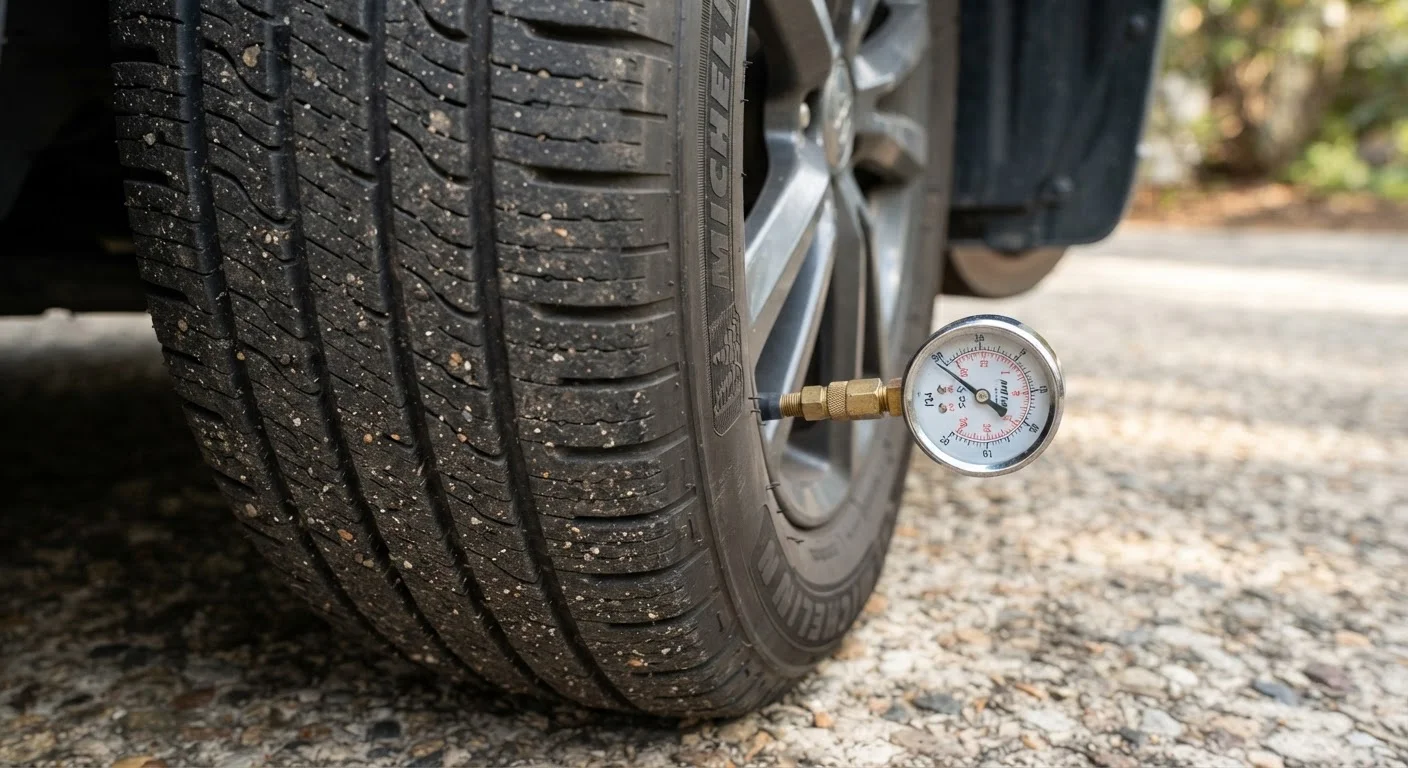
Tire Pressure: Understanding PSI
PSI stands for pounds per square inch - the unit used to measure the air pressure inside your tires. Every vehicle has a recommended PSI range set by the manufacturer, not the tire maker. You'll find it on the sticker inside the driver's door jamb or in your owner's manual. The number molded on the tire sidewall is the maximum pressure the tire can safely hold - not the target you should inflate to.
| Typical Passenger Car PSI Range | 32-36 PSI (Vehicle door jamb sticker is the authoritative source per vehicle) |
| New Tire Tread Depth | 10/32" - 11/32" (Standard for most new passenger tires) |
| Legal Minimum Tread Depth (most U.S. states) | 2/32" (Verify your state's specific requirement) |
| Recommended Replacement Threshold | 4/32" (Widely recommended for wet/winter safety margin) |
| Typical Rotation Interval | Every 5,000-7,500 miles (Always consult your owner's manual for model-specific guidance) |
| Pressure Rise While Driving | 4-8 PSI above cold reading (Normal range; always check pressure cold) |
Most passenger vehicles fall between 32 and 36 PSI for front and rear tires, though SUVs, trucks, and spare tires often differ. Check pressure when tires are cold - meaning the car has been parked for at least three hours - because driving heats air and temporarily raises readings by 4-8 PSI.
Under-inflation increases rolling resistance, causes uneven wear on the outer edges, and raises the risk of blowout. Over-inflation makes the center tread wear faster and reduces the tire's ability to absorb road impact. If your dashboard illuminates a tire pressure warning, see what that alert actually means before driving far.
Tread Depth: Reading the Numbers
Tread depth is measured in 32nds of an inch. A new passenger tire typically starts at 10/32" to 11/32". The legal minimum in most U.S. states is 2/32", at which point tires are considered bald and must be replaced. However, many safety organizations recommend replacing tires at 4/32" - particularly in wet or wintry conditions - because stopping distances increase significantly below that threshold.
PSI (Pounds Per Square Inch)
The unit used to measure tire inflation pressure. Your vehicle's recommended PSI is found on the driver's door jamb sticker, not on the tire sidewall.
Tread Depth
The measurement from the top of the tire's rubber tread to the bottom of its deepest grooves, expressed in 32nds of an inch. It indicates how much grip and water-channeling ability remains.
Tread Wear Indicator
Small raised bars molded into tire grooves at the 2/32" level. When they appear flush with the tread surface, the tire has reached the legal minimum depth and must be replaced.
Tire Rotation
The practice of moving tires between wheel positions at regular intervals to equalize wear patterns and extend the usable life of the full set.
Cold Pressure
Tire pressure measured after the vehicle has been stationary for at least three hours. Manufacturer PSI recommendations are always given for cold tires, since driving raises internal temperature and temporarily inflates readings.
Directional Tires
Tires designed to rotate in a single direction, identifiable by a V-shaped tread pattern and an arrow on the sidewall. They can only be rotated front-to-rear on the same side of the vehicle.
How to check without a gauge: The penny test is widely known - inserting a penny with Lincoln's head down and seeing the top of his head means you're at or below 2/32". The quarter test (Washington's head) gives you a 4/32" warning. A purpose-built tread depth gauge, available at auto parts stores, is more precise and worth owning.
Look for tread wear indicators - small rubber bars molded into the grooves of the tire. When those bars sit flush with the surrounding tread, the tire has reached 2/32" and needs immediate replacement. Uneven wear patterns (cupping, feathering, center wear) signal alignment, balance, or inflation problems that should be addressed before the next set of tires is installed.
Rotation: Why Intervals Matter
Tires don't wear at the same rate across all four positions. Front tires on front-wheel-drive vehicles handle steering and most braking force, so they wear faster - often two to three times faster than the rear pair. Rotation moves tires between positions in a defined pattern to even out wear and extend the overall life of the set.
A common general guideline is to rotate tires every 5,000 to 7,500 miles, though your owner's manual is the authoritative source for your specific vehicle. Some manufacturers align this with oil change intervals, making it easier to remember. Vehicles with a full-size spare can include it in the rotation, extending usable life across five tires.
Rotation patterns vary by drivetrain and whether tires are directional (designed to roll in one direction) or non-directional. Directional tires can only move front-to-rear on the same side. Non-directional tires offer more pattern options, including cross-rotation. A qualified tire technician can determine the correct pattern for your setup.
Consistent rotation is one of the most cost-effective maintenance steps a driver can take. It's also part of the broader routine that contributes to reaching high-mileage milestones - a topic explored in detail in what it takes to reach 100,000 miles.
The content provided on our blog site traverses numerous categories, offering readers valuable and practical information. Readers can use the editorial team’s research and data to gain more insights into their topics of interest. However, they are requested not to treat the articles as conclusive. The website team cannot be held responsible for differences in data or inaccuracies found across other platforms. Please also note that the site might also miss out on various schemes and offers available that the readers may find more beneficial than the ones we cover.