

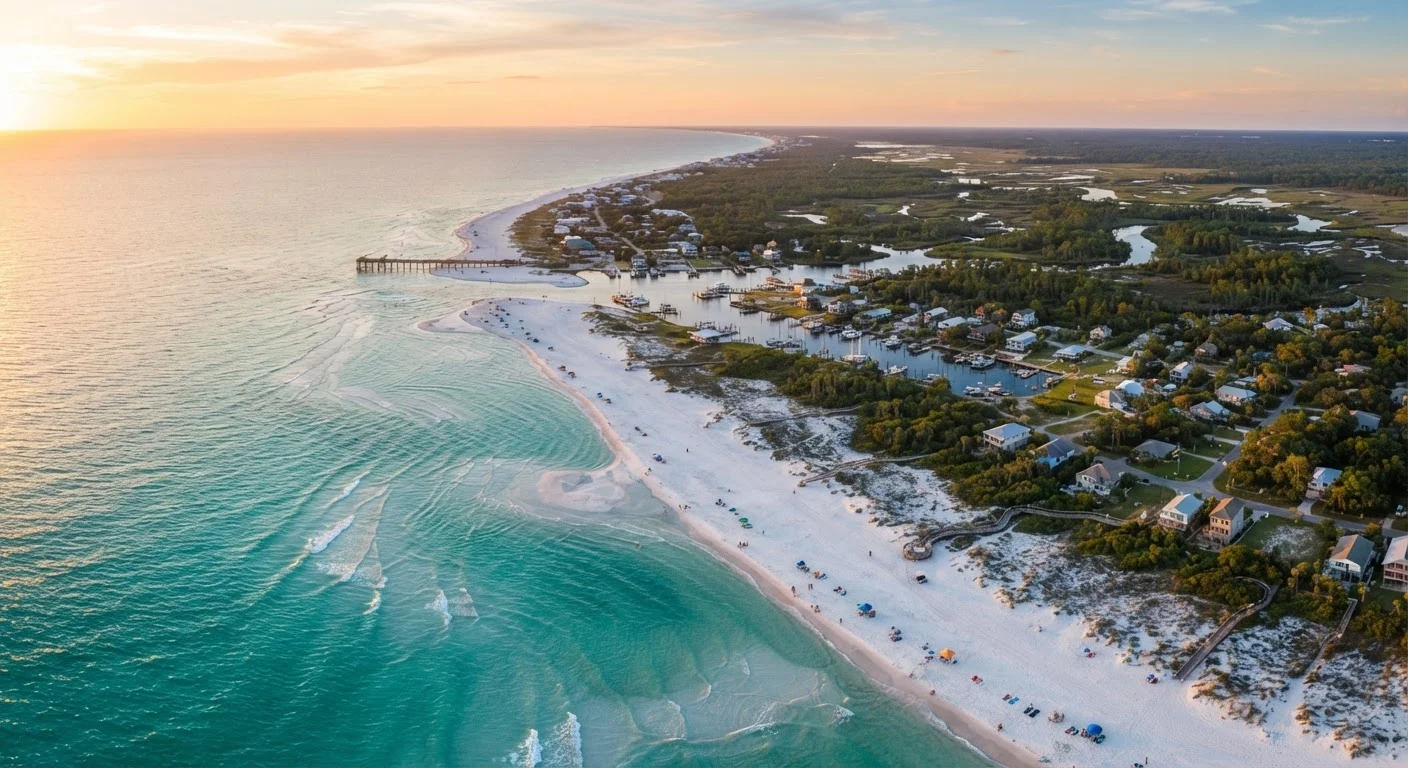
Why the Gulf Coast Deserves More Attention
Most American travelers default to Florida's Atlantic side or the Pacific Coast when they picture a beach trip. The Gulf Coast - stretching roughly 1,600 miles from Brownsville, Texas, to the Florida Keys - rarely gets top billing. That oversight works in curious travelers' favor.
What the Gulf offers is layered in ways that purely scenic coastlines aren't. This is a shoreline shaped by Spanish colonial history, French Creole culture, African American heritage, Indigenous traditions, and successive waves of fishing communities. The food alone spans five distinct culinary vocabularies. The water, shallower and warmer than both coasts, stays swimmable well into autumn along most of the shore.
If you're still deciding whether this region suits your travel personality, understanding what makes a destination genuinely right for you is a useful starting point before booking anything.
1,631 mi
Total US Gulf Coast shoreline length
According to NOAA, the Gulf Coast spans five states from Texas to Florida, including bays and estuaries.
~80°F
Average summer Gulf water temperature
Gulf of Mexico surface temperatures typically reach the high 70s to low 80s Fahrenheit in summer, warmer than most Atlantic beaches.
5 states
States along the Gulf Coast
Texas, Louisiana, Mississippi, Alabama, and Florida each contribute distinct culture, cuisine, and coastline to the corridor.
Texas Gulf Coast: Bayous, BBQ, and Barrier Islands
The Texas shoreline runs from the Rio Grande Valley north to the Bolivar Peninsula near Galveston. Padre Island National Seashore - the longest undeveloped stretch of barrier island in the US - offers a genuinely wild beach experience, with sea turtle nesting grounds and nearly unbroken dunes. Galveston anchors the urban end: a Victorian port city with a walkable Strand historic district, strong Juneteenth heritage, and a year-round seafood culture built around Gulf shrimp and redfish.
Corpus Christi sits between both worlds, with access to the USS Lexington museum ship, a thriving migratory birding corridor, and the Art Museum of South Texas. Inland day-trips reveal King Ranch, one of the largest ranches in the world, and the complex borderlands culture of the Rio Grande Valley.
Time your visit to the Texas coast for April or October - you'll find milder temperatures, fewer crowds, and some of the best birding in North America as migratory species funnel through the coastal corridor.
The Central Flyway passes directly over the Texas Gulf Coast, making it a globally significant birding destination in spring and fall migration windows.
In Louisiana, skip the tourist-facing restaurants on Bourbon Street for your first serious Creole meal and instead ask locals to point you toward neighborhood lunch spots - these often serve more authentic, better-value plates.
New Orleans' best culinary traditions are rooted in neighborhood cooking; the most celebrated local dishes are frequently found in unfussy, family-run spots rather than high-profile venues.
Food here leans toward Gulf Coast Tex-Mex, smoked brisket, and fresh-caught shrimp po'boys. Don't overlook the Vietnamese seafood restaurants concentrated around Port Arthur - the result of a large Gulf Coast Vietnamese community whose culinary imprint is deeply regional.
Louisiana: Where the River Meets the Sea
Louisiana's Gulf Coast isn't a beach destination in the traditional sense - it's a delta landscape of bayous, barrier islands, and wetlands that feels unlike anywhere else in the country. New Orleans is the obvious entry point, and it earns every word written about it: the French Quarter, the Tremé neighborhood's jazz heritage, the extraordinary Creole and Cajun food scene, and Mardi Gras traditions that run all year in spirit if not in parade form.
Beyond the city, the Atchafalaya Basin - the largest river swamp in the US - rewards visitors who rent a kayak or join a guided tour. The small towns of Breaux Bridge, Eunice, and Opelousas are anchors of Cajun culture, with zydeco music halls, boudin sausage stands, and crawfish farms that supply the whole country.
The Gulf Coast communities here - Grand Isle, Houma, Thibodaux - offer a quieter, fishing-village version of Louisiana that barely registers on most travel itineraries. They're exactly the kind of places that underestimated domestic destinations are made of.
Mississippi and Alabama: The Quiet Middle
Mississippi's Gulf Coast gets passed over partly because it's genuinely compact - about 62 miles of shoreline - but that brevity obscures real depth. Biloxi carries centuries of French colonial history alongside its current identity as a resort corridor. The nearby Maritime and Seafood Industry Museum tells the region's oystering and shrimping story better than most places in the country.
Ocean Springs, just east of Biloxi, has evolved into one of the Gulf's most quietly impressive arts towns. The Walter Anderson Museum of Art celebrates an artist whose obsessive, luminous paintings of the local coast and barrier islands are among the most distinctive works produced in the American South.
Alabama's slice of the Gulf - centered on Gulf Shores and Orange Beach - delivers some of the coast's finest white-sand beaches. Fort Morgan at the bay's western tip is a remarkably intact 19th-century coastal fortification with Civil War significance. The area's oyster and blue crab traditions anchor a seafood culture that locals rightly take pride in.
Florida Panhandle: Sugar Sand and Southern Roots
The Florida Panhandle surprises travelers expecting the tropical Florida of Miami or the Keys. This is the Deep South's coastline - culturally closer to Alabama than to Orlando, with a strong country music presence, military history (Pensacola Naval Air Station and the National Naval Aviation Museum are significant draws), and arguably the finest quartz-white sand beaches in the continental US.
Pensacola's historic downtown, Seaside's planned architecture, and the raw beauty of Grayton Beach State Park all offer different registers of the same shoreline. The Emerald Coast corridor between Destin and Panama City Beach draws enormous summer crowds; traveling in spring or fall meaningfully changes the experience. Apalachicola, farther east and less visited, remains one of the Gulf's most charming small towns - famous for oysters, a thriving arts scene, and a pace that feels genuinely unhurried.
If you're weighing this region against other landscapes entirely, comparing what coastal and mountain trips actually deliver can sharpen your thinking before you commit.
Planning Your Gulf Coast Journey
The Gulf Coast rewards road-trippers more than almost any US region. The logical route follows US-90 and US-98 through coastal towns, with Interstate 10 as the faster parallel option when time is tight. Flying into Houston, New Orleans, or Pensacola and driving the coast between two of those hubs creates a natural point-to-point itinerary.
Seasonality matters significantly. Peak summer brings high heat, humidity, and crowds to the most popular beaches. Spring (March through May) and fall (September through November, storm risk aside) offer the most comfortable conditions and thinner crowds. Hurricane season officially runs June 1 through November 30; always check the National Hurricane Center's forecasts and verify your travel insurance terms before booking Gulf Coast trips during those months.
Budget considerations: The Gulf Coast spans a wide cost range. New Orleans accommodations and dining can rival any major US city; Mississippi's coast and the Alabama Gulf Shores corridor offer substantially more affordable options. State park campgrounds along the route - particularly in Florida and Texas - are among the most scenic and economical stays available.
For travelers heading out solo, the realities of solo travel in the US offers an honest look at what to anticipate on an independent Gulf Coast itinerary.
Travel Insurance Is Worth Reviewing Here
Given the Gulf Coast's hurricane season overlap with popular travel windows, reviewing what your travel insurance actually covers - including weather cancellations and evacuation costs - is particularly worthwhile before booking. Policies vary considerably in what qualifies as a covered event. Always read the policy terms and consult the insurer directly if you have questions.
The content provided on our blog site traverses numerous categories, offering readers valuable and practical information. Readers can use the editorial team’s research and data to gain more insights into their topics of interest. However, they are requested not to treat the articles as conclusive. The website team cannot be held responsible for differences in data or inaccuracies found across other platforms. Please also note that the site might also miss out on various schemes and offers available that the readers may find more beneficial than the ones we cover.