

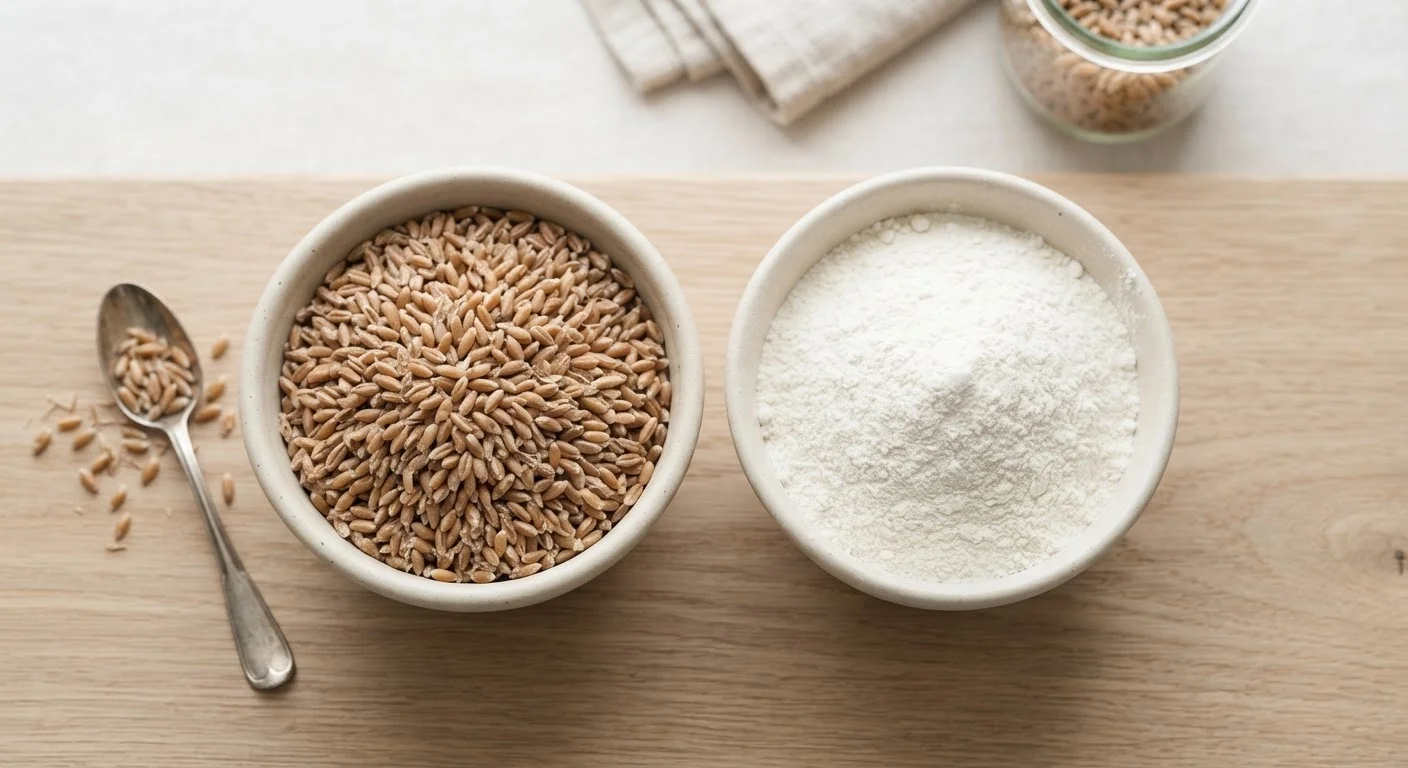
Option A
Whole Grains
The nutritionally complete, minimally processed grain option.
Best for: People seeking to maximize fiber, vitamins, and minerals from everyday grain foods.
Option B
Refined Grains
The widely available, highly processed grain alternative.
Best for: Situations where texture, shelf life, or palatability is prioritized over nutritional density.
What Happens Inside the Grain During Milling
A grain kernel is composed of three distinct parts: the bran (the fibrous outer shell), the germ (the nutrient-dense embryo), and the endosperm (the starchy interior). Whole grains preserve all three. Refined grains do not.
During conventional milling, the bran and germ are physically separated and removed, leaving only the starchy endosperm. This produces a finer, softer flour with a longer shelf life - the germ's natural oils can go rancid over time, so removing it extends storage. The trade-off is significant nutritional loss.
The bran layer contains the majority of a grain's dietary fiber, along with B vitamins like thiamine, riboflavin, and niacin. The germ supplies vitamin E, healthy fats, additional B vitamins, and a range of minerals including iron, magnesium, and zinc. When both are discarded, roughly 25% of a grain's protein and the bulk of at least 17 key nutrients are lost, according to the Whole Grains Council.
| Criterion | Whole Grains | Refined Grains |
|---|---|---|
| Kernel parts retained | Bran, germ, and endosperm | Endosperm only |
| Dietary fiber content | High (intact from bran) | Low (bran removed) |
| B vitamins | Naturally present | Partially added back via enrichment |
| Vitamin E | Present (from germ) | Largely absent |
| Glycemic impact (general) | Lower (fiber slows digestion) | Higher (faster starch breakdown) |
| Shelf life | Shorter (oils in germ can oxidize) | Longer (germ removed) |
| Texture and palatability | Denser, heartier | Lighter, softer |
Enrichment: What Gets Added Back - and What Doesn't
Since the mid-20th century, US regulations have required that certain refined grain products be enriched - meaning specific nutrients stripped during milling are added back synthetically. These typically include iron and several B vitamins: folic acid, thiamine, riboflavin, and niacin.
Enrichment has had meaningful public health outcomes. The mandatory addition of folic acid to enriched grains in 1998 is credited with substantially reducing neural tube defect rates in the United States. These nutritional wins are real and worth acknowledging.
However, enrichment does not restore everything. Dietary fiber is not added back. Neither are most phytochemicals - the plant compounds in the bran and germ that researchers continue to study for their potential roles in metabolic health. Enrichment is partial restoration, not nutritional equivalence.
A Note on Individual Dietary Needs
While whole grains are broadly recommended, some individuals - including those with certain digestive conditions or specific medical dietary requirements - may need personalized guidance on grain intake. High-fiber foods are not universally suitable for everyone. If you have a chronic condition or are following a medically supervised diet, consult a registered dietitian before making significant grain-related changes.
This article is intended for general informational purposes only and does not constitute medical or dietary advice. Consult a registered dietitian or healthcare provider before making significant changes to your diet.
How to Identify Whole Grains on a Label
Food labeling in the US can be genuinely confusing. Terms like multigrain, wheat bread, stone-ground, and seven-grain describe characteristics of a product but do not confirm it is made primarily from whole grains. A product could use all of these descriptors and still be mostly refined flour.
The reliable indicator is the ingredients list. Look for the word "whole" before the grain name - for example, "whole wheat flour," "whole oat flour," or "whole grain corn." The first ingredient listed by weight is the most abundant in the product. If a refined flour appears first, the product is predominantly refined even if some whole grain is present.
Understanding what's in processed grain foods connects directly to the broader question of food processing - if you want a deeper look at how manufacturers transform ingredients, see what 'ultra-processed food' actually means and why it matters.
≥50%
Recommended whole grain share of daily grains
The 2020-2025 Dietary Guidelines for Americans recommend that at least half of all grains consumed daily be whole grains.
~17
Nutrients significantly reduced during refining
The Whole Grains Council notes that conventional milling removes meaningful amounts of at least 17 nutrients found naturally in the whole kernel.
~6%
Reduction in neural tube defect rates
The CDC has linked mandatory folic acid fortification of enriched grain products, introduced in 1998, to a meaningful decrease in neural tube defects in the US.
The content provided on our blog site traverses numerous categories, offering readers valuable and practical information. Readers can use the editorial team’s research and data to gain more insights into their topics of interest. However, they are requested not to treat the articles as conclusive. The website team cannot be held responsible for differences in data or inaccuracies found across other platforms. Please also note that the site might also miss out on various schemes and offers available that the readers may find more beneficial than the ones we cover.