

Our Verdict
A home workout setup can be one of the most cost-effective and sustainable ways to stay active - provided you start with the essentials and resist the urge to over-invest before you've established a habit. The core gear is minimal and accessible; the rest is optional and best added gradually based on actual needs.
Best for self-motivated individuals who want flexibility and convenience, or anyone building an exercise habit for the first time without committing to a gym membership.
The Case for Working Out at Home
Home workouts have moved well beyond a pandemic-era workaround. For many Americans, exercising at home is a practical, long-term strategy - one that removes common barriers like commute time, membership costs, and scheduling pressure. But a cluttered garage full of unused equipment is its own kind of barrier.
The key question isn't whether a home gym is a good idea - it often is. The real question is: what do you actually need to make it work? If you're weighing home training against other options, our guide on group exercise vs. solo training can help you think through which approach fits your life.
No commute or membership fees required
Eliminating travel time and monthly gym dues removes two of the most common reasons people abandon exercise routines. Over a year, savings can be substantial.
Exercise on your own schedule
Home access means a 6 a.m. session or a late-evening workout is equally available, making it far easier to stay consistent around work and family commitments.
Private, low-pressure environment
Many people feel self-conscious in public gyms, particularly when starting out. Exercising at home removes that social barrier entirely.
Minimal equipment covers a wide range of goals
Resistance bands, a mat, and bodyweight movements can address strength, flexibility, and cardiovascular fitness - covering the core components of a well-rounded routine.
Easy to integrate into daily routine
A home setup lets you slot movement into gaps throughout the day - a 20-minute session between meetings is far more feasible without travel involved.
What You Actually Need (The Non-Negotiables)
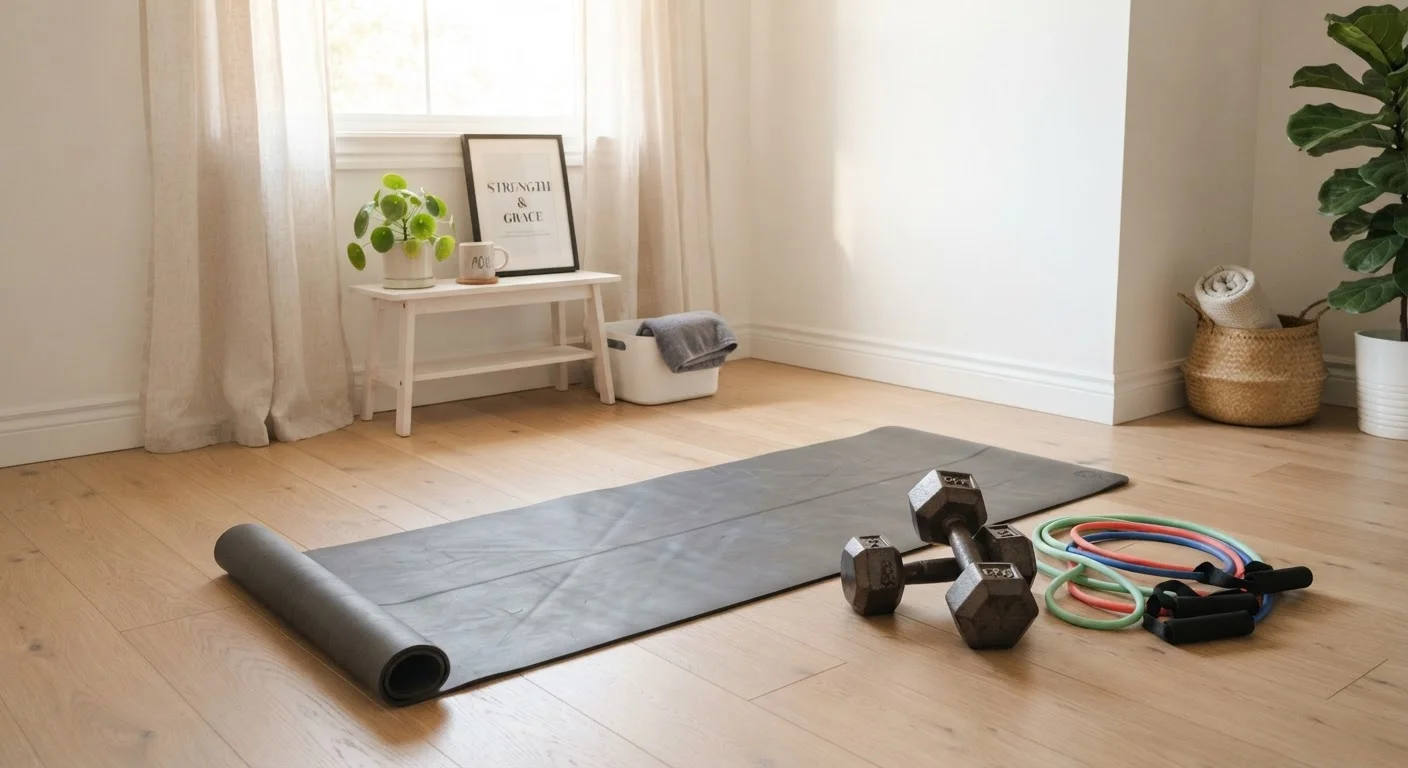
Effective home workouts genuinely require very little. Here's what earns its space:
- A clear, dedicated space: Even a 6×6 foot area is enough for most bodyweight and resistance work. You don't need a separate room - a cleared section of a bedroom or living room works.
- A quality exercise mat: Provides joint cushioning for floor work, stretching, and yoga-style movements. A durable mat also doubles as your visual cue that it's workout time.
- Resistance bands (a set of varied tensions): Lightweight, inexpensive, and remarkably versatile. Bands can replicate many cable and free-weight movements for strength, mobility, and rehabilitation work. Our bodyweight strength training guide shows how far you can go with minimal equipment.
- Supportive footwear: Appropriate shoes protect joints during lateral movements and jumping. Bare feet are fine for yoga or mobility work, but not for high-impact sessions.
- A reliable timer or interval app: Structuring work-to-rest ratios is a simple habit that makes sessions more effective - and free apps handle this well.
A Note on Starting Small
Research consistently shows that habit formation - not equipment quality - is the strongest predictor of long-term exercise adherence. Starting with the minimum viable setup reduces the risk of over-investing before you know what your routine will actually look like. You can always add gear later, but you can't get back money spent on equipment gathering dust. If you're thinking about how to approach any kind of deliberate, needs-based packing approach to purchasing, the same logic that applies to packing for a trip without overpacking works well here too - bring only what you'll genuinely use.
What's Nice to Have (But Not Necessary)
Once you've established a consistent routine - a process that typically takes several weeks - adding equipment becomes a meaningful investment rather than an impulse purchase.
Self-motivation is entirely your responsibility
Without a class schedule, a trainer, or workout partners, it's easy to postpone sessions indefinitely. External accountability structures common in gyms are absent by default.
Space limitations restrict some exercise types
Apartment living or shared spaces can make high-impact cardio, heavy lifting, or large movement patterns impractical or inconsiderate to neighbors and housemates.
No professional oversight of form or progression
Poor movement technique is a leading cause of home-workout injuries. Without a trainer present, learning to self-correct requires extra effort and attention.
Equipment costs add up if not planned carefully
Buying gear reactively - one piece at a time without a clear plan - can result in spending more than a gym membership would have cost, with less utility per dollar.
Home distractions undermine workout quality
Children, household chores, phones, and TV compete for attention in ways a dedicated gym environment doesn't. Protecting workout time at home requires deliberate habit-setting.
Optional gear worth considering after building your habit includes:
- Adjustable dumbbells: Space-efficient and useful for progressive overload, but costly upfront.
- Pull-up bar (door-mounted): Adds genuine upper-body pulling work that bands approximate but don't fully replace.
- Foam roller: Helpful for recovery and mobility, though stretching routines cover much of the same ground.
- Stability ball or kettlebell: Adds variety and challenge, best introduced when you've plateaued on foundational movements.
Large-ticket items - cable machines, power racks, commercial cardio equipment - are rarely justified for most home exercisers and carry significant space and budget commitments. Think of your household budget before adding anything substantial.
Honest Pros and Cons of the Home Workout Setup
No setup is perfect for everyone. Here's a balanced look at the real trade-offs:
~$50-$100
Estimated cost of core home workout essentials
A quality mat and a set of resistance bands typically cost less than two months of a mid-tier gym membership in most U.S. cities.
6×6 ft
Minimum floor space for most home workouts
General fitness guidance suggests this footprint comfortably accommodates bodyweight exercises, yoga, and resistance band work.
The advantages are real: no commute, no wait times for equipment, full control over your environment, and the ability to exercise at any hour. These factors significantly reduce one of the most common barriers to physical activity - logistics. If you're just getting started, this beginner's introduction to physical activity can help you understand what a sustainable foundation looks like.
The disadvantages are equally real: without external accountability, motivation can slip. A crowded home, hard floors, or thin walls can make certain exercises impractical. And unlike a gym, there's no professional on-site to check your form or suggest progressions.
Before committing to any new fitness approach, it's worth reviewing a personal readiness checklist to make sure you're set up for success physically and logistically.
This article is for general informational and educational purposes only. It is not a substitute for professional medical advice, diagnosis, or treatment. Consult a qualified healthcare provider before beginning any new exercise program, particularly if you have existing health conditions or injuries.
The content provided on our blog site traverses numerous categories, offering readers valuable and practical information. Readers can use the editorial team’s research and data to gain more insights into their topics of interest. However, they are requested not to treat the articles as conclusive. The website team cannot be held responsible for differences in data or inaccuracies found across other platforms. Please also note that the site might also miss out on various schemes and offers available that the readers may find more beneficial than the ones we cover.