

What School Zone Signs Are Actually Telling You
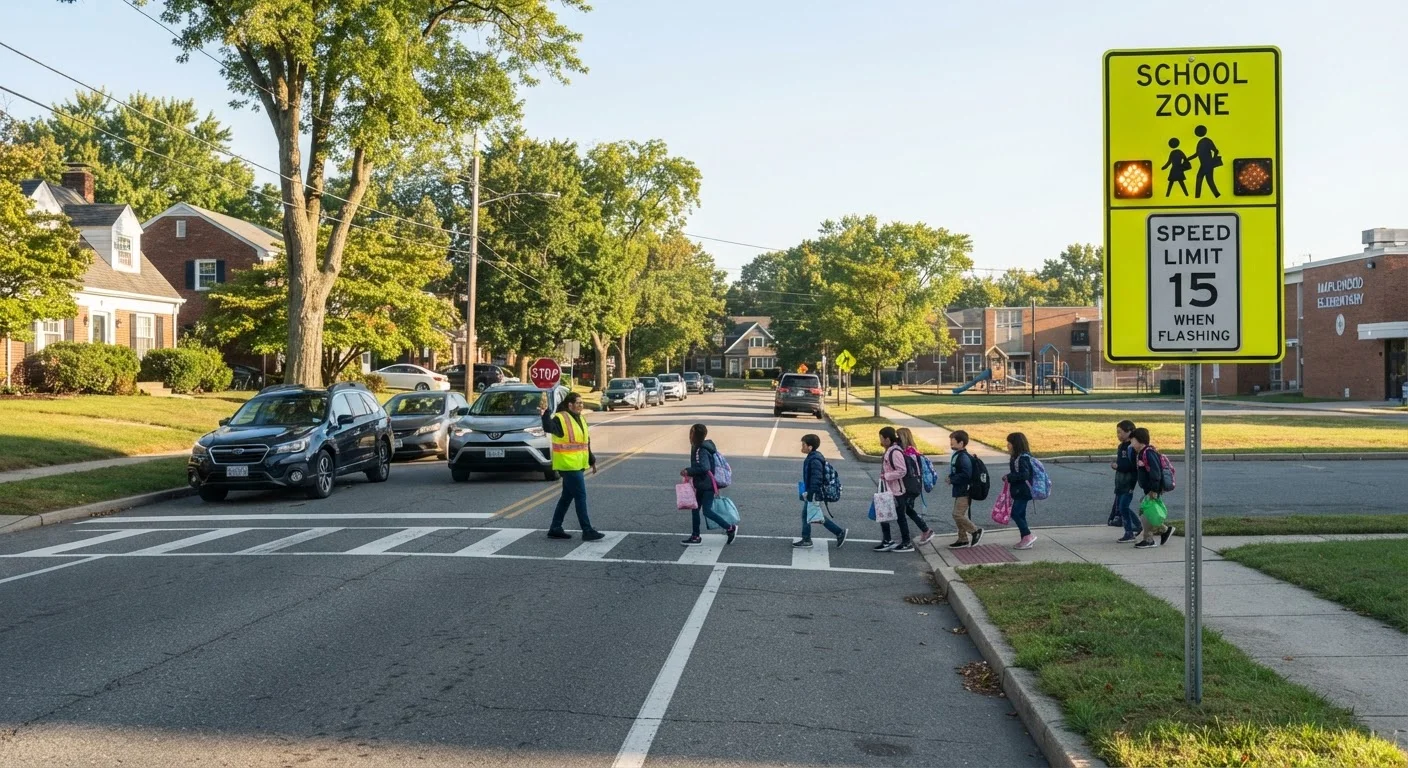
Most drivers recognize the bright yellow pentagon-shaped school warning sign, but fewer understand exactly what each element requires of them legally. School zone signage typically includes three distinct messages: an advance warning that a school zone is ahead, the reduced speed limit that applies within the zone, and time-and-day restrictions indicating when that limit is in effect.
Some zones supplement fixed signs with flashing amber beacons mounted above the speed limit. In many states, the reduced speed limit is only enforceable while those beacons are flashing - but in others, the posted hours are binding whether or not lights are active. Treat every illuminated beacon as a firm legal signal to drop your speed immediately.
Zone boundaries matter too. Look for the sign marking where the school zone ends - it's easy to accelerate too soon if you're not watching for it. For a broader refresher on how speed limits work across different road types, see our quick rules reference on speed limits and right-of-way.
The School Bus Stop Law Every Driver Must Know
One of the most serious and commonly misunderstood rules in American traffic law involves school buses. When a school bus activates its red flashing lights and extends its stop arm, traffic in both directions must stop on undivided roads - you cannot pass until the arm retracts and lights deactivate. This rule applies in all 50 states.
On divided highways with a physical median, the rules vary: some states require only oncoming traffic to stop, while others require all lanes to halt. Ignorance of your state's specific rule is not a legal defense, and penalties are steep - fines can exceed $1,000 in some states, with repeat violations leading to license suspension.
Watch for School Bus Cameras
Automated school bus cameras are increasingly common nationwide. These systems photograph vehicles that illegally pass stopped buses, and citations can be issued even without a police officer present. Camera enforcement means the risk of a fine exists even on quiet streets with no visible patrol.
Automated school bus cameras are increasingly common nationwide. These systems photograph vehicles that illegally pass stopped buses, and citations can be issued even without a police officer present.
Crossing Guards: Legal Authority and Driver Obligations
A crossing guard's signal carries the same legal weight as a traffic signal or a law enforcement officer's direction. When a guard steps into the roadway and raises a hand or stop sign, you are required by law to stop - even if the traffic light is green. Failing to yield to a crossing guard is a traffic violation in every state.
Practically speaking, approach any intersection near a school with your foot near the brake, not the accelerator. Crossing guards may appear at locations without traffic signals, and their visibility can be limited by parked vehicles or morning glare. This kind of attentional challenge is similar to the visibility risks drivers face after dark - the environment demands active scanning, not passive cruising.
School Zone Rules Vary by State
There is no single federal school zone standard - each state sets its own speed limits, enforcement hours, and bus-stop rules. If you regularly drive in multiple states, it's worth reviewing the DMV guidelines for each jurisdiction. Assumptions based on your home state's rules can lead to unintended violations when traveling.
Fines, Penalties, and Why School Zone Violations Cost More
School zone traffic fines are intentionally punitive. Most states impose doubled or even tripled base fines for speeding violations that occur within a school zone during active hours. A speeding ticket that might cost $150 on an ordinary road can run $300 or more inside a school zone - and some municipalities layer on additional surcharges.
Beyond fines, violations typically add points to your driving record, which can raise insurance premiums. Certain serious violations - like striking a pedestrian in a school zone - can carry criminal charges. The financial and legal consequences are designed to reinforce what the risk data already shows: children near schools are disproportionately vulnerable, and the stakes of driver error are extremely high.
Distraction is one of the leading factors in school-zone crashes. If you find yourself relying on habits rather than active awareness, review the driving habits that quietly erode road safety - some risky patterns feel completely routine until something goes wrong.
This article provides general information about school zone traffic rules for educational purposes. Laws vary by state and municipality. Always verify current local regulations with your state DMV or a qualified legal professional.
Frequently Asked Questions
School zone speed limits vary by state and municipality, but commonly fall between 15 and 25 mph. Always look for posted signs, as the limit can differ even within the same city. When in doubt, slow down and match the posted zone limit.
Generally, no - school zone rules typically apply only on school days during specified hours. However, this varies by jurisdiction. Some signs display time-and-day restrictions; if yours doesn't, check your state's DMV guidelines or err on the side of caution.
Passing a stopped school bus with an extended stop arm is illegal in all 50 states. Penalties can include significant fines, license points, and in some states, license suspension. Many states have expanded these rules to apply on divided highways as well.
Not in every state. Some states only enforce the reduced speed limit when the amber beacons are flashing; others enforce it during posted hours regardless. Check your state's specific rules so you aren't caught off guard.
Yes. In most jurisdictions, the presence of children is not required for the speed limit to be legally enforceable - what matters is the posted time or the active beacon. Officers and automated cameras enforce these limits regardless of whether children are in sight.
Many school zones extend beyond the school's immediate frontage and cover nearby side streets and intersections. The zone boundaries are marked by signage - watch for both the start and end signs to know exactly where the rules apply.
The content provided on our blog site traverses numerous categories, offering readers valuable and practical information. Readers can use the editorial team’s research and data to gain more insights into their topics of interest. However, they are requested not to treat the articles as conclusive. The website team cannot be held responsible for differences in data or inaccuracies found across other platforms. Please also note that the site might also miss out on various schemes and offers available that the readers may find more beneficial than the ones we cover.