

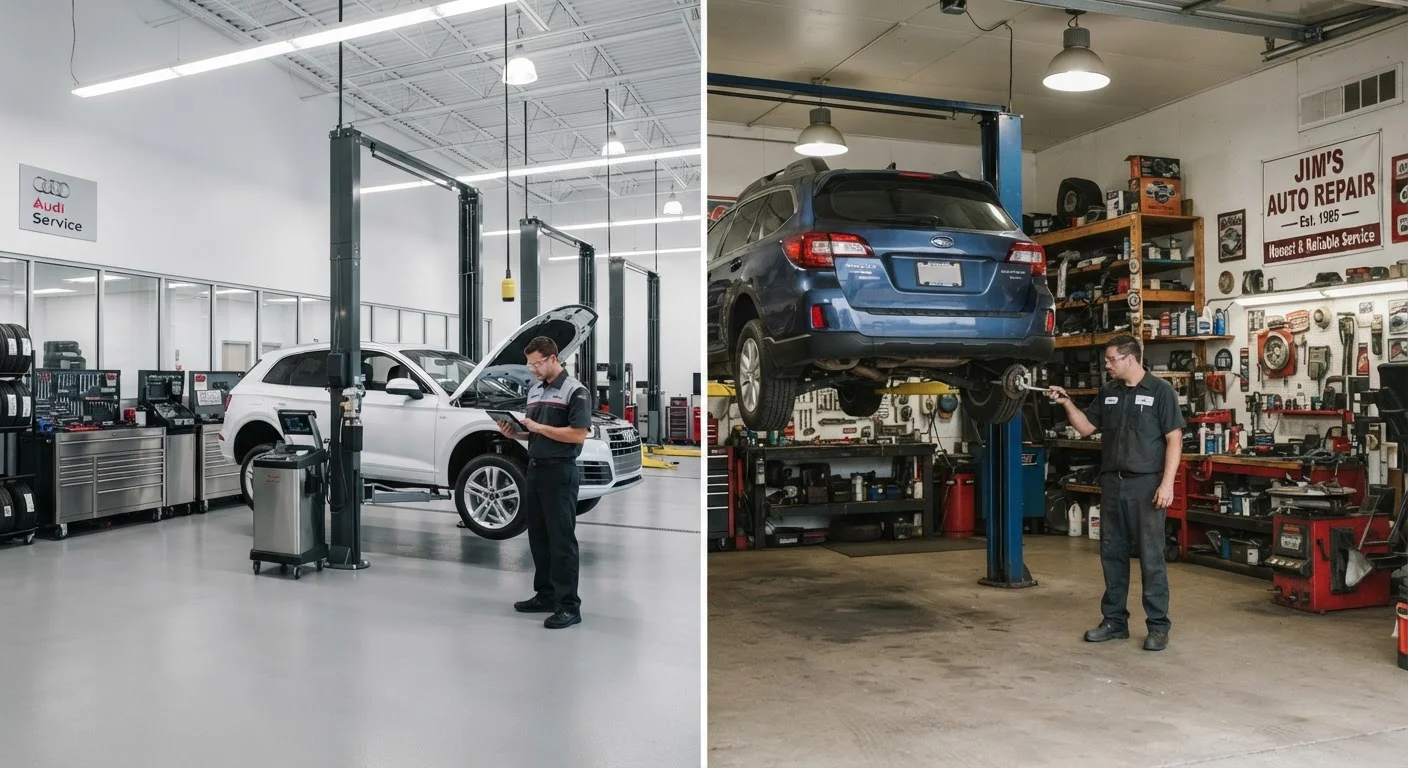
Our Verdict
Dealer service centers carry clear advantages for warranty-related work, recalls, and complex, model-specific diagnostics. Independent shops often deliver competitive quality at lower cost for routine maintenance and common repairs. Most drivers benefit from using both strategically rather than committing exclusively to one.
| Best for | Recommended |
|---|---|
| Vehicles still under manufacturer warranty | Dealer Service Center |
| Routine maintenance on older, out-of-warranty vehicles | Independent Mechanic |
| Complex electrical or software diagnostics on newer models | Dealer Service Center |
| Budget-conscious drivers seeking everyday upkeep | Independent Mechanic |
Why This Decision Matters More Than Most Drivers Realize
Choosing where to take your car for service isn't just a convenience question - it directly affects what you pay, how long work takes, and whether your warranty remains intact. Yet most drivers pick based on habit or proximity rather than a clear-eyed look at their situation.
The good news: this is a manageable decision once you understand what each option actually offers. Before you read a mechanic's estimate, it helps to know who wrote it and why the source matters.
| Dealer Service Center | Independent Mechanic | |
|---|---|---|
| Technician Training | Brand-specific factory training | ASE-certified or trade-school trained |
| Parts Used | OEM parts standard | OEM, aftermarket, or remanufactured |
| Typical Labor Cost | Higher hourly rates | Generally lower hourly rates |
| Warranty & Recall Work | Required for recall repairs | Cannot perform recall work |
| Diagnostic Capability | Proprietary brand-specific tools | Advanced aftermarket tools; may have limits |
| Best For | Newer, warranted, or complex vehicles | Older vehicles, routine maintenance |
What Dealer Service Centers Do Well
Franchised dealership service departments employ technicians trained specifically on their brand's vehicles. They have access to OEM parts - components made to the same specifications as what came on your car originally - and proprietary diagnostic software that aftermarket tools may not fully replicate.
This specialization matters most in three scenarios:
- Active warranties: Federal law (the Magnuson-Moss Warranty Act) does not require you to use a dealer for routine maintenance to keep a warranty valid, but warranty repair work itself must typically be completed at an authorized facility.
- Recalls and technical service bulletins: Only dealers can perform recall repairs, which are covered at no charge to you.
- Advanced diagnostics: Newer vehicles with complex driver-assistance systems or proprietary software architecture often need brand-specific tools to diagnose accurately.
The trade-off is cost. Dealer labor rates tend to run higher than independent shops, and OEM parts carry a price premium over comparable aftermarket alternatives.
Keep Records Regardless of Where You Go
Whether you use a dealer or an independent shop, always save itemized invoices for every service visit. A documented maintenance history supports warranty claims, helps your mechanic diagnose future issues, and can add credibility when selling the vehicle. Digital photos of your odometer reading at each visit are a simple backup habit worth building.
Where Independent Mechanics Hold Their Own
A well-established independent shop with certified technicians - look for ASE certifications as one quality indicator - can handle the vast majority of work most vehicles need over their lifetime: oil changes, brake service, tire rotations, belt and fluid replacements, suspension work, and many engine repairs.
Independent mechanics generally charge lower hourly labor rates and can source quality aftermarket or remanufactured parts that meet or exceed OEM specifications for common repairs. For a high-mileage vehicle well past its warranty period, paying dealer rates for routine work rarely adds tangible value.
The relationship factor is also real. A trusted independent mechanic who knows your car's history can be a genuine asset. That said, vetting a new shop requires some legwork: check reviews, ask about certifications, and always request a written estimate before authorizing any work. Our guide to understanding a repair estimate walks through what those line items mean.
Key Factors to Weigh for Your Situation
Rather than defaulting to one option, consider these variables:
- Warranty status
- If your vehicle is under a manufacturer or extended warranty, confirm what the warranty terms require before choosing a shop. Routine maintenance at an independent shop is generally permissible, but keep records.
- Vehicle age and complexity
- Older vehicles with well-understood mechanical systems are strong candidates for independent repair. Late-model vehicles with advanced electronics may genuinely benefit from dealer diagnostics.
- Nature of the repair
- Recalls and warranty claims are dealer territory by necessity. Brake pads and oil changes are not.
- Cost and convenience
- Factor in labor rate differences, parts sourcing, loaner vehicle availability, and scheduling flexibility. These vary widely even within each category.
For a broader look at how dealer relationships affect your overall vehicle costs, see the Car Costs & Finance hub. If you're also evaluating what maintenance tasks you can handle yourself, that comparison can further sharpen your decision.
The content provided on our blog site traverses numerous categories, offering readers valuable and practical information. Readers can use the editorial team’s research and data to gain more insights into their topics of interest. However, they are requested not to treat the articles as conclusive. The website team cannot be held responsible for differences in data or inaccuracies found across other platforms. Please also note that the site might also miss out on various schemes and offers available that the readers may find more beneficial than the ones we cover.