

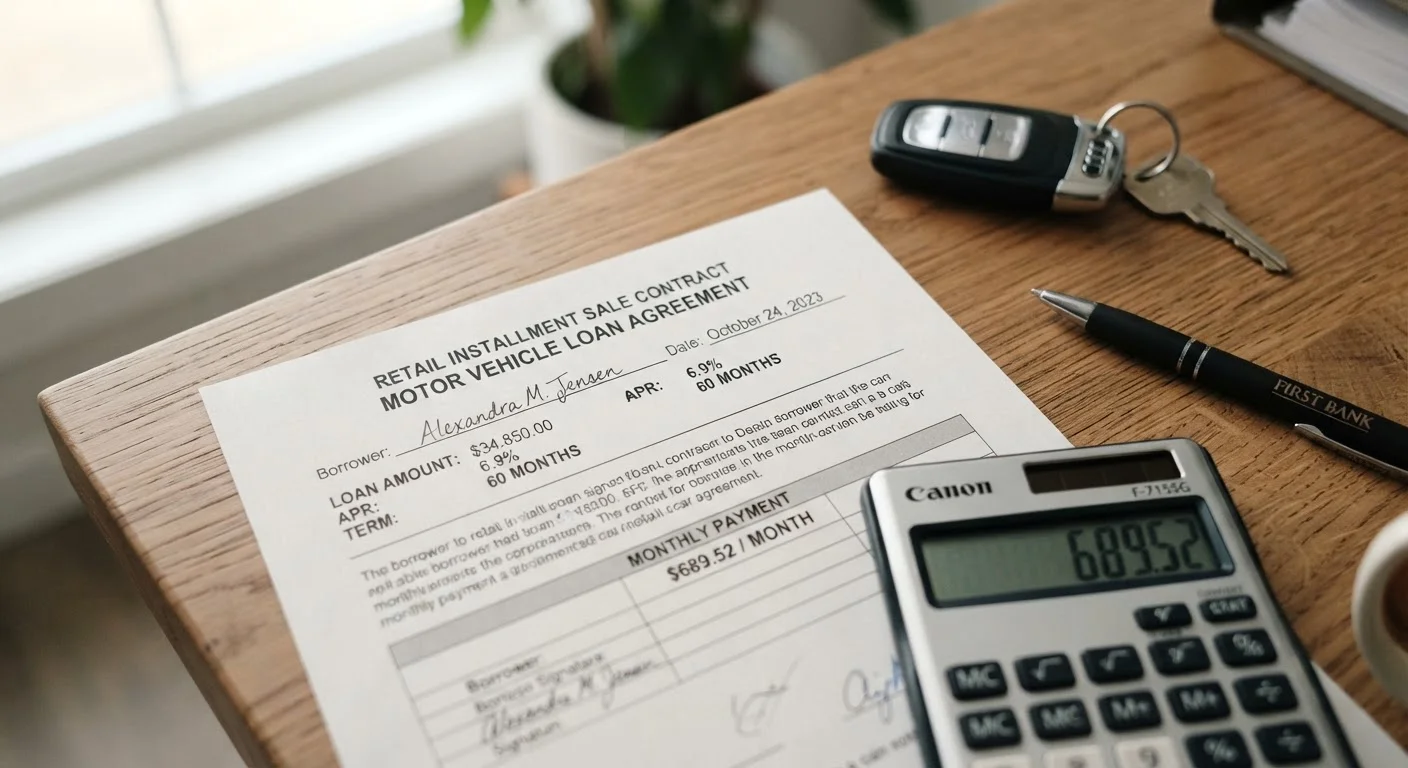
The Monthly Payment Is a Partial Picture
When a salesperson or lender quotes a monthly payment, they are showing you one output of a much more complex equation. The same monthly figure can result from a low-price car with a short loan, or a high-price car stretched over many years. Without seeing the other variables, the number is nearly meaningless as a measure of affordability.
Consider two scenarios. In one, a driver finances $22,000 over 48 months at a reasonable interest rate. In another, a different driver finances $32,000 over 84 months at a higher rate. Both might land near the same monthly payment - but the second driver pays thousands more in interest and owns a vehicle that depreciates faster than the loan balance shrinks. The payment number alone would never reveal that gap.
To genuinely understand what you're committing to, you need to look at the total cost of the loan: the monthly payment multiplied by the number of payments. That figure, not the monthly installment, reflects what you are actually paying for the car.
How Loan Terms Quietly Inflate Costs
Auto loan terms have grown significantly longer over time. Loans of 72 or even 84 months are now common. Lenders and dealers often present these extended terms as a convenience - a way to keep payments manageable. In practice, they can substantially increase what you pay overall.
84 months
Common maximum auto loan term offered today
Industry data from Experian and others has tracked a steady rise in loan terms exceeding six years among new and used vehicle borrowers in the US.
~$1,000+
Extra interest on a long vs. short loan term
Extending a loan from 48 to 72 months on a typical financed amount can add over a thousand dollars in total interest, even at the same interest rate.
Over 30%
Share of trade-ins with negative equity
Automotive industry research has consistently found that roughly a third or more of vehicle trade-ins carry a negative equity balance at the time of trade.
Interest accrues over every month of the loan. The longer the term, the more months interest compounds on the remaining balance. A driver who stretches repayment to seven years on a $28,000 loan may pay several thousand dollars more in interest than one who commits to a four-year term, even if the interest rate is similar. That difference is invisible when attention stays fixed on the monthly figure.
Long loan terms also create a window where the car depreciates faster than the loan balance drops - a situation known as negative equity. If you need to sell or trade in the vehicle during that window, you could owe more than it is worth, putting you at a financial disadvantage before your next purchase even begins.
For a deeper look at how interest rates interact with these costs, see our guide on what your APR really means on a car loan.
What the Payment Figure Doesn't Include
Even if you understand the loan structure, the monthly payment figure typically excludes several real costs of ownership. Insurance premiums, registration fees, fuel, maintenance, and unexpected repairs are paid separately - but they are just as real a drain on your budget as the loan itself.
Dealers sometimes roll add-ons - extended warranties, gap insurance, paint protection packages - into the financed amount. This raises the loan balance without visibly changing the monthly payment much, especially when the term is already long. Buyers often agree to these additions without fully registering their total cost.
Calculate Total Cost Before You Sign
Before agreeing to any financing offer, multiply the monthly payment by the number of months. That product is what you are committing to pay. Compare that number - not just the monthly figure - across different loan options or term lengths to make a genuinely informed decision.
The hidden costs of car ownership extend well beyond the loan payment. Budgeting only for the monthly installment consistently leads drivers to underestimate what their vehicle truly costs per year.
Leasing introduces a different structure entirely - one where the monthly payment reflects depreciation and fees rather than building toward ownership. Our explainer on what you're actually paying for when you lease outlines how that math differs.
A Better Way to Evaluate a Car Loan
Shifting your attention from the monthly payment to a set of more meaningful figures changes how you evaluate any financing offer. Before agreeing to a loan, consider asking for - and comparing - the following:
- Total repayment amount: The monthly payment multiplied by the loan term. This is what you actually pay.
- Annual Percentage Rate (APR): A standardized rate that includes interest and certain fees, making it easier to compare offers. See what APR really means for how to read it accurately.
- Loan term in months: Shorter is generally less expensive overall, even if the monthly payment is higher.
- Amount financed: The actual loan balance, which may include rolled-in fees or add-ons beyond the vehicle price.
Armed with these numbers, you can make a side-by-side comparison that reflects real cost rather than surface-level affordability. The monthly payment has its place - it must fit your cash flow - but it should be the last figure you evaluate, not the first.
This article provides general financial information for educational purposes and is not personalized financial or lending advice. Consult a qualified financial professional for guidance specific to your situation.
Frequently Asked Questions
The monthly payment reflects just one variable in a multi-factor loan. Two buyers could have the same $450 monthly payment but very different total costs depending on their interest rate and loan length. Focusing solely on the payment can lead you to overlook how much you are actually paying for the vehicle overall.
Extending your loan term reduces the monthly payment but increases the number of months interest accrues. A six-year loan on the same balance at the same rate will cost meaningfully more in total interest than a four-year loan, even though it feels more affordable month to month.
Negative equity - sometimes called being "underwater" - means you owe more on the loan than the car is currently worth. This typically happens when a long loan term causes the balance to fall more slowly than the vehicle depreciates. It becomes a serious problem if you need to sell or trade in the car before the loan is paid off.
Focus on the total repayment amount (monthly payment multiplied by the number of months), the APR, the loan term, and any fees rolled into the loan. These figures together give you a much clearer picture of what the vehicle actually costs you.
Yes. A larger down payment reduces the amount you borrow, which lowers both the monthly payment and the total interest paid over the life of the loan. It also reduces the risk of negative equity in the early months of ownership.
The content provided on our blog site traverses numerous categories, offering readers valuable and practical information. Readers can use the editorial team’s research and data to gain more insights into their topics of interest. However, they are requested not to treat the articles as conclusive. The website team cannot be held responsible for differences in data or inaccuracies found across other platforms. Please also note that the site might also miss out on various schemes and offers available that the readers may find more beneficial than the ones we cover.