

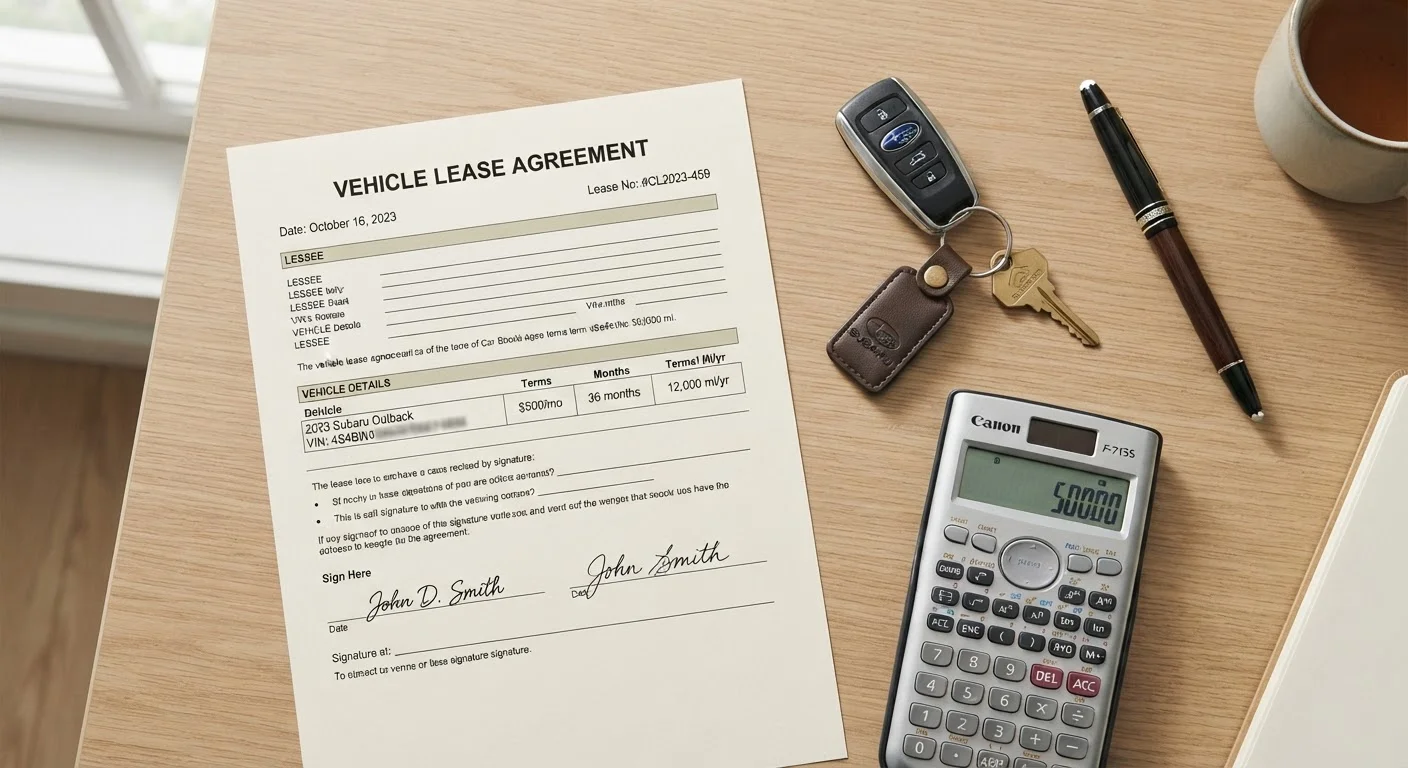
The Core Idea: You're Paying for Depreciation
When you lease a vehicle, you are not financing its full purchase price. You are financing the difference between what the car is worth today and what the leasing company projects it will be worth when the lease ends. That projected future value is called the residual value.
For example, if a vehicle's negotiated price (the capitalized cost) is $35,000 and its residual value after three years is estimated at $21,000, the depreciation you're financing is $14,000 - spread across 36 monthly payments. This is fundamentally different from a loan, where you finance the entire purchase price and gradually build ownership equity. As explored in our article on the true cost of owning a car, depreciation is the single largest expense in most vehicle ownership scenarios - and in a lease, it's essentially the entire product you're buying.
~30%
Typical 3-year depreciation for a new vehicle
Industry data broadly suggests new vehicles lose roughly 30% or more of their value in the first three years, making depreciation the dominant cost in most leases.
10,000-15,000
Standard annual mileage allowance in most leases
Most standard lease contracts set annual mileage caps in this range; exceeding them triggers per-mile fees that can significantly increase total cost.
~28%
Share of new vehicle transactions that are leases
According to Experian automotive data, leasing has historically accounted for roughly a quarter to a third of new vehicle retail transactions in the US.
The Money Factor: The Cost of Financing the Lease
On top of depreciation, every lease includes a financing charge called the money factor (sometimes called the lease factor). It works similarly to an interest rate but is expressed as a very small decimal - for instance, 0.00150. Multiply by 2,400 to get a rough annual percentage rate equivalent (0.00150 × 2,400 = 3.6% APR).
The finance charge is calculated by adding the capitalized cost and the residual value, then multiplying by the money factor. This means financing charges apply to both the amount being depreciated and the portion of the car's value not being consumed - which is one reason leases can feel more expensive than they initially appear.
Ask for the Money Factor Before You Negotiate
Dealerships are not required to volunteer the money factor, but they must disclose it if you ask directly. Getting this number upfront lets you compare the financing cost across different lease offers the same way you'd compare APRs on a loan. Converting it (multiply by 2,400) gives you a familiar percentage to work with.
It's worth understanding that monthly payment figures can be misleading in both leasing and financing contexts. A low monthly figure doesn't always reflect a favorable deal once all costs are factored in.
Fees That Live Outside the Payment Line
The monthly payment is not the full story. Several charges sit outside that figure and affect total lease cost significantly:
- Acquisition fee: A lender fee charged at lease inception, typically $400-$1,000, sometimes rolled into the payment.
- Disposition fee: Charged at lease-end if you return the vehicle and don't lease or buy another from the same brand, often $300-$500.
- Excess mileage charges: Most leases set an annual mileage cap (commonly 10,000-15,000 miles). Going over triggers per-mile penalties.
- Excess wear charges: Damage beyond normal wear - dents, interior stains, tire wear - is billed at return.
- Early termination fees: Ending a lease early can be costly, sometimes rivaling the remaining payments owed.
These charges are detailed in the lease contract and should be read carefully before signing. For a broader look at costs drivers frequently overlook, see our guide on hidden car ownership costs.
How Leasing Compares to Financing Overall
Because you're only paying for depreciation, lease payments are generally lower than loan payments for the same vehicle. But that comparison stops being simple quickly. At lease-end, you have no asset - you return the car and start over. With a loan, payments eventually end and you own the vehicle outright.
Neither path is universally better. Leasing can make sense for drivers who want lower monthly costs, prefer newer vehicles on a regular cycle, and drive predictable mileage. Financing typically builds more long-term value for those who drive high mileage, keep vehicles for many years, or want the freedom to modify or sell. Our detailed leasing vs. financing comparison walks through the long-term cost trade-offs side by side.
This article is for general informational purposes only and does not constitute financial or legal advice. Consult a qualified financial professional for guidance specific to your situation.
Frequently Asked Questions
The money factor is the financing charge built into a lease, similar to an interest rate on a loan. You can convert it to an approximate annual percentage rate by multiplying by 2,400. A lower money factor means you pay less in finance charges over the lease term.
Yes - the capitalized cost (the vehicle's negotiated price) is the most impactful figure to negotiate. Lowering the cap cost reduces your monthly payment the same way a lower purchase price reduces a loan payment. The money factor and acquisition fee are sometimes negotiable depending on the lender.
Excess mileage charges are spelled out in the lease contract and typically range from $0.10 to $0.30 per mile over the limit. These fees can add up to hundreds or thousands of dollars at lease-end, so it's worth estimating your annual mileage carefully before signing.
A large upfront payment (called a capitalized cost reduction) lowers your monthly payment but does not change the total cost of the lease much. It also carries a risk: if the vehicle is totaled early in the lease, you may not recover that money. Many financial educators suggest keeping upfront lease payments modest.
The residual value is the lender's estimate of what the vehicle will be worth at the end of the lease term. A higher residual value means less depreciation is being financed, which lowers monthly payments. It is set by the leasing company and is generally not negotiable.
The content provided on our blog site traverses numerous categories, offering readers valuable and practical information. Readers can use the editorial team’s research and data to gain more insights into their topics of interest. However, they are requested not to treat the articles as conclusive. The website team cannot be held responsible for differences in data or inaccuracies found across other platforms. Please also note that the site might also miss out on various schemes and offers available that the readers may find more beneficial than the ones we cover.