

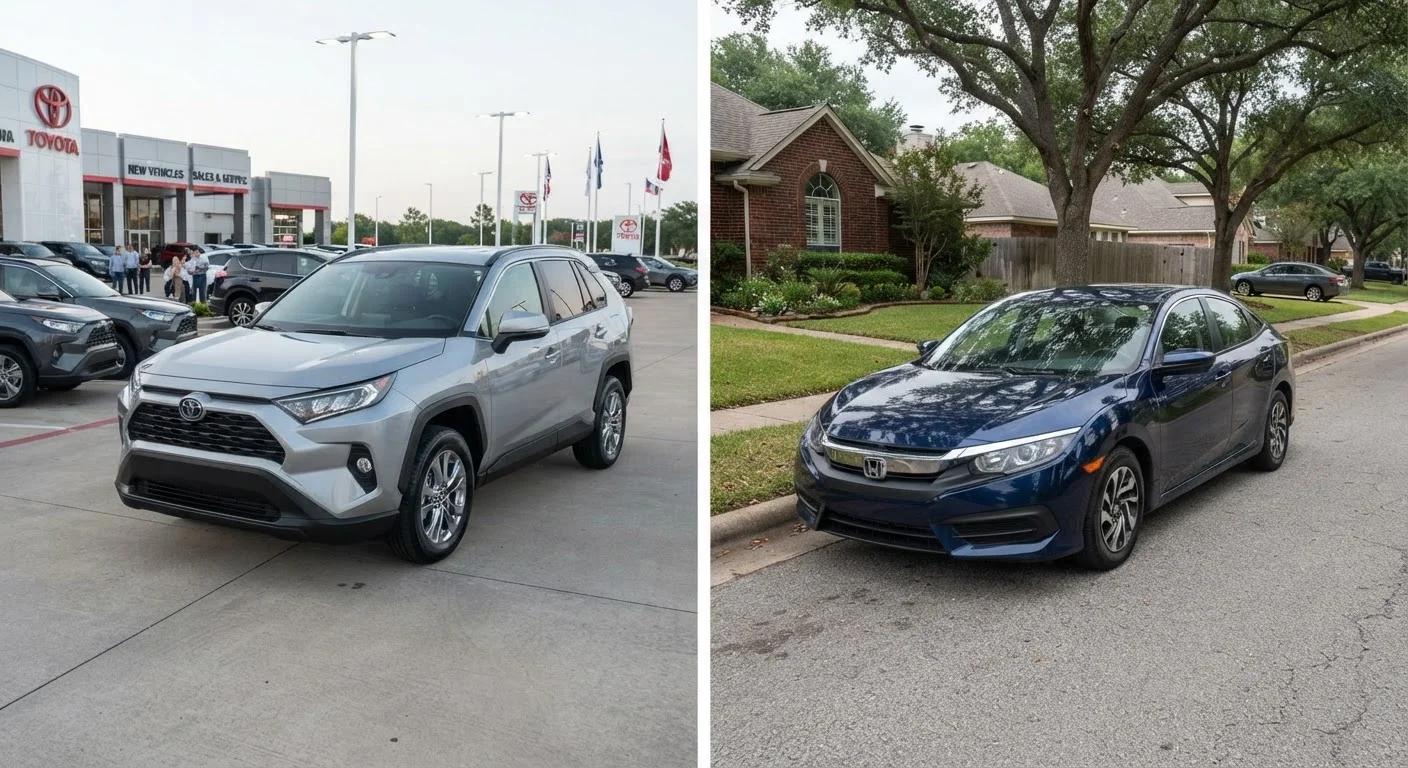
Option A
Buying New
The full-warranty, zero-history choice.
Best for: Drivers who prioritize reliability guarantees, the latest safety features, and predictable ownership costs over the first several years.
Option B
Buying Used
The depreciation-dodge, value-forward alternative.
Best for: Budget-conscious drivers willing to accept some unknowns in exchange for a significantly lower purchase price and slower value loss.
The Depreciation Gap: Where the Real Money Is Lost
No single factor separates new and used vehicle costs more dramatically than depreciation - the rate at which a vehicle sheds market value over time. A new car typically loses a significant portion of its value within the first 12 months of ownership, before the owner has even paid off a meaningful share of the loan principal. Over five years, many vehicles lose roughly half their original purchase price.
This reality means the buyer of a brand-new vehicle absorbs the steepest part of the depreciation curve. A driver who purchases a vehicle that is two or three years old has, in effect, let someone else take that first sharp loss. For a thorough breakdown of how this process works, see how vehicles lose value over time.
Used vehicles still depreciate - but at a slower rate. The practical implication: if you buy used and sell after three years, the gap between what you paid and what you recover is typically narrower than it would be on a comparable new vehicle bought and sold over the same window.
~20%
Average first-year new car depreciation
Industry estimates suggest many new vehicles lose approximately 15-25% of their value within the first 12 months, according to general automotive valuation data.
~50%
Value lost over 5 years on average
Automotive valuation sources broadly indicate that many vehicles retain only around half their original value after five years of ownership.
1-2%+
Typical APR premium on used auto loans
Used vehicle loan rates have historically run higher than new vehicle rates from the same lenders, reflecting increased collateral risk on older vehicles.
Financing, Insurance, and the Hidden Cost Equation
Purchase price is only the opening chapter. Financing terms, insurance premiums, and maintenance costs shape the true cost of ownership in ways that are easy to underestimate. Used car buyers often face higher annual percentage rates (APRs) on auto loans than new car buyers - lenders treat older vehicles as higher-risk collateral. Depending on the rate differential, a lower purchase price on a used vehicle can be partially eroded by the higher interest paid over the loan term.
Insurance costs also vary. Comprehensive and collision coverage on a new vehicle may cost more in absolute dollar terms, though a lower-value used car may still carry similar liability requirements. Drivers should obtain insurance estimates for any specific vehicle before completing a purchase.
| Criterion | Buying New | Buying Used |
|---|---|---|
| Purchase Price | Higher - full market value | Lower - post-depreciation price |
| First-Year Depreciation | Steepest drop (often 15-25%) | Slower, already past the cliff |
| Loan Interest Rate | Typically lower APR | Typically higher APR |
| Warranty Coverage | Full factory warranty | Limited or none (CPO varies) |
| Maintenance Risk | Low - covered under warranty | Higher - history may be unknown |
| Safety Technology | Latest ADAS features standard | Varies by model year |
| Insurance Cost | Often higher in absolute terms | Often lower for older vehicles |
Maintenance is the other variable that quietly separates the two paths. New vehicles under factory warranty shift most major repair costs to the manufacturer for the first several years. Used vehicles - especially those purchased outside of a certified pre-owned program - can carry unknown service histories that surface as unexpected repair bills. Understanding the full picture means looking well beyond the sticker. See our overview of the true cost of owning a car in America for a complete cost framework.
Making the Decision That Actually Fits Your Situation
Neither new nor used is objectively superior - the right answer depends on how you drive, how long you keep vehicles, your financing access, and how much uncertainty you can absorb in your household budget. A driver who holds vehicles for ten years and drives conservatively may find a new car's long warranty and reliability record justify the higher initial cost. A driver replacing vehicles every three to four years is almost certainly better served by a used vehicle that has already weathered its steepest depreciation drop.
It also pays to factor in costs that rarely appear in purchase negotiations. Registration fees, tire replacement cycles, parking, and fuel economy differences are explored in more detail in our piece on hidden car ownership costs most drivers underestimate. And if you are weighing financing options beyond a simple auto loan, leasing vs. financing is worth reading before you sign anything.
Finally, if a trade-in is part of your plan, timing matters. Rolling negative equity - the amount you still owe beyond what your current car is worth - into a new loan is a common and costly mistake. Our guide on trade-in timing explains when trading makes financial sense and when it works against you.
This article is for general informational purposes only and does not constitute personalized financial advice. Consult a qualified financial professional before making significant purchasing or financing decisions.
The content provided on our blog site traverses numerous categories, offering readers valuable and practical information. Readers can use the editorial team’s research and data to gain more insights into their topics of interest. However, they are requested not to treat the articles as conclusive. The website team cannot be held responsible for differences in data or inaccuracies found across other platforms. Please also note that the site might also miss out on various schemes and offers available that the readers may find more beneficial than the ones we cover.