

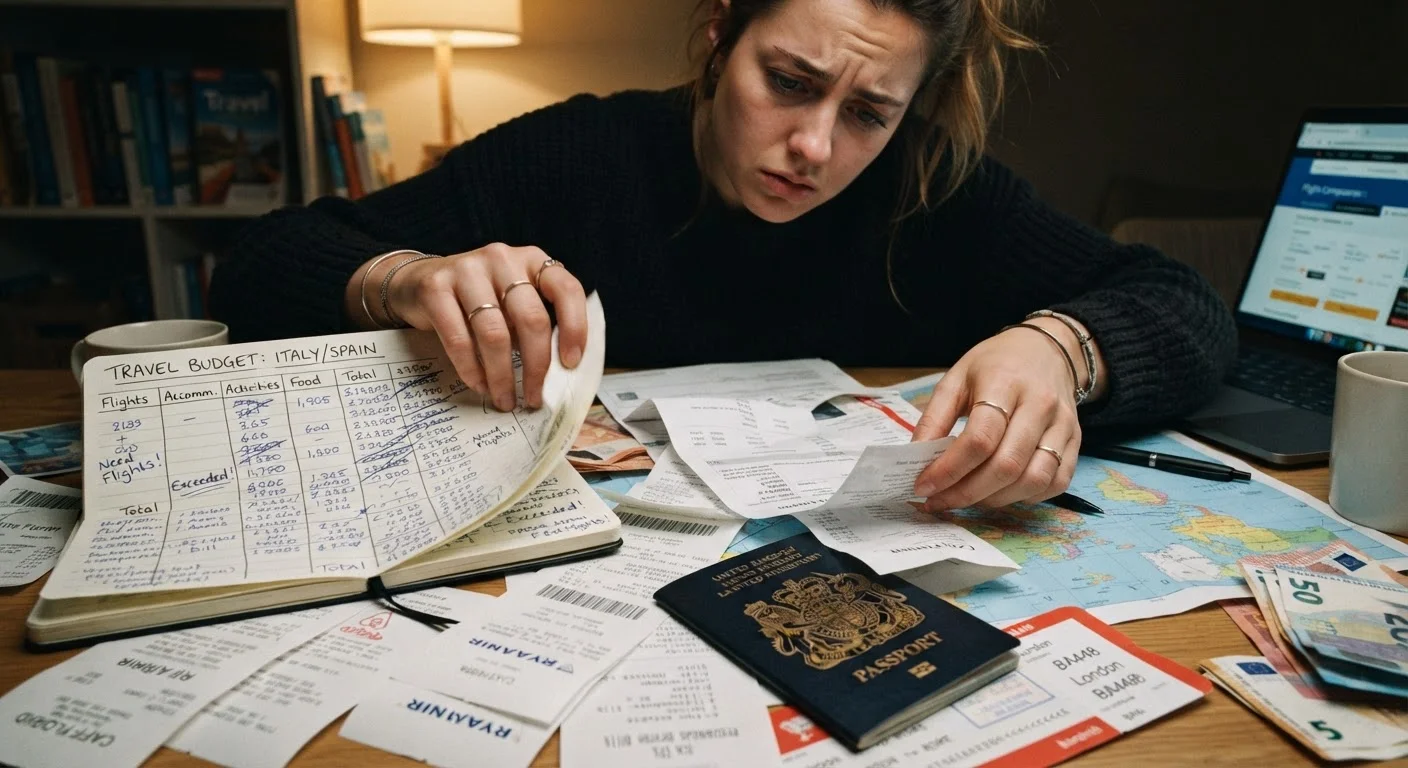
The Planning Phase Is Where Most Budgets Actually Break
It's tempting to blame overspending on weak willpower at a beachside bar or an impulse splurge on a tour. But for most travelers, the budget was already doomed before they packed a bag. The structural mistakes happen during the planning phase - in the estimates, the assumptions, and the categories that never made the spreadsheet.
Understanding where these gaps open up is the first step to closing them. The mistakes below aren't about spending too much on vacation; they're about setting up a budget that was never realistic to begin with. Work through them honestly before your next booking, and you'll arrive at your destination with a plan that actually holds.
Budgeting only for flights and accommodation while ignoring daily spending categories.
Why it happens: Flights and hotels are the largest single line items and the easiest to find prices for, so travelers anchor their entire budget to those numbers and assume the rest will 'work itself out.'
Overlooking pre-departure expenses that happen before you ever reach the airport.
Why it happens: These costs - new luggage, travel-size toiletries, pet boarding, house-sitter fees, airport parking, and travel-day meals - feel separate from 'the trip,' so they rarely make it into the budget.
Skipping a contingency buffer and assuming the estimate will be accurate.
Why it happens: Travelers want to believe their planning is thorough, and adding a buffer feels like admitting failure or inflating the budget unnecessarily.
Using best-case pricing instead of realistic mid-range estimates.
Why it happens: Budget calculators and online research surface the lowest available prices, and optimistic travelers assume they'll consistently find those deals throughout the trip.
Failing to account for currency conversion costs and international transaction fees.
Why it happens: Travelers focus on the exchange rate itself and underestimate or completely ignore ATM withdrawal fees, foreign transaction fees, and dynamic currency conversion charges at point of sale.
Setting a budget number without a system to track spending during the trip.
Why it happens: Planning energy is spent on the pre-trip phase; the tracking infrastructure - a simple app, shared spreadsheet, or daily check-in habit - never gets established.
How to Build a Budget That Survives Contact With Reality
Avoiding these mistakes isn't about being restrictive - it's about being accurate. A travel budget built on realistic mid-range estimates, complete category coverage, and a built-in buffer gives you more freedom on the trip, not less, because you're not white-knuckling every purchase.
Your Budget Needs a Buffer - Always
Even meticulous planners encounter surprise costs: a delayed flight requiring an extra night, a mandatory resort fee, or an unexpected medical visit. A contingency of 10-15% of your total estimated trip cost isn't pessimism - it's the single most important structural habit in sound travel budgeting. Without it, one unplanned expense can put the entire trip on a credit card balance you'll be paying off for months.
Start by auditing your last two or three trips if you have records. Where did actual spending diverge most from what you planned? That category - food, local transport, activities - almost always reveals a systematic underestimate worth correcting in future plans.
If you're new to structured trip planning, the starter framework for budget travel walks through destination research, cost estimation, and booking timing in a logical sequence. For a broader look at keeping any budget functional over time, the Travel on a Budget hub has resources organized around every stage of the planning process.
Don't Confuse Booking Cost with Trip Cost
Clicking 'confirm' on a flight and hotel feels like the budget is set - but that moment typically covers only 40-60% of what a trip actually costs. Food, transportation, activities, gratuities, travel insurance, and incidentals add up fast. Treat your booking total as the starting point for budgeting, never the finish line.
The travelers who consistently stay on budget aren't the ones who spend the least - they're the ones who planned the most honestly. That distinction is worth sitting with before your next trip.
The content provided on our blog site traverses numerous categories, offering readers valuable and practical information. Readers can use the editorial team’s research and data to gain more insights into their topics of interest. However, they are requested not to treat the articles as conclusive. The website team cannot be held responsible for differences in data or inaccuracies found across other platforms. Please also note that the site might also miss out on various schemes and offers available that the readers may find more beneficial than the ones we cover.