

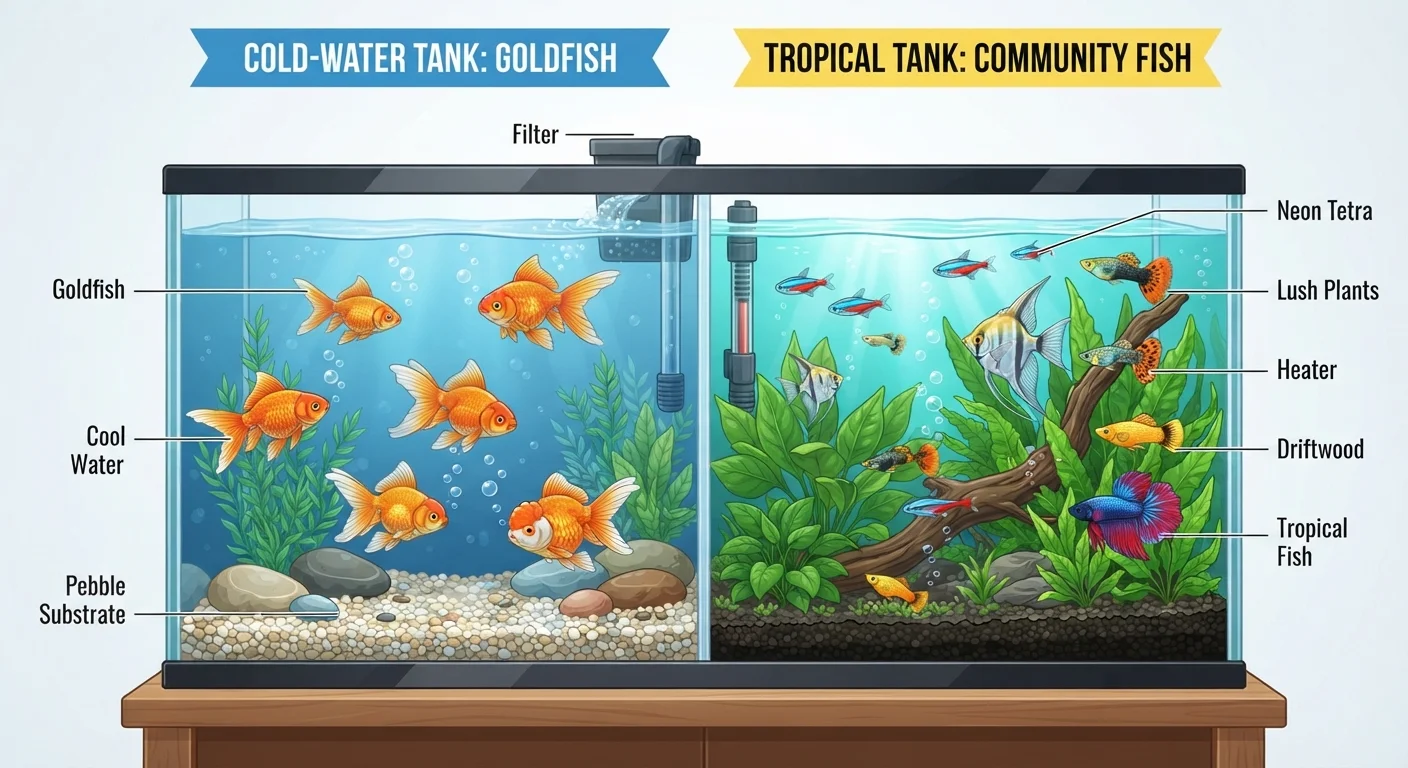
Option A
Cold-Water Fish Tanks
The low-maintenance, room-temperature setup.
Best for: Owners who want an accessible aquarium without investing in a heater or managing strict temperature windows.
Option B
Tropical Fish Tanks
The vibrant, species-rich warm-water environment.
Best for: Hobbyists ready to maintain stable heated conditions in exchange for a wider, more colorful fish selection.
Temperature: The Core Difference Between Both Tank Types
Temperature is the defining factor that separates these two aquarium categories. Cold-water tanks operate comfortably between 60-72°F, relying largely on ambient room temperature rather than supplemental heating. Tropical tanks, by contrast, require a consistent 74-80°F - a range that demands a submersible aquarium heater and a reliable thermometer to sustain.
This distinction has cascading effects. Cooler water holds more dissolved oxygen, which is why cold-water fish like goldfish produce significant waste and benefit from strong surface agitation. Tropical species evolved in warmer, often slower-moving water, and many prefer calmer flow rates and slightly lower oxygen saturation. Running a cold-water species in a tropical tank - or vice versa - causes chronic stress and shortens lifespan considerably.
If your home regularly dips below 65°F in winter or spikes above 80°F in summer without climate control, factor that into your decision before stocking any tank.
| Criterion | Cold-Water Tanks | Tropical Tanks |
|---|---|---|
| Ideal Temperature Range | 60-72°F | 74-80°F |
| Heater Required | Usually not | Yes, always |
| Species Diversity | Limited | Very broad |
| Live Plants | Challenging | Widely compatible |
| Filtration Demand | High (goldfish bioload) | Varies by species |
| Beginner Friendliness | High (fewer devices) | Moderate (more equipment) |
| Dissolved Oxygen | Naturally higher | Naturally lower |
Compatible Species and Stocking Considerations
Cold-water tanks are most commonly associated with goldfish, white cloud mountain minnows, and weather loaches. These species are hardy, tolerate moderate temperature swings, and are widely available. However, goldfish produce a disproportionate amount of ammonia relative to their size, so cold-water tanks still require robust filtration - a common misconception is that cold-water setups need less filtration overall.
Tropical tanks open up a dramatically wider species catalog: tetras, livebearers (like guppies and mollies), cichlids, gouramis, corydoras catfish, and many more. This diversity allows for intricate community tanks with carefully matched temperament, water-hardness preferences, and swimming levels. Most aquatic plants also thrive at tropical temperatures, enabling planted tank designs that are difficult to replicate in cooler water.
500+
Freshwater tropical fish species commonly available
Tropical freshwater fish represent the majority of species sold in the US aquarium trade, according to industry estimates from aquatic hobbyist organizations.
10-20 years
Potential lifespan of well-kept common goldfish
Goldfish kept in appropriately sized cold-water tanks with proper filtration regularly exceed a decade in lifespan, per aquatics care literature.
4-6 weeks
Typical new tank nitrogen cycling period
Both cold-water and tropical tanks require a cycling period before fish are introduced, a standard recommendation from aquarium care resources.
One firm rule: do not mix cold-water and tropical species. The temperature sweet spot for one group is actively harmful for the other. Before choosing fish, confirm their specific temperature range - not just their broad category - as some tropical species tolerate cooler conditions while others require the upper end of the tropical range.
For a thorough walkthrough of stocking a freshwater setup safely, see our freshwater tank setup guide, which covers cycling, compatibility, and stocking sequences step by step.
Filtration, Maintenance, and Equipment Differences
Both tank types require biological filtration - beneficial bacteria that convert toxic ammonia into less harmful nitrate - but the equipment choices and maintenance rhythms differ in meaningful ways.
Cold-water tanks often need a higher-capacity filter than their size would suggest, because goldfish are heavy bioload producers. Canister filters or hang-on-back filters rated for larger tanks are frequently recommended even for modest goldfish setups. Weekly partial water changes of 25-30% are standard practice.
Tropical tanks benefit from a heater with an adjustable thermostat, a thermometer (ideally placed away from the heater for an accurate ambient reading), and a filter matched to the specific community's bioload. Planted tropical tanks may also use CO₂ injection systems and full-spectrum lighting to support plant growth - adding another layer of equipment to manage.
In both cases, an aquarium test kit measuring ammonia, nitrite, nitrate, and pH is essential. Neither setup is truly low-maintenance; they simply require different types of attention. New tank owners should expect a cycling period of four to six weeks before fish are added, regardless of water temperature.
This article is for general informational purposes only. Always consult an aquatics specialist or veterinarian for guidance specific to your fish species and tank conditions.
The content provided on our blog site traverses numerous categories, offering readers valuable and practical information. Readers can use the editorial team’s research and data to gain more insights into their topics of interest. However, they are requested not to treat the articles as conclusive. The website team cannot be held responsible for differences in data or inaccuracies found across other platforms. Please also note that the site might also miss out on various schemes and offers available that the readers may find more beneficial than the ones we cover.