

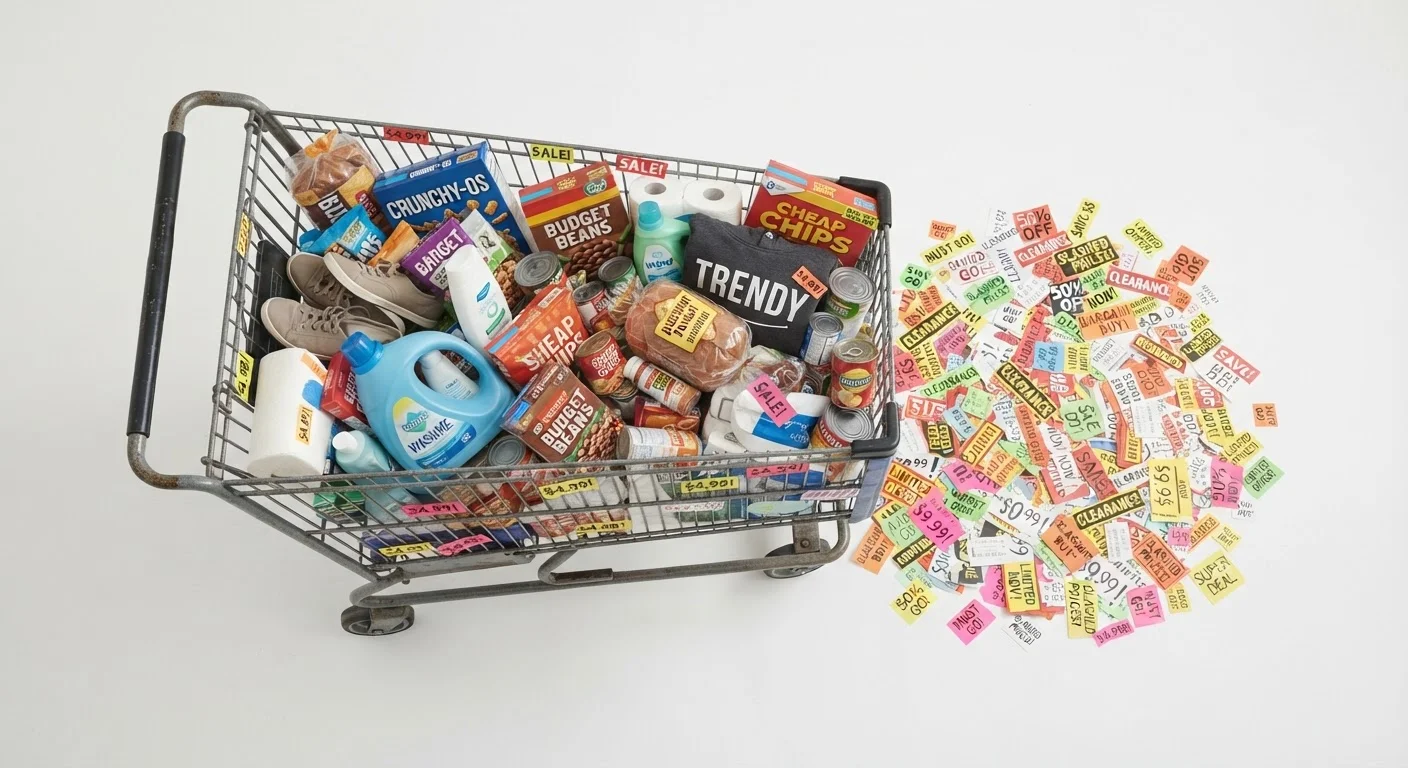
Your Brain Treats a Discount as a Reward
When you see a price slashed in red, something specific happens in the brain before you've even consciously decided anything. Research in behavioral economics consistently shows that a sale price activates the brain's reward circuitry in a way a regular price does not. The deal itself - independent of the product - generates a small burst of positive feeling.
This is the foundation of transaction utility: the idea that people derive satisfaction from the act of getting a bargain, not just from owning the item. That feeling nudges you toward the purchase even when the item wasn't on your list, wasn't in your budget, and might not get used. The discount has done its job before you've reached the register.
“People don't simply buy goods - they buy transactions. A bargain is not just a price; it's an experience of winning, and that experience can override almost any rational spending intention.”
— Richard Thaler, Nobel Prize-winning behavioral economist and author of 'Nudge'
Understanding this mechanism isn't about blaming yourself - it's about recognizing a predictable pattern so you can interrupt it. See our guide to spending triggers for a broader look at the environmental and emotional cues that drive unplanned purchases.
Anchoring Bias: How Original Prices Distort Judgment
Retailers know that the number you see first shapes every number you see after it. This is called anchoring bias - your brain latches onto an initial reference point and evaluates all subsequent information relative to that anchor.
A jacket priced at $180 and crossed out, with a new price of $90, feels like you're gaining $90. But if you had no intention of buying a jacket, you haven't saved $90 - you've spent $90 you weren't going to spend. The anchor (the original price) manufactured a sense of value that didn't exist for you personally.
40%+
Of US consumers buy unplanned items due to sales
Consumer behavior research consistently finds that a significant share of unplanned purchases are directly attributed to in-store promotions and price reductions.
2-3x
Quantity increase when bulk discounts are offered
Studies in retail purchasing behavior show shoppers often buy two to three times their normal quantity when a per-unit discount is framed as a bulk offer, regardless of actual need.
60%
Of shoppers report spending more than planned during sales events
Survey data from consumer spending research indicates the majority of sale shoppers exceed their pre-event budget, often citing 'too good to pass up' as the primary reason.
This is particularly powerful in categories like clothing, electronics, and home goods, where 'original' prices are sometimes set artificially high to make the markdown look more dramatic. Anchoring also explains why the first item you see in a store - often a premium-priced one - makes everything else feel reasonably priced by comparison.
The 'Stock Up' Trap and Quantity Discounts
One of the most reliable ways sales inflate total spending is through the stock-up mentality. A buy-two-get-one offer, a bulk discount, or a 'limited time' pricing structure all send the same signal: buy more now and you'll save later. Sometimes that's true. Often it isn't.
The problem is that this logic gets applied indiscriminately. People stock up on perishables that expire before use, on products they'll eventually switch brands on, and on items they simply don't need in quantity. The per-unit price falls; the total dollars spent rises - sometimes dramatically.
This pattern connects directly to grocery budget drift, where sale-driven bulk purchasing is one of the quiet drivers of rising household food costs. The savings feel real in the moment; the budget impact is spread out enough that it rarely triggers an alarm.
The Full-Price Test: One Question That Works
Before adding a sale item to your cart, ask: 'Would I buy this at full price right now?' If the honest answer is no, put it back. The discount hasn't created value for you - it's created an impulse. This single question, applied consistently, can meaningfully reduce unplanned spending over time.
How to Use Sales Without Letting Them Use You
None of this means avoiding sales altogether. It means approaching them with a clear, pre-set intention rather than letting the discount structure set your agenda for you.
A few practical principles help:
- Write the list first, browse second. Decide what you need before you look at what's discounted. A sale on something not on your list is not a saving.
- Apply the full-price test. Ask whether you would buy the item at its regular price. If the answer is no, the markdown isn't saving you money - it's extracting money you had no plan to spend.
- Set a total-spend ceiling, not a per-item ceiling. Focusing only on how cheap each item is ignores what the basket costs in total.
Building habits like these is part of what separates mindful spending from simply tracking a budget after the fact. These small, repeatable decisions compound over time - and so does the alternative. Falling for sale psychology is one of the quiet ways people steadily drain their savings without a single obvious splurge triggering the alarm.
This article is for general informational and educational purposes only and does not constitute personalized financial advice. Consult a qualified financial professional for guidance specific to your situation.
Frequently Asked Questions
Sales trigger a psychological reward response that makes buying feel rational and even virtuous. The discount acts as permission to spend, often on items you wouldn't have bought otherwise. Retailers deliberately use pricing anchors and urgency cues to amplify this effect.
Anchoring bias is when your brain fixates on a reference price - usually the original, higher price - and judges the sale price relative to that anchor. A $60 item marked down from $100 feels like a $40 gain, even if $60 is still more than you planned to spend.
For non-perishables you genuinely use regularly, buying in bulk during a sale can reduce long-term costs. The problem arises when stocking up becomes a habit applied to discretionary or perishable items, which almost always inflates spending.
Make a specific list before you browse any sale and commit to it. Ask yourself whether you would buy each item at full price. If the answer is no, the discount isn't saving you money - it's costing you money you didn't plan to spend.
Transaction utility, a concept from behavioral economics, describes the satisfaction derived purely from getting a good deal - separate from the usefulness of the item. This can make a bad financial decision feel like a smart one simply because a discount is involved.
They often do. Points and reward thresholds encourage spending just enough to unlock the next benefit, which regularly pushes total spend above what was originally planned. The reward feels tangible; the extra spending feels abstract.
The content provided on our blog site traverses numerous categories, offering readers valuable and practical information. Readers can use the editorial team’s research and data to gain more insights into their topics of interest. However, they are requested not to treat the articles as conclusive. The website team cannot be held responsible for differences in data or inaccuracies found across other platforms. Please also note that the site might also miss out on various schemes and offers available that the readers may find more beneficial than the ones we cover.