

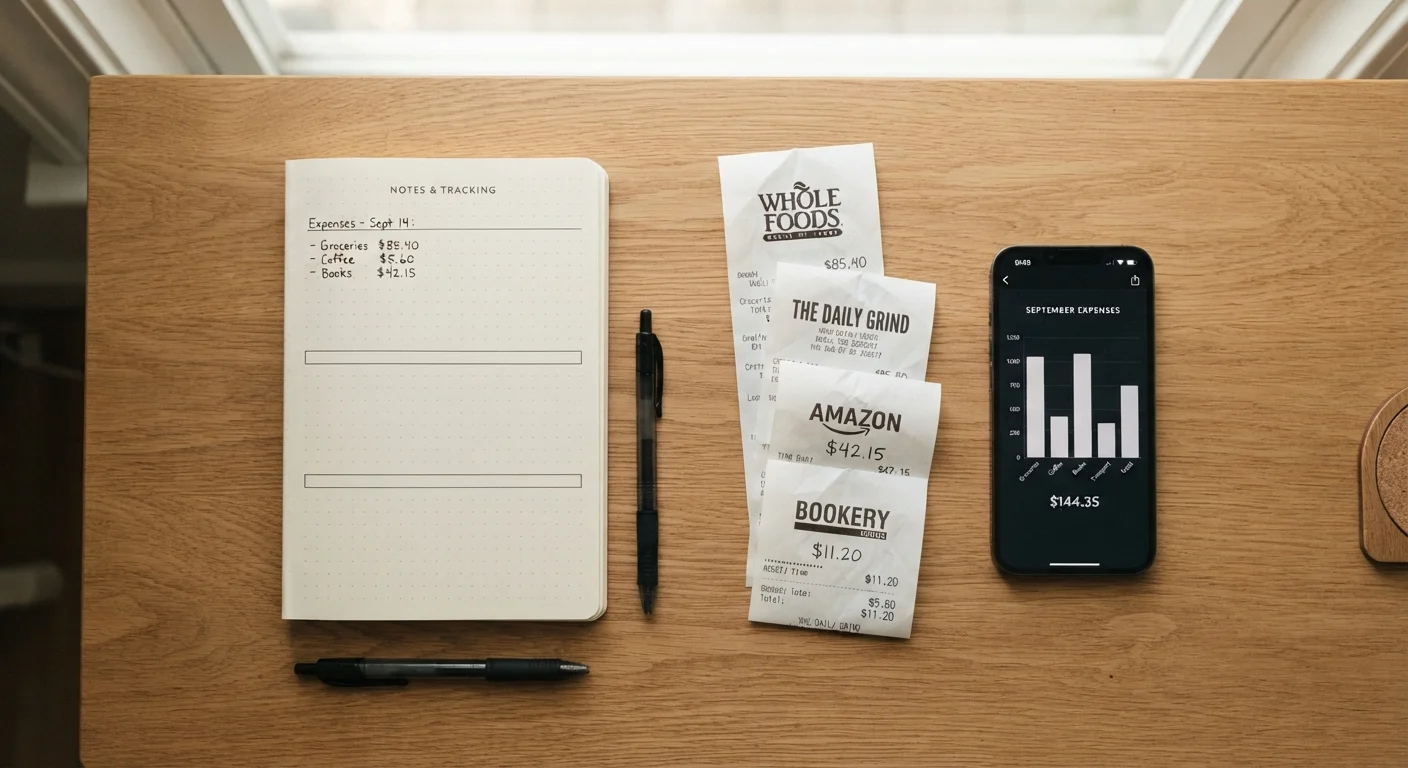
Why Tracking Matters Before You Budget
Most households underestimate their spending in at least one category. Research by the US Bureau of Labor Statistics consistently shows gaps between what consumers think they spend and what their statements actually reflect. Before you can build a realistic budget, you need an honest picture of where money is currently going.
The good news: you don't need a finance degree or expensive software. The eight approaches below range from zero-cost manual methods to app-based automation. Each suits a different temperament, schedule, and level of financial complexity. Understanding the options helps you choose - or combine - what fits your life.
For a broader foundation on smart daily money habits, explore the Everyday Money Wins hub, which covers small, compounding financial moves worth building into your routine.
Tracking Is Not the Same as Budgeting
Tracking where money goes is an observation exercise - it tells you what has happened. Budgeting is a planning exercise - it sets intentions for what should happen next. Both are valuable, but they serve different functions. Many households find that a few weeks of honest tracking is the most useful first step before setting any budget targets, because the data tends to challenge assumptions about where money is actually going.
Eight Ways to Track Your Spending
Monthly Bank Statement Review
The most accessible starting point requires nothing but your online banking login or a paper statement. Go line by line once a month, grouping charges into broad categories - groceries, dining, utilities, subscriptions, and so on. This approach costs nothing and requires no new habits beyond a single monthly session.
Best for: Beginners who want a low-friction entry point with no tools to learn.
A single monthly statement review costs nothing and can reveal surprising spending patterns immediately.
Spreadsheet Budgeting
A custom spreadsheet - built in any free tool - gives you full control over categories, formulas, and visual summaries. You enter transactions manually or paste exported data from your bank. The setup takes an hour or two upfront, but the result is a personalised ledger that evolves with your life.
Best for: Detail-oriented people who want flexibility and don't mind a bit of manual data entry.
A spreadsheet gives you complete control over how your financial picture is organised and displayed.
Envelope Budgeting (Cash-Based)
This classic method involves withdrawing a set amount of cash at the start of each pay period and dividing it into labeled envelopes by category - groceries, gas, entertainment, and so on. When an envelope is empty, spending in that category stops. The physical act of handing over cash creates friction that naturally reduces impulse purchases.
Best for: People who overspend on cards and benefit from tangible spending limits.
Spending physical cash creates a natural brake on impulse purchases that card transactions rarely provide.
Digital Envelope Apps
A digital version of the envelope method assigns virtual «buckets» to spending categories. You fund each bucket at the start of the month and track draws against it throughout. This approach blends the discipline of envelope budgeting with the convenience of cashless transactions.
Best for: People who like the envelope concept but rarely carry cash.
Digital envelopes bring the discipline of cash budgeting into a card-first world without requiring ATM trips.
Automated Expense-Tracking Apps
Many apps connect securely to your bank and card accounts, importing and auto-categorising transactions in real time. You review summaries rather than entering data manually. The trade-off is granting the app read access to your financial accounts, so evaluating an app's privacy policy and security practices before connecting is worthwhile.
Best for: Busy households who want visibility with minimal manual effort.
Automated apps reduce data-entry time to near zero, making consistent tracking far easier to sustain.
The Spending Journal
A spending journal is exactly what it sounds like: you write down every purchase shortly after making it, along with the amount and a brief note on why you bought it. The act of writing - especially the «why» - builds spending awareness faster than any automated tool. It also surfaces emotional or habitual triggers that pure numbers miss.
Best for: People trying to change spending behaviour, not just observe it. Also pairs well with mindful spending practices.
Writing down the 'why' behind each purchase can surface emotional spending patterns no app will flag.
The 50/30/20 Framework
Rather than tracking every line item, this framework asks you to sort spending into three buckets: roughly 50% of after-tax income toward needs, 30% toward wants, and 20% toward savings and debt repayment. You review total spending in each bucket monthly and adjust if a category is consistently over or under. It is a rule of thumb, not a rigid prescription, and households should adapt proportions to their own income and obligations.
Best for: People who find granular category tracking overwhelming but want a structural guide.
The 50/30/20 framework trades precision for simplicity, making it easier to maintain over the long term.
Net-Worth Snapshot Tracking
Instead of monitoring individual transactions, this approach tracks the big picture: total assets minus total liabilities, updated monthly or quarterly. While it doesn't show where every dollar went, a declining net worth is a reliable signal that spending is outpacing income or savings. Tools range from a simple spreadsheet to dedicated net-worth apps.
Best for: People further along financially who want a high-level gauge rather than transaction-level detail. Works well alongside a more granular method for a fuller picture. For more on growing the savings side of the equation, see the Saving & Debt hub.
Tracking net worth monthly gives a reliable early warning when overall financial health is moving in the wrong direction.
Start With Just One Method
Resist the urge to set up multiple systems simultaneously. Pick the single approach that feels most manageable and use it consistently for 30 days. After a month of real data, you'll have a clearer sense of whether you need more detail, less friction, or a complementary tool. Adding complexity before building the basic habit is one of the most common reasons people abandon tracking altogether.
Choosing - or Combining - Your Approach
There is no universally superior method. A freelancer with variable income may rely heavily on a spreadsheet, while a dual-income household with consistent bills may do fine with monthly bank statement reviews supplemented by a budgeting app. The key variable is consistency: a simple system used every week beats a sophisticated one opened twice a year.
Consider pairing a tracking method with a regular review rhythm. A weekly money reset routine takes as little as ten minutes and dramatically improves how much you actually absorb from the data you collect. Similarly, once you can see recurring charges clearly, a monthly bill audit can surface subscriptions or fees worth renegotiating.
If your longer-term goal is to save more automatically, understanding round-up savings versus automatic transfers can help you put idle dollars to work once your spending picture is clear.
This article is for general informational and educational purposes only and does not constitute personalised financial advice. For guidance tailored to your specific situation, consult a qualified financial professional.
The content provided on our blog site traverses numerous categories, offering readers valuable and practical information. Readers can use the editorial team’s research and data to gain more insights into their topics of interest. However, they are requested not to treat the articles as conclusive. The website team cannot be held responsible for differences in data or inaccuracies found across other platforms. Please also note that the site might also miss out on various schemes and offers available that the readers may find more beneficial than the ones we cover.