

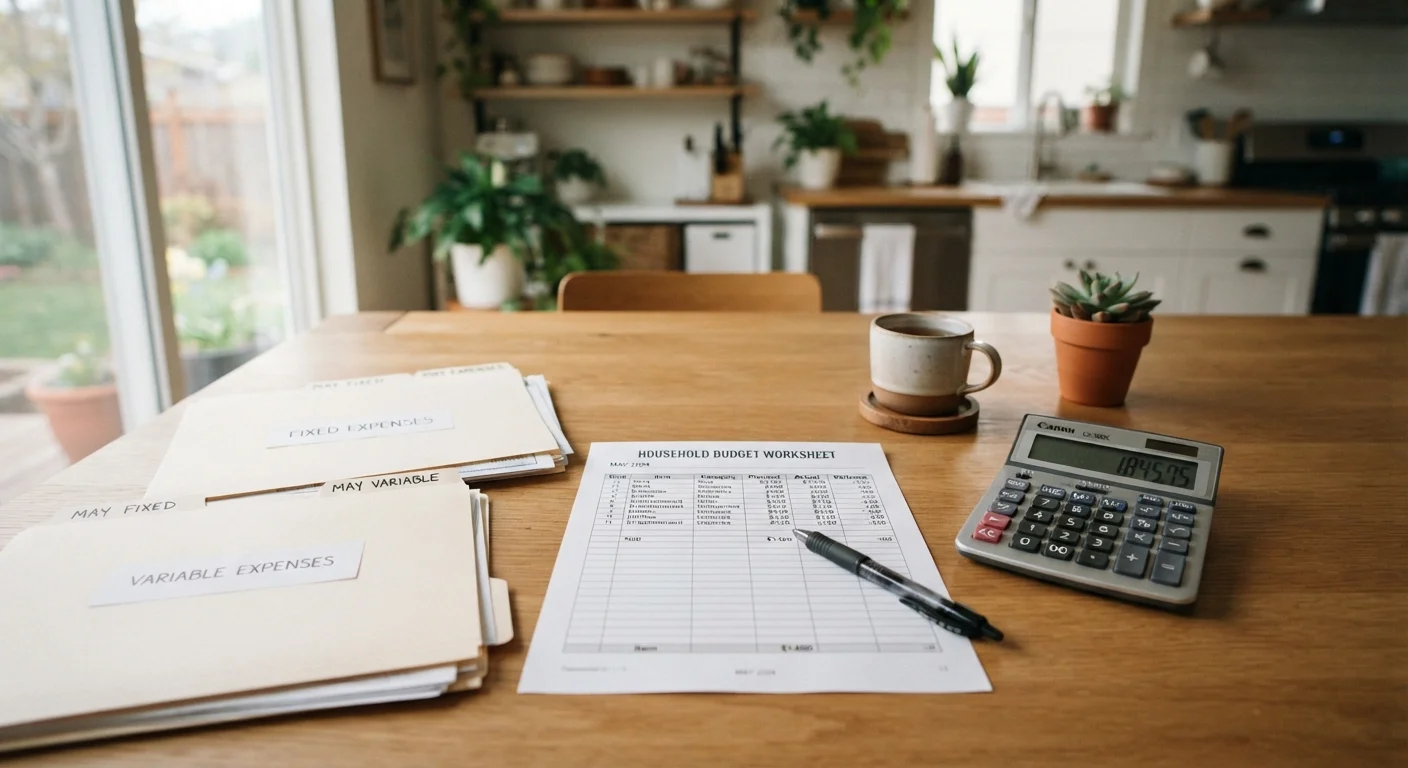
Option A
Fixed Expenses
The predictable, non-negotiable costs that anchor your monthly budget.
Best for: Households that want a stable baseline to plan around, since these amounts rarely change month to month.
Option B
Variable Expenses
The flexible, fluctuating costs that give your budget room to breathe - or tighten.
Best for: Budget categories where conscious spending decisions can directly reduce how much you spend each month.
What Makes an Expense 'Fixed' or 'Variable'?
Every dollar leaving your household each month behaves in one of two ways: it either shows up as the same amount every time, or it shifts depending on how much you use, consume, or choose to spend. That's the core distinction between fixed expenses and variable expenses - and it's one of the most practically useful concepts in personal budgeting.
Fixed expenses are costs that stay constant from month to month regardless of your behavior. Your rent or mortgage payment, car loan payment, and renter's insurance premium are classic examples. The amount is set by a contract or obligation, and short of renegotiating or canceling, you owe the same figure every billing cycle. For a more complete glossary of terms like these, see our plain-language budgeting glossary.
Variable expenses, by contrast, change based on how much you use a service or how often you make a purchase. Groceries, gasoline, dining out, and utility bills are common examples. You control these amounts - at least partially - through the choices you make each month.
There's also a category worth naming: periodic fixed expenses. These are costs that are predictable in amount but don't hit every month - annual auto insurance premiums, semi-annual subscription renewals, or vehicle registration fees. They're fixed in size but irregular in timing, which is exactly why a tool like a sinking fund helps. Sinking funds are designed to spread these lump-sum costs across the months before they're due.
| Criterion | Fixed Expenses | Variable Expenses |
|---|---|---|
| Amount each month | Same every billing cycle | Fluctuates with usage or choice |
| Common examples | Rent, car loan, insurance premium | Groceries, gas, dining out, utilities |
| Ease of reducing | Difficult - requires renegotiation | Easier - adjust day-to-day habits |
| Budget planning role | Sets your monthly spending floor | Provides room for adjustment |
| Risk in a financial crunch | High - obligations remain fixed | Lower - can be reduced quickly |
| Predictability | High - amount known in advance | Low to moderate - varies month to month |
Why the Distinction Changes How You Budget
Understanding expense types isn't just academic - it changes the mechanics of how you build and adjust a budget.
When you sit down to budget, listing your fixed expenses first tells you your spending floor: the minimum amount of income you need to cover non-negotiable obligations. For someone earning a variable paycheck, this number is especially critical. If you're navigating unpredictable income, our guide to budgeting on an irregular income walks through strategies built around this exact principle.
Variable expenses, meanwhile, are your budget's adjustment zone. When money is tight, cutting a streaming subscription or reducing restaurant visits can free up cash within days. Fixed expenses rarely offer that flexibility - lowering a mortgage payment typically requires refinancing, and breaking a lease carries financial penalties.
~33%
Average share of income spent on housing
According to U.S. Bureau of Labor Statistics Consumer Expenditure data, housing consistently represents the largest single fixed expense category for American households.
~15%
Average share of income spent on food
BLS Consumer Expenditure surveys show food - a predominantly variable expense - typically accounts for around 12-15% of household spending, with significant variation by income level.
This also affects how you respond to a financial shock. If your hours get cut at work, your fixed expenses don't shrink with your paycheck - but your variable expenses can. That asymmetry is why financial educators often advise keeping fixed obligations as low as reasonably possible relative to your income, leaving more of your budget in the flexible, adjustable column.
Couples managing combined finances often discover that disagreements about money are frequently disagreements about variable expenses - where one partner sees a necessity, the other sees a discretionary choice. If that tension sounds familiar, budgeting as a couple requires explicit conversations about which variable categories each person values.
Is a Utility Bill Fixed or Variable?
Utility bills - like electricity and gas - are technically variable because the amount changes based on usage. However, some utility providers offer budget billing programs that average your annual usage into a flat monthly payment, converting a variable cost into a predictable fixed one. Check with your provider if billing consistency is a priority for your household.
Budgeting is more than tracking - it involves intentional decision-making. For a broader perspective on that distinction, see how mindful spending differs from budgeting.
This article is for general informational and educational purposes only and does not constitute personalized financial advice. Consult a qualified financial professional for guidance specific to your situation.
The content provided on our blog site traverses numerous categories, offering readers valuable and practical information. Readers can use the editorial team’s research and data to gain more insights into their topics of interest. However, they are requested not to treat the articles as conclusive. The website team cannot be held responsible for differences in data or inaccuracies found across other platforms. Please also note that the site might also miss out on various schemes and offers available that the readers may find more beneficial than the ones we cover.