

Why the Type of Aid Matters
When a college sends an award letter, the total number at the top can feel reassuring - until you realize not all aid works the same way. A package mixing $10,000 in grants with $7,500 in loans is very different from one that's mostly loans. Knowing what each category means helps families make accurate comparisons and avoid surprises at repayment time.
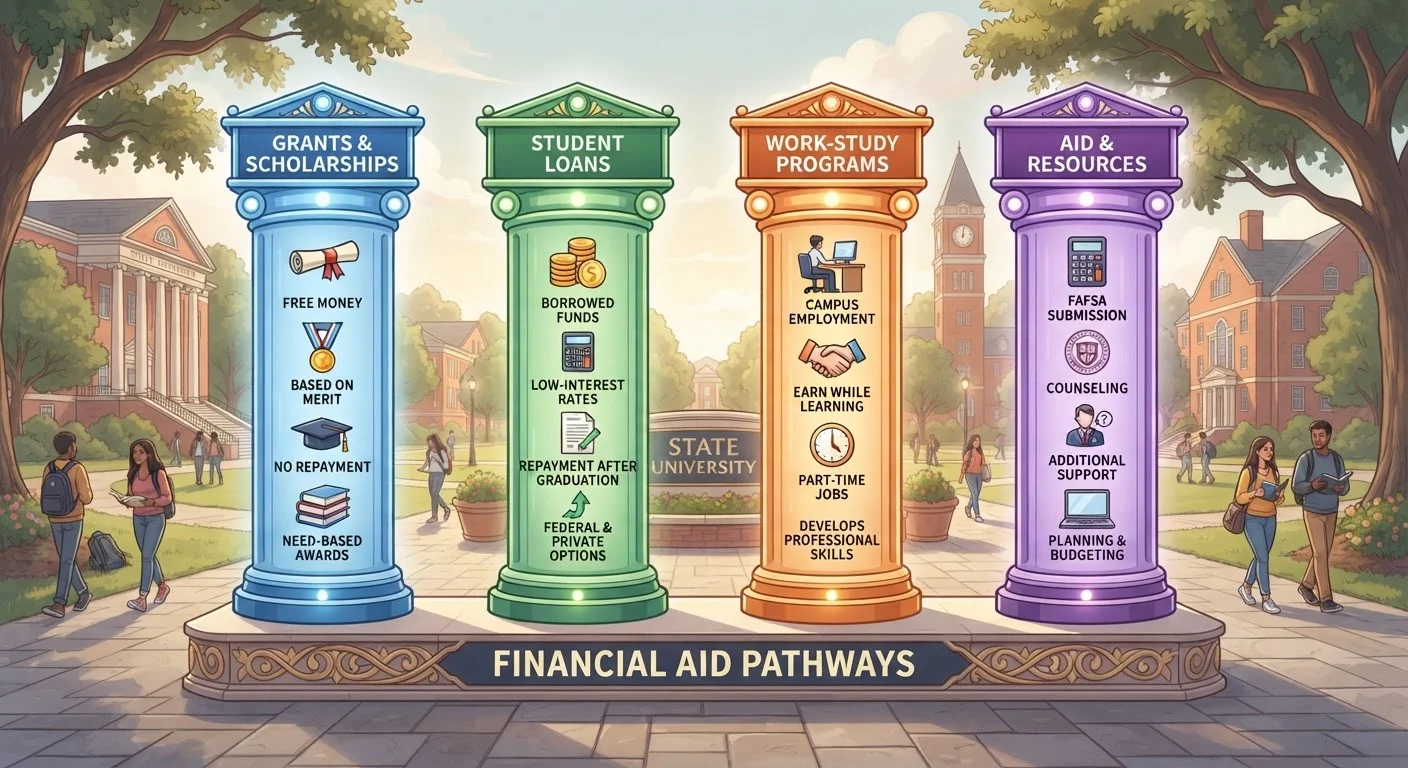
The four pillars of financial aid are scholarships, grants, work-study, and loans. The first two are gift aid that doesn't require repayment. Work-study is earned income. Loans must be paid back, with interest. Our first-timer's financial aid roadmap provides a broader overview of how these pieces fit together from application to enrollment.
$234B+
Total federal student aid awarded annually
According to the College Board's Trends in Student Aid report, the federal government distributes over $234 billion in aid each year through grants, loans, and work-study programs.
~6.1M
Students receiving Federal Pell Grants
The U.S. Department of Education reports that roughly 6 million undergraduates receive Pell Grants each academic year, making it the largest source of federal grant aid.
43%
Undergrads who borrow federal loans
The National Center for Education Statistics estimates that about 43% of undergraduate students take out federal student loans to help finance their education.
Scholarships: Merit, Mission, and More
Scholarships are awarded based on specific criteria - academic achievement, athletic ability, artistic talent, community service, intended major, or demographic background, among others. They come from colleges, private foundations, nonprofits, employers, and civic organizations. Unlike loans, scholarships never need to be repaid.
Eligibility requirements vary widely. Some scholarships require a minimum GPA; others are essay-based or tied to financial need as a secondary factor. Many private scholarships have annual application windows, so students benefit from starting their search early - ideally before senior year of high school.
Search Multiple Scholarship Databases
Free scholarship search tools hosted by libraries, nonprofits, and state agencies can surface awards that students frequently overlook. Local community foundations and employer scholarship programs often have less competition than national awards. Apply to several smaller scholarships - they add up quickly and reduce reliance on loans.
One important note: scholarship income can affect other aid. If a scholarship pushes your total aid above your school's cost of attendance, the school may reduce other aid components. Always notify your financial aid office when you receive outside scholarships.
Grants: Need-Based Aid You Don't Repay
Grants are primarily awarded based on financial need, though some target specific programs or student populations. The Federal Pell Grant is the most widely known - it provides funds to undergraduate students with demonstrated financial need, and the award amount depends on your Student Aid Index (SAI), enrollment status, and cost of attendance. The maximum Pell Grant award is set by Congress and adjusted periodically.
Beyond Pell, students may qualify for the Federal Supplemental Educational Opportunity Grant (FSEOG), state-level grants, and institutional grants offered directly by colleges. Understanding how your financial need is calculated matters enormously here - see how the FAFSA formula works to understand what drives your grant eligibility.
Federal Work-Study: Earning While You Learn
The Federal Work-Study (FWS) program provides part-time employment opportunities for students with financial need. Jobs are typically on campus - in libraries, administrative offices, or research settings - though some off-campus positions exist, often with nonprofits or public agencies.
Work-study awards appear in your aid package as a dollar amount, but that figure represents your maximum earnings potential, not a guaranteed check. You must find and secure an eligible job, then earn those funds through your paycheck over the academic year. Wages are at least federal minimum wage, and earnings go directly to you - not automatically to your tuition bill.
Work-Study Funds Don't Roll Over
If you don't earn your full work-study allocation by the end of the academic year, the unused amount doesn't transfer to the next year or convert to a grant. Each year's work-study eligibility is determined separately through the FAFSA. Plan your work schedule early in the semester to make the most of your award.
Work-study income won't cover large tuition bills on its own, but it can meaningfully offset living expenses and reduce the amount you need to borrow. Students who use work-study often report benefits beyond the paycheck: professional references, resume experience, and campus connections.
Student Loans: Borrowing Wisely
Loans are borrowed money that must be repaid with interest - making them the most expensive form of aid when held long-term. Federal student loans come in two primary forms for undergraduates: Direct Subsidized Loans (need-based; the government pays interest while you're in school) and Direct Unsubsidized Loans (available regardless of need; interest accrues from disbursement).
Graduate students and parents may also access Direct PLUS Loans, which carry higher interest rates and require a credit check. Private loans from banks or credit unions are a separate category entirely, with variable rates and fewer borrower protections.
Before signing any loan promissory note, it's worth reviewing this pre-enrollment finance checklist to ensure you understand your total debt obligation. Borrowers should also be aware that federal loans come with repayment options - income-driven repayment plans can adjust monthly payments based on earnings after graduation. Managing loan debt over time fits naturally into broader savings and debt strategies.
This article provides general educational information about financial aid categories and is not personalized financial or legal advice. Consult your school's financial aid office or a qualified adviser for guidance specific to your situation.
Frequently Asked Questions
Scholarships are typically awarded based on merit, talent, or specific criteria like field of study or community involvement. Grants are usually awarded based on financial need. Both are considered gift aid and do not need to be repaid.
No. Federal Work-Study wages are earned income, not a loan. You work part-time jobs - often on campus - and receive a paycheck. However, those earnings may be counted as income on next year's FAFSA.
If your aid exceeds your school's direct charges (tuition, fees, room, board), the school typically refunds the difference to you. Loan funds in a refund still must be repaid, so consider returning unneeded loan money promptly.
Federal loans generally offer more protections - fixed interest rates, income-driven repayment options, and potential forgiveness programs - compared to private loans. Financial aid counselors commonly recommend exhausting federal options before turning to private lenders.
Yes. Most aid packages combine multiple types. A student might receive a Pell Grant, a merit scholarship from their school, a work-study position, and subsidized federal loans together in a single award package.
Yes. Federal aid programs, including Pell Grants and Direct Loans, apply to eligible community colleges and vocational schools, not just four-year universities. Eligibility still depends on enrollment status and FAFSA results.
The content provided on our blog site traverses numerous categories, offering readers valuable and practical information. Readers can use the editorial team’s research and data to gain more insights into their topics of interest. However, they are requested not to treat the articles as conclusive. The website team cannot be held responsible for differences in data or inaccuracies found across other platforms. Please also note that the site might also miss out on various schemes and offers available that the readers may find more beneficial than the ones we cover.