

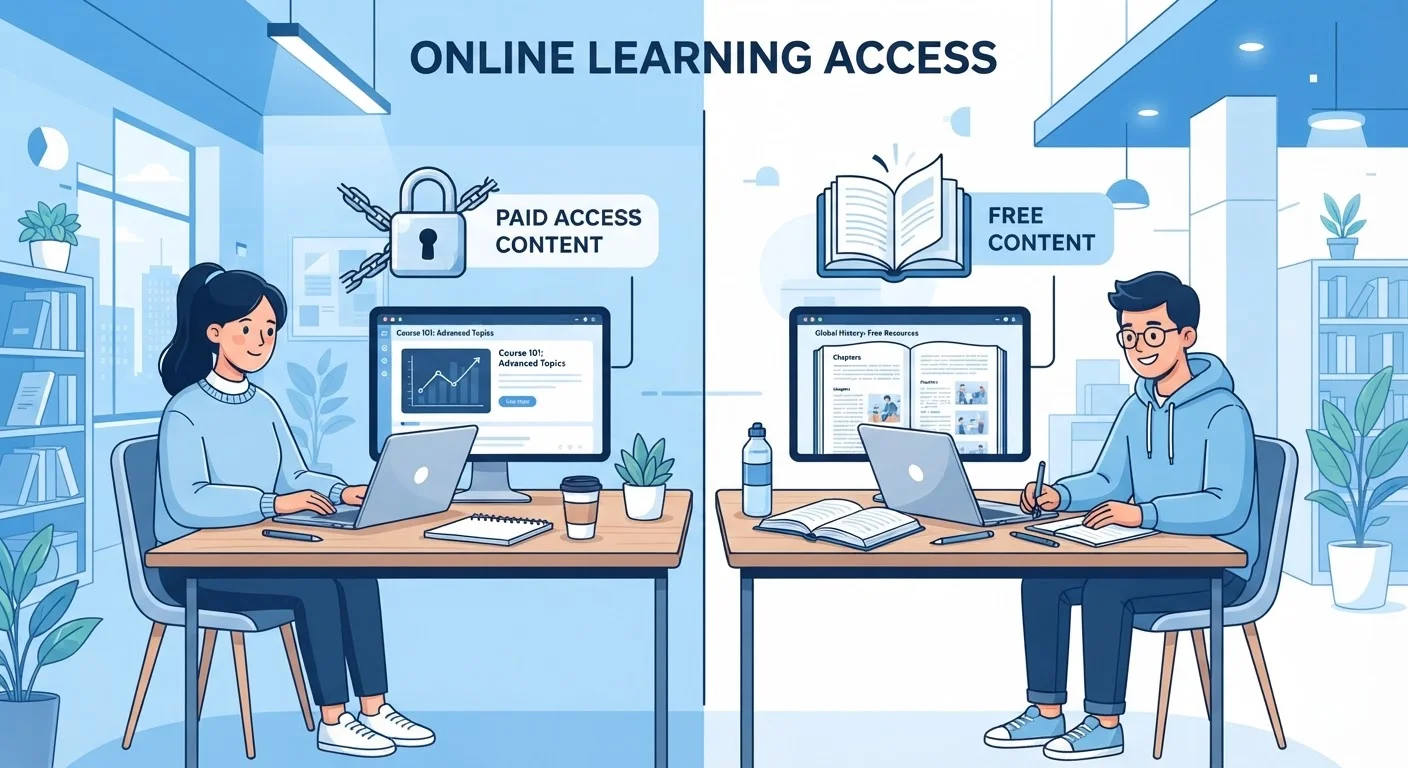
Option A
Free Online Courses
The accessible, no-cost entry point to online learning.
Best for: Learners exploring new subjects, building foundational skills, or testing a field before committing money.
Option B
Paid Online Courses
The structured, credential-backed path to verifiable skills.
Best for: Learners seeking employer-recognized certificates, guided feedback, or career-focused outcomes.
What Free Courses Actually Include
Free online courses - including many offered through MOOCs - typically provide access to video lectures, reading materials, and self-graded quizzes. Platforms such as Coursera, edX, and Khan Academy make this content available at no cost, often sourced from accredited universities. What you generally don't get for free: graded assignments reviewed by instructors, peer-assessed projects, or a shareable certificate of completion.
That distinction matters. The learning content itself may be identical to what a paying student receives - but the verification layer is stripped out. For learners whose goal is pure skill-building or curiosity, that trade-off is entirely acceptable. For those who need documented proof of learning, it is a meaningful gap. See our honest look at how MOOCs work for a fuller picture of what these platforms deliver.
| Criterion | Free Online Courses | Paid Online Courses |
|---|---|---|
| Cost | $0 | $15 to thousands of dollars |
| Certificate or credential | Rarely included | Typically included |
| Instructor feedback | Usually not available | Often included |
| Graded assessments | Limited or self-graded | Graded with review |
| Employer recognition | Low to none | Varies by institution |
| Accountability structures | Minimal | Deadlines and submissions |
| Content quality | Can be university-level | Varies widely by provider |
What You're Actually Paying For
Paid online courses charge anywhere from $15 to several thousand dollars depending on scope, institution, and credential type. That range alone signals that price is a poor proxy for quality. What paid enrollment typically unlocks includes: graded assessments with feedback, certificates or badges that can appear on a résumé or LinkedIn profile, and in many cases, access to a cohort of peers and an instructor or teaching assistant.
Importantly, the value of a paid credential depends heavily on who issues it. A certificate from a regionally accredited university carries different weight than one from a small independent platform. Before paying, it is worth researching whether employers in your target field recognize the credential. Our guide on what platforms don't always disclose upfront can help you ask the right questions before enrolling.
<15%
Typical MOOC completion rate
Research consistently finds that free open online courses see completion rates well below 15%, largely due to limited accountability structures.
$15-$5,000+
Range of paid online course costs
Paid online courses vary enormously in price depending on provider type, course length, and whether a recognized credential is included.
73%
Adults interested in online learning for career reasons
According to Pew Research Center surveys, a majority of US adults who pursue online learning do so primarily to advance or change their careers.
Completion Rates, Accountability, and Outcomes
One consistent finding in online education research is that free courses have substantially lower completion rates than paid ones. A widely cited estimate suggests completion rates for free MOOCs often fall below 15%. This is not primarily a motivation problem - it reflects structural differences. Paid courses tend to build in deadlines, required submissions, and instructor touchpoints that create accountability. Free learners must generate that structure themselves.
This does not make free courses inferior for self-directed learners. Someone with clear goals and disciplined habits may complete a free course and apply the knowledge effectively. But for learners who know they need external structure, that accountability alone may justify a paid enrollment. To think through which goal actually drives your learning decision, see our article on skill-building versus credential-earning.
Making the Right Choice for Your Situation
The most useful framework is not free versus paid - it is what outcome do I need? If you are exploring a career pivot, a free introductory course is a low-risk way to assess fit before investing money or time in a longer program. If you are trying to satisfy a job requirement or add a verifiable qualification, a paid course from a credible issuer is likely necessary.
Budget is a real factor too. Financial aid and income-share options exist for some paid programs, and audit options on platforms like Coursera allow free access to course content even within paid tracks. Always check whether a free audit option exists before paying for a course you primarily want for the content rather than the credential.
For a broader look at how these choices connect to larger education decisions, our comparison of online certifications versus degree programs walks through cost, time, and career impact across both paths.
This article is for general informational and educational purposes only. It does not constitute personalized financial, academic, or career advice. Readers should verify program details, costs, and credential recognition directly with institutions and relevant employers before making enrollment decisions.
The content provided on our blog site traverses numerous categories, offering readers valuable and practical information. Readers can use the editorial team’s research and data to gain more insights into their topics of interest. However, they are requested not to treat the articles as conclusive. The website team cannot be held responsible for differences in data or inaccuracies found across other platforms. Please also note that the site might also miss out on various schemes and offers available that the readers may find more beneficial than the ones we cover.