

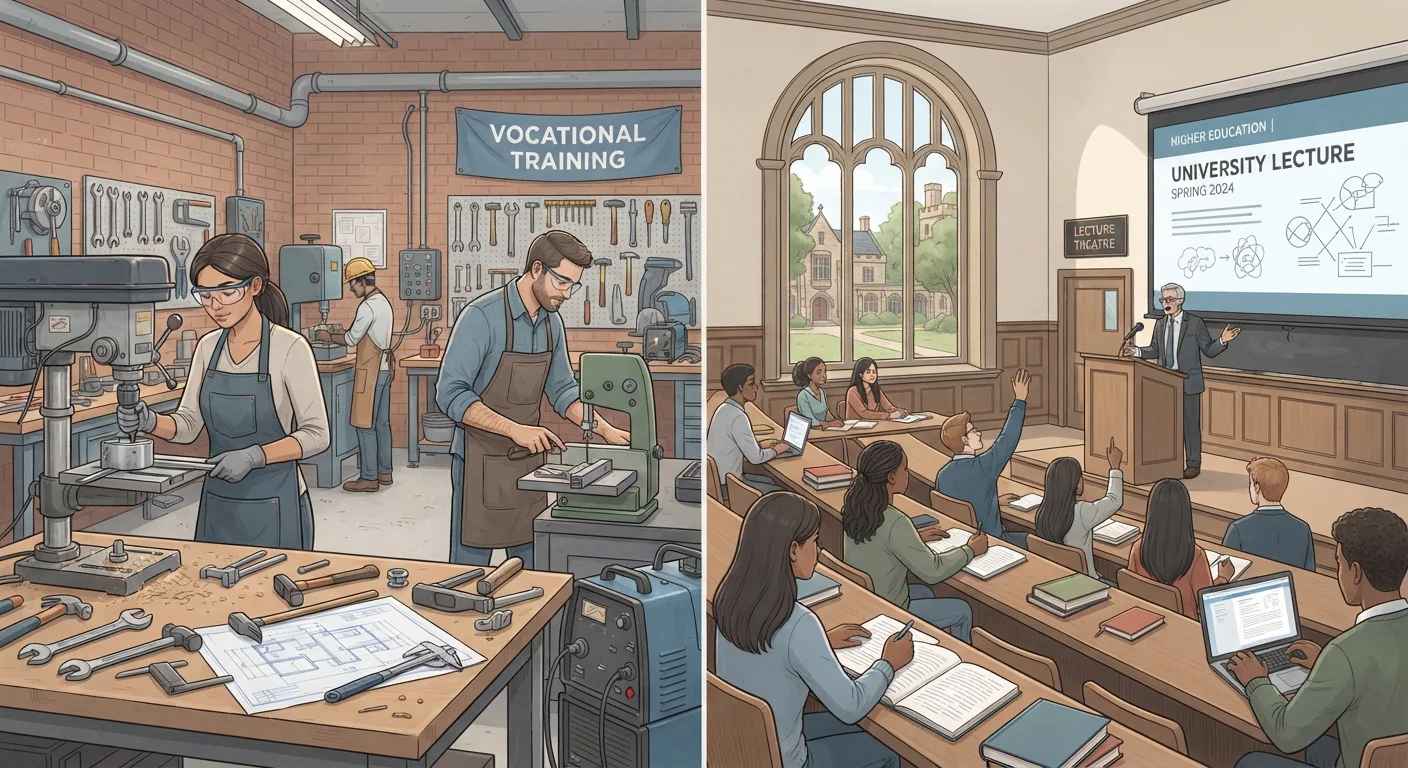
Option A
Vocational Training
The hands-on, career-focused fast track.
Best for: Adults seeking targeted job-ready skills in a specific trade or technical field within one to two years.
Option B
Four-Year College Degree
The broad-based, credential-intensive traditional route.
Best for: Students pursuing careers that require a bachelor's degree as a baseline credential or broad academic grounding.
Cost and Time: Where the Paths Diverge Most Sharply
One of the starkest contrasts between vocational training and a four-year college degree is what each costs - in both money and time.
According to the National Center for Education Statistics, the average published tuition and fees at a public four-year institution run several thousand dollars per year, with total costs including room, board, and books often exceeding $25,000 annually. A full degree can represent $100,000 or more in total investment, and that figure climbs considerably at private institutions. Vocational and trade programs at community colleges or technical schools, by contrast, frequently cost between $5,000 and $15,000 in total - and many take just one to two years to complete.
Time-to-employment is equally different. A plumbing apprenticeship or medical coding certificate may position a graduate for entry-level work within 12 to 24 months. A bachelor's degree program requires a minimum of four years of full-time enrollment for most students, and data from the National Student Clearinghouse shows that only about 60% of students at four-year institutions graduate within six years.
| Criterion | Vocational Training | Four-Year College Degree |
|---|---|---|
| Typical duration | 1-2 years | 4+ years |
| Estimated total cost (public) | $5,000-$15,000 | $40,000-$100,000+ |
| Curriculum focus | Occupation-specific skills | Broad academic + major |
| Time to first job | Often under 2 years | Typically 4-6 years |
| Median earnings (BLS data) | Varies by trade; many above $50K | Higher median across occupations |
| Financial aid eligibility | Yes (Pell Grants, loans) | Yes (Pell Grants, loans) |
| Credential stackability | Certificates can stack or transfer | Degree can lead to graduate study |
If you are weighing other credential formats alongside these two paths, our comparison of online certifications and degree programs walks through additional trade-offs in detail.
Earnings and Employment Outcomes
Earnings data tend to favor four-year degree holders in the aggregate. The U.S. Bureau of Labor Statistics (BLS) reports that workers with a bachelor's degree earn a higher median weekly wage than those with some college or an associate degree. Over a 40-year career, that gap can compound substantially.
However, averages can be misleading. BLS occupational data shows that licensed electricians, elevator installers, and radiation therapists - all fields entered primarily through vocational or apprenticeship routes - post median annual wages well above $60,000. Some master tradespeople earn six figures. Meanwhile, many four-year graduates work in roles that do not require their degree, which can dilute the income premium when averaged across the full population of graduates.
~$608
Median weekly earnings with some college or associate degree
According to the U.S. Bureau of Labor Statistics Employment Situation summary, workers with some college or an associate degree earn less than bachelor's degree holders on average.
~$1,305
Median weekly earnings for bachelor's degree holders
BLS data shows bachelor's degree holders consistently earn more at the median than workers with sub-baccalaureate credentials across most occupations.
60%
Six-year graduation rate at four-year institutions
National Student Clearinghouse Research Center data indicates roughly 60% of students who enroll at four-year colleges graduate within six years.
The labor market for skilled trades also reflects documented shortages. Industry groups have repeatedly flagged gaps in qualified workers for roles in construction, manufacturing, and healthcare support - a dynamic that tends to support wages for trained vocational workers.
The honest takeaway: a four-year degree offers a statistically higher earnings ceiling in many fields, but vocational credentials deliver strong, reliable returns in specific high-demand occupations. Understanding your target field specifically - rather than relying on broad averages - is essential to making a sound decision.
Curriculum, Flexibility, and What Each Path Actually Teaches
A four-year degree is built around breadth. General education requirements in writing, mathematics, social sciences, and the humanities are standard across most accredited institutions. This breadth is intentional - it aims to develop critical thinking, communication, and adaptability alongside field-specific knowledge. For careers in law, medicine, research, or management, that foundational academic scaffolding is often explicitly valued by employers and required for graduate school admission.
Vocational programs are designed around depth. Coursework focuses tightly on the technical and practical competencies of a specific occupation. A dental hygiene program, for example, centers on clinical procedure, anatomy, and patient care - with little room for electives outside the field. That focus is an asset for students who are certain of their career direction and want a direct, efficient path to employment.
Flexibility looks different too. Many vocational programs offer evening, weekend, or hybrid formats designed for working adults. Four-year programs, particularly at residential universities, tend to assume full-time, daytime enrollment - though this has shifted with the growth of online options. For a closer look at how online formats change the degree picture, our comparison of online and traditional degrees offers useful context.
It is also worth noting that these paths are not always mutually exclusive. Some community colleges allow vocational certificate credits to count toward an associate degree, and some states have articulation agreements that let associate degree credits transfer to four-year programs. For those interested in building credentials progressively, understanding the difference between skill-building and credential-earning can help clarify which approach fits your current goals.
This article provides general educational information only and is not financial, career, or legal advice. Readers should consult qualified professionals and verify program details directly with institutions before enrolling.
The content provided on our blog site traverses numerous categories, offering readers valuable and practical information. Readers can use the editorial team’s research and data to gain more insights into their topics of interest. However, they are requested not to treat the articles as conclusive. The website team cannot be held responsible for differences in data or inaccuracies found across other platforms. Please also note that the site might also miss out on various schemes and offers available that the readers may find more beneficial than the ones we cover.