

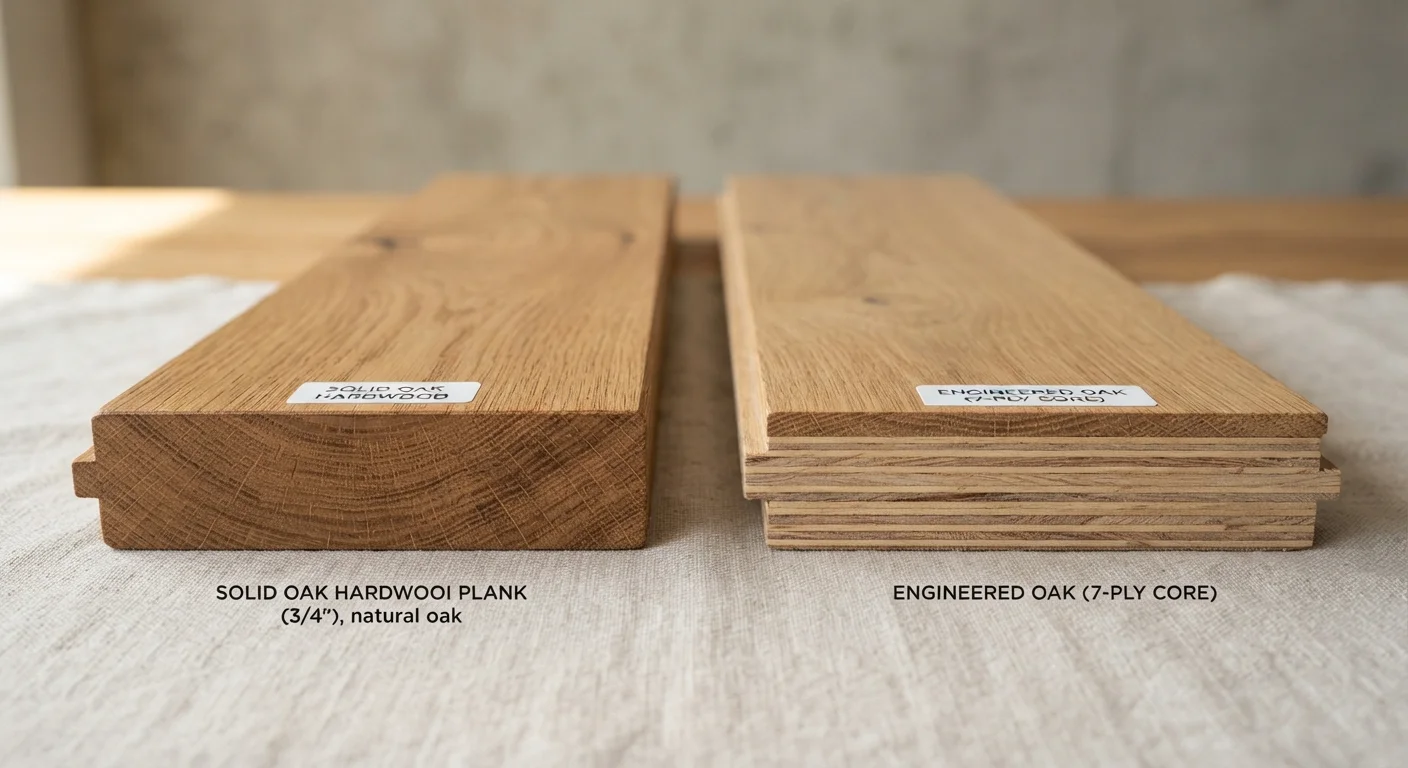
Option A
Solid Hardwood Flooring
The timeless, refinishable classic.
Best for: Homeowners in climate-controlled, dry living spaces who want a floor they can sand and refinish multiple times over decades.
Option B
Engineered Wood Flooring
The dimensionally stable, moisture-smart alternative.
Best for: Homeowners installing flooring below grade, over concrete, or in rooms where humidity fluctuates - without sacrificing a wood look.
What Each Type Actually Is
Despite sharing a similar surface appearance, solid hardwood and engineered wood are structurally very different products.
Solid hardwood is exactly what the name implies - a plank milled from a single piece of lumber, typically ¾ inch thick. Common species include oak, maple, hickory, and walnut. Because the entire plank is wood throughout, it can be sanded down and refinished numerous times over its lifespan, often making it last 50 to 100 years with proper care.
Engineered wood is a manufactured product with a real hardwood veneer - usually 1/16 to 1/6 inch thick - bonded on top of multiple layers of plywood or high-density fiberboard (HDF). Those cross-ply layers run in alternating grain directions, giving the plank structural stability that solid wood simply cannot match. Importantly, the top layer is genuine wood, so it looks and feels authentic underfoot.
| Criterion | Solid Hardwood | Engineered Wood |
|---|---|---|
| Core material | Single solid wood plank | Wood veneer over plywood/HDF layers |
| Moisture resistance | Low - prone to warping | High - dimensionally stable |
| Below-grade installation | Not recommended | Generally suitable |
| Over concrete subfloor | Risky without vapor barrier | Compatible with proper prep |
| Refinishing potential | Multiple times (4-7+) | Limited by veneer thickness |
| DIY installation ease | Moderate to difficult | Easier with click-lock systems |
| Typical lifespan | 50-100 years with care | 25-50 years depending on quality |
| Appearance | Authentic solid wood look | Virtually identical surface look |
Moisture, Stability, and Where You Can Install Each
This is the most critical practical difference between the two flooring types, and it should drive many homeowners' decisions before any other factor.
Solid hardwood is a natural material that expands when it absorbs moisture and contracts when it dries out. In rooms with stable humidity - typically main floors and upper floors of climate-controlled homes - this movement is manageable. However, solid hardwood is generally not recommended below grade (basements) or directly over concrete slabs, where ground moisture and humidity can cause planks to cup, buckle, or develop gaps.
Engineered wood's cross-ply construction dramatically reduces this movement. It can be installed in basements, over radiant heat systems, and on concrete subfloors - anywhere solid hardwood would be risky. This makes engineered wood the practical choice for open-concept spaces where flooring needs to flow from a slab-on-grade living area into upper rooms without a seam.
Acclimation Matters for Both Types
Before installation, both solid hardwood and engineered wood should be acclimated to the room's temperature and humidity for at least 48-72 hours - sometimes longer for solid planks. Skipping this step is one of the most common causes of post-installation gapping or buckling. Always follow the manufacturer's specific acclimation guidelines, as they vary by product and climate zone.
Refinishing, Durability, and Long-Term Maintenance
Solid hardwood holds a clear advantage when it comes to longevity through refinishing. Because the entire plank is wood, homeowners can sand the surface down and apply a fresh finish multiple times - typically four to seven times over the floor's life, depending on plank thickness. This means scratches, dents, and worn finishes can be corrected rather than forcing a full replacement.
Engineered wood can also be refinished, but only as many times as the veneer layer allows. Thicker veneer layers (3 mm and above) may permit two or three refinishes; thinner veneers may only tolerate one, or none at all. Once the veneer is sanded through, the floor must be replaced.
Both types can be finished with polyurethane, oil, or hardwax oil coatings, and both require similar daily maintenance - sweep regularly, clean up spills promptly, and use appropriate wood-floor cleaners. Neither type should be mopped with excessive water.
Installation Methods and Cost Considerations
Solid hardwood is typically installed using nail-down or staple-down methods, which require a wood subfloor and some experience with flooring tools. Glue-down installations are also possible. Because expansion must be managed carefully, solid hardwood usually demands professional installation - or at minimum, a confident and experienced DIYer.
Engineered wood offers more installation flexibility. Depending on the product, it can be nailed, glued, or floated (click-lock planks that simply snap together without fasteners). Floating installation over existing subfloors is one of the most approachable DIY flooring projects a homeowner can undertake.
Regarding cost, neither type is universally cheaper. Entry-level engineered products can be less expensive than premium hardwood species, but high-end engineered wood with thick veneers can cost as much as solid hardwood. Installation labor for solid hardwood is generally higher. When budgeting, factor in subfloor preparation, underlayment (often required for engineered floating floors), and finishing or acclimation time.
¾ inch
Typical solid hardwood plank thickness
This full-thickness construction is what allows solid hardwood to be sanded and refinished multiple times over decades.
1/16"-1/6"
Engineered wood veneer thickness range
Thicker veneers (closer to 1/6 inch) allow more refinishes and are generally considered higher quality and longer-lasting.
3-5 layers
Typical cross-ply layers in engineered wood
Alternating grain directions across these layers give engineered wood its dimensional stability against moisture and temperature changes.
The content provided on our blog site traverses numerous categories, offering readers valuable and practical information. Readers can use the editorial team’s research and data to gain more insights into their topics of interest. However, they are requested not to treat the articles as conclusive. The website team cannot be held responsible for differences in data or inaccuracies found across other platforms. Please also note that the site might also miss out on various schemes and offers available that the readers may find more beneficial than the ones we cover.