

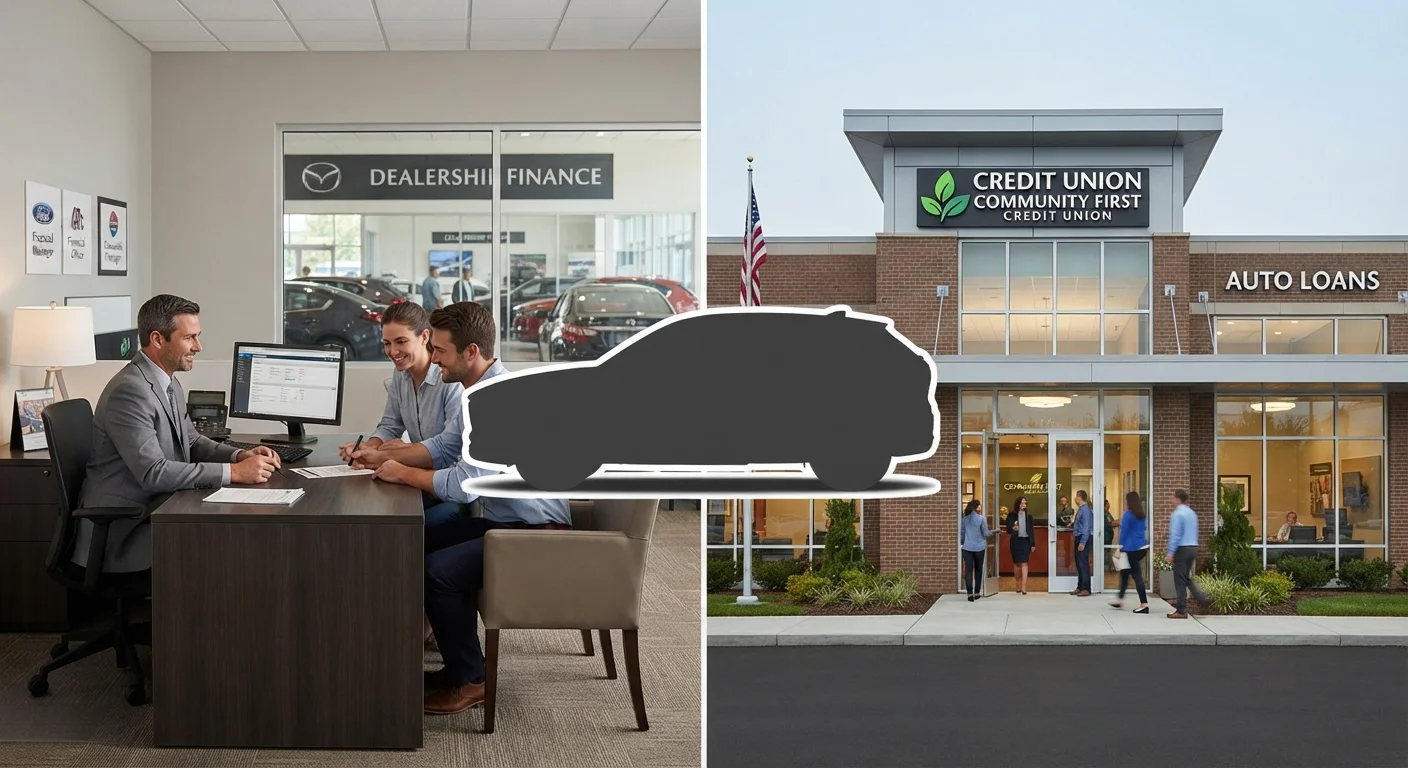
Option A
Dealership Financing
The convenient, one-stop lending option.
Best for: Buyers who want a streamlined purchase process and may qualify for manufacturer-backed promotional rates.
Option B
Bank or Credit Union Financing
The independent, borrower-controlled alternative.
Best for: Buyers who want to shop rates before visiting a dealership and negotiate from a position of financial clarity.
How Each Financing Channel Actually Works
Understanding the mechanics behind each option helps you evaluate offers more critically. Before you visit a showroom, it's worth reviewing auto loan fundamentals so you know what lenders are assessing when they quote you a rate.
Dealership Financing
When you finance through a dealer, the dealership submits your credit application to one or more lenders - often a bank, a finance company, or the automaker's own captive finance arm (a lender owned by the manufacturer). The dealer acts as an intermediary. If the lender approves you at, say, 6%, the dealer may present you a rate of 7% and keep the difference as a dealer reserve or finance markup. This practice is legal and widespread, though some lenders cap the markup dealers can add.
Bank or Credit Union Financing
Here, you approach a lender directly - either your existing bank or a credit union you belong to. You apply for a loan before or after selecting a vehicle, receive an approval letter showing your rate and maximum loan amount, and bring that to the dealership as a pre-approval. Credit unions, as member-owned nonprofits, often price loans more favorably than for-profit banks, making them a particularly useful starting point. The pre-approval process typically involves a hard credit inquiry, so aim to complete all rate-shopping within a short window - credit scoring models generally treat multiple auto-loan inquiries within 14-45 days as a single inquiry.
| Criterion | Dealership Financing | Bank or Credit Union Financing |
|---|---|---|
| Where you apply | At the dealership | Directly with lender |
| Rate markup risk | Possible dealer reserve added | No intermediary markup |
| Promotional APR access | Yes, via manufacturer offers | No manufacturer promotions |
| Pre-approval option | Not typically | Yes, standard practice |
| Works for private-party sales | No | Yes |
| Negotiating leverage | Lower - rate and price mixed | Higher - price negotiated separately |
| Speed of process | Fast, same-day possible | Requires prior application |
Key Trade-Offs: Convenience vs. Control
Neither channel is universally superior - the better choice depends on your credit profile, the vehicle type, and how much time you're willing to invest in the process.
Where Dealer Financing Has an Edge
- Promotional APR offers: Manufacturers occasionally run 0% or low-APR campaigns for qualified buyers. These rates are only accessible through the dealer and can be genuinely hard to beat.
- Speed and simplicity: Everything - vehicle selection, trade-in, and financing - is handled in one location.
- Flexibility on unusual credit profiles: Some captive lenders are motivated to approve deals because they also want to sell cars, which can benefit buyers with limited credit history.
Where Your Own Institution Has an Edge
- Rate transparency: You know your actual rate before you negotiate the vehicle price, preventing those discussions from becoming entangled.
- No markup risk: You deal directly with your lender, so there's no intermediary adding a spread to your rate.
- Stronger negotiating position: Walking in with financing in hand shifts focus to the vehicle price rather than the monthly payment - a distinction that matters. Dealers sometimes quote affordable-sounding monthly payments that obscure a higher total cost.
It's also worth noting that choosing one channel doesn't lock you out of comparing the other. You can arrive at a dealership with a pre-approval and still ask whether their in-house offer is more competitive. Common misconceptions about credit scores can also affect how borrowers approach these negotiations - understanding the facts helps.
Rate Shopping and Your Credit Score
Applying for auto financing at multiple lenders within a short window - generally 14 to 45 days depending on the scoring model - is typically treated as a single credit inquiry for scoring purposes. This means you can comparison-shop rates at your bank, credit union, and dealer without disproportionately affecting your credit score. Checking your own credit report beforehand is a smart first step and does not affect your score at all.
Making the Right Call for Your Situation
The most cost-effective approach for many buyers is to obtain at least one pre-approval from a bank or credit union before visiting a dealer, then compare that offer against whatever the dealership presents. If the dealer beats your pre-approval - legitimately, not by stretching the loan term - take it. If not, use your pre-approval.
Pay close attention to the total amount repaid over the life of the loan, not just the monthly payment. A lower monthly payment achieved by extending the loan term from 48 to 72 months often means paying substantially more in interest overall. For a structured look at whether your current auto loan terms still make sense, see our guide on when refinancing an auto loan is worth it.
If you're still weighing whether to finance at all versus exploring a lease, leasing vs. financing covers the long-term cost differences in detail. And for broader context on managing auto costs within a monthly budget, the budgeting basics hub offers practical frameworks to apply.
~80%
New car buyers who finance through a dealer
Industry estimates from the National Automobile Dealers Association suggest the large majority of new vehicle buyers use some form of dealer-arranged financing.
0.5-2.5%
Typical dealer markup range on loan rates
Consumer financial regulators and industry observers have noted that dealer reserve markups commonly range from half a point to over two percentage points above the lender's buy rate.
This article is for general informational purposes only and does not constitute personalized financial or lending advice. Consult a qualified financial professional regarding your specific borrowing situation.
The content provided on our blog site traverses numerous categories, offering readers valuable and practical information. Readers can use the editorial team’s research and data to gain more insights into their topics of interest. However, they are requested not to treat the articles as conclusive. The website team cannot be held responsible for differences in data or inaccuracies found across other platforms. Please also note that the site might also miss out on various schemes and offers available that the readers may find more beneficial than the ones we cover.